
Tagged: self-help
Start with Why
 Start with Why: How Great Leaders Inspire Everyone to Take Action by Simon Sinek, 2/5
Sinek poses an interesting premise: companies wishing to develop an extremely loyal customer base and have the greatest influence on society and industry must let a clear sense of why they do what they do influence all decisions about what and how. By communicating a sense of purpose and how this purpose fits into the bigger picture of life, a business can ostensibly attract similarly-minded, passionate customers and ultimately have the freedom to be more innovative and influential than the faceless corporations trapped in “features” battles with each other, desperate to manipulate buyers with endless “deals” and minute spec improvements. Sinek basically argues that companies should function like good people, with strong character, ethics and a sense of higher purpose, instead of being focused solely on the bottom line. In fact, he goes so far as to say that “The goal of business should not be to do business with anyone who simply wants what you have. It should be to focus on the people who believe what you believe. When we are selective about doing business only with those who believe in our WHY, trust emerges” (80).
While Sinek’s approach is thought-provoking, I see a clear conflict between it and a society that is rife with lawsuits against businesses who refuse to provide services, based on religious beliefs. I wish the author had addressed this issue instead of beating one simple idea to death with a tedious, repetitive writing style and relentless references to Apple Inc. Perhaps he also could have supplemented his few cherry-picked examples, by explaining why numerous industry-leading companies have achieved great success while clearly not following his why-centered philosophy. He also does not adequately address the connection between authenticity and advertising–couldn’t it be argued that the only difference between companies appearing to have a strong “why” and all the others is merely superior advertising strategies (not necessarily fundamental differences in philosophy and operation)?
Why I read it: My brother recommended it under circumstances I have since forgotten (I procrastinated on writing this review for far too long!).
The Last Lecture
 The Last Lecture by Randy Pausch with Jeffrey Zaslow, 2/5
Is it the mystery of death or mere crass curiosity that makes people so fascinated by “last words”? For whatever reason, the appeal is undeniable. However, it is also undeniable that everyone dies and, heartless as it may sound, imminent death is no philosophical or literary credential. Mostly according to himself, Pausch was a great success as a human being: intelligent, successful, hard-working, loved and loving…but this short book somehow still left ample opportunity for me to repeatedly wonder when it was going to get profound, insightful, or helpful in any way. It felt rather like a Wikipedia article written about someone, not because they had such a noteworthy effect on the world that it deserved lasting mention, but merely because they died. (Interestingly, I later looked up Pausch’s Wikipedia article and that is almost exactly what happened–it was created the month he got his terminal diagnosis, not at any time during his career). Perhaps people who are dealing with life-threatening illness would have a different perspective, but I felt this book had very little to offer besides voyeuristic appeal, though I’m sure that as a memoir for his family, it is beyond value.
Why I read it: My gym friend, Tyler, thought I might enjoy it and lent me his copy.
The Book of Five Rings
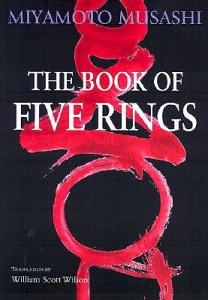 The Book of Five Rings by Miyamoto Musashi, translated by William Scott Wilson, 5/5
It is absolutely stunning how relevant this book remains to today’s students of combat sports, though it was written almost 400 years ago for Japanese swordsmen. I recognize so many of the techniques and concepts that Musashi describes from my own kickboxing, Brazilian jiu-jitsu and MMA sparring experiences. In fact, I believe such review and recognition is likely where this work’s main interest and value lies–I certainly don’t feel able to learn subtle martial arts concepts from a book (certainly not from a picture-less book!), but it is fascinating to see what I have learned from my coaches and through experience reflected on the page. Perhaps this is why the ever-practical Musashi ends each lesson with a comment like “You should make efforts in this,” or “You should practice this well.”
Why I read it: I came across Musashi’s “21 Rules of Life” online, read a bit about him and remembered that though I had given my brother a beautifully illustrated copy of The Book of Five Rings many years ago, I had never actually gotten around to reading it myself.
The Five Languages of Apology
 The Five Languages of Apology: How to Experience Healing in All Your Relationships by Gary Chapman and Jennifer Thomas, 4/5
Making and receiving apologies has always seemed like a fairly natural part of human interaction to me, so I’ve never given the topic much thought. However, I was recently very confused to be told plaintively by someone that “so-and-so has never apologized to me in twenty years!” What was so confusing about this comment? Well “so-and-so” had recently made an unexpected and unsolicited apology to me! Was I to believe this same person had purposefully withheld all apologies from someone else, or was there some other communication issue at play?
It turns out that different people have different expectations when it comes to what makes a sincere apology. According to this book, if one or more of the five “languages” of apology is lacking, the whole effort can fail to register with the recipient as a sincere apology, no matter how genuine it was intended to be.
- Expressing Regret: “I am sorry.”
- Accepting Responsibility: “I was wrong.”
- Making Restitution: “What can I do to make it right?”
- Genuinely Repenting: “I’ll try not to do that again.”
- Requesting Forgiveness: “Will you please forgive me?”
I feel that the use of the word “languages” to describe these five aspects is a too-obvious effort to tie this book in with Chapman’s The Five Love Languages, but it is undeniably helpful to know what shortcomings could cause an apology to ring untrue. While the main focus of the book is on how to make sure your apology meets the intended recipient’s subconscious criteria, it is also interesting to understand that just because an apology doesn’t cover the aspect that is most important to you, doesn’t necessarily mean that it is insincere.
Another very interesting point the authors make is that, while forgiveness is a decision, trust is an emotion (213). You can choose to forgive someone, but trust should be earned. Forgiveness doesn’t mean forgetting what someone has done, making light of their bad actions, or going back to the way things were, but it does mean giving your relationship with them a chance to heal and grow.
Why I read it: my sister recommended it and I’m always interested in learning to be a better communicator.
Wired to Eat
 Wired to Eat: Turn Off Cravings, Rewire Your Appetite for Weight Loss, and Determine the Foods that Work for You by Robb Wolf, 3/5
If lack of information is the reason you struggle with weight loss, then you may find this book to be life-changing–it certainly contains a lot of information. If lack of motivation is what’s holding you back, then you may find this book to be helpful–its tone is very motivational. However, if you are already familiar with the ultimate weight loss triumvirate Sleep More, Move More, Eat Less Processed Food, but you simply lack the self control to put it into practice, then you will likely find this to be just another useless diet book.
Many of Wolf’s observations are in line with my personal experience, especially that junk food makes you feel hungrier beyond reason and hyper-palatable, highly-processed foods are pure evil. However, I think of these facts as incidental to weight loss; in other words, learning them was simply the by-product of successful weight loss and maintenance in my case, not the cause. If knowledge gained through personal experience is insufficiently motivating, how much less is knowledge gained from merely reading a book? Such pessimistic practicalities aside, Wolf does his best to get his readers fired up and seems genuinely motivated to help people. His use of pop science/psychology is purposeful at least, though somewhat nauseating, and I respect his unusual advice that each person find the foods that work for them (within limits, obviously) instead of slavishly following some one-size-fits-all diet/religion. However, I feel that Wolf does not make nearly as convincing, scientific or detailed a case for the paleo diet as Good Food, Great Medicine makes for the Mediterranean diet (with the added benefit of much less hype and pop science).
Why I read it: My boyfriend thought it sounded interesting but I thought it sounded sketchy, so I read it first to save him time in case it sucked.
The Five Love Languages
 The Five Love Languages: How to Express Heartfelt Commitment to Your Mate by Gary Chapman, 5/5
It took an effort to get past the cringe-worthy cover and subtitle, but this book is well-written and explores concepts that can apply to a variety of relationships besides marriage (such as between friends, family members, or people who are dating). Using common sense and many examples from his years of experience as a marriage counselor, Gary Chapman proposes that, while everyone needs to feel loved, each individual tends to recognize and express love in primarily one of five ways: words of affirmation, quality time, receiving gifts, acts of service and physical touch. Two people with loving intentions who speak different “languages” can be left each feeling uncared for and confused as to why their expressions of love aren’t accepted as such. Chapman encourages people in relationships to notice which of the five categories their partner might belong to and adjust their own behavior accordingly. It seems to me that this could be a bit forced and awkward in some cases, especially if the other person knows you very well and notices that you start acting out of character. I think it makes more sense for everyone to learn each other’s love languages, not so that they can necessarily speak them, but so that they can appreciate love in its different forms. For example, if someone prefers to hear affirming words, they should learn to appreciate the love of a person who makes time for them or quietly does helpful things. Or if a person wants their partner to show they care by giving them gifts, they should also realize that a kind word or touch can be equally meaningful and heartfelt expressions of love.
Why I read it: One of my sisters said it was interesting and it is important to me that the people I care about feel loved.
Steal Like An Artist
 Steal Like An Artist: 10 Things Nobody Told You About Being Creative by Austin Kleon, 5/5
The 10 points about creativity that form the backbone of this little book are deceptively simple (even unimpressive) at first glance. Happily, my first impression was wrong–the author uses this list merely as a starting point for an encouraging and inspiring discussion about artistic creativity. Reading this book first normalised, then challenged, many of the negative feelings that have caused me in the past to describe myself as an uncreative person.
- Steal like an artist.
It’s refreshing to hear someone creative admit that “every new idea is just a mashup or a remix of one or more previous ideas” (9). - Don’t wait until you know who you are to get started.
- Write the book you want to read.
This is so much more inspiring than the advice to “write what you know.” - Use your hands.
- Side projects and hobbies are important.
Having a wide variety of interests can be difficult and it’s sometimes tempting to feel like a loser for not focusing on just one. Kleon doesn’t make a particularly convincing case for his advice of “don’t throw any of yourself away” (68), but I do like the idea that “what unifies your work is the fact that you made it” (72). - The secret: Do good work and share it with people.
- Geography is no longer our master.
- Be nice. (The world is a small town.)
- Be boring. (It’s the only way to get work done.)
It may not be living the dream, but having a boring day job can give you the financial freedom to pursue creative endeavors. Kleon points out that, contrary to instinct, “establishing and keeping a routine can be even more important than having a lot of time” when it comes to being creative (124). - Creativity is subtraction.
Why I read it: Imgur user morganic mentioned this book in a comment on a photography post.
Verbal Judo
 Verbal Judo: The Gentle Art of Persuasion by George J. Thompson, Ph.D., and Jerry B. Jenkins, 4/5
This book contains some helpful, commonsense advice about communicating that I think would be especially useful for parents and other people in leadership roles. Of course, the author is a bit full of it and there are endless acronyms and 5-steps to this and 9-stages of that, but the big emphasis is on the concept of empathy and its related technique–paraphrasing. There is also a helpful list of “Eleven Things Never to Say to Anyone (And How to Respond If Some Idiot Says Them to You),” which includes my personal favourites: “Come here!” (usually shouted threateningly) and “Calm down!” (“BUT I AM CALM!!!”).
[Why I read it: Came across it while sorting through some of my Dad’s books.]
Better Than Before
 Better Than Before: Mastering the Habits of Our Everyday Lives by Gretchen Rubin, 3/5
They say that opposites attract, in which case I suspect that I may be very similar to the author, who I found to be thoroughly grating. Perhaps it’s her approach to the topic, which is somehow both overly analytical and overly anecdotal, or perhaps it’s because studying how to make habits seems pointless to me (surely the hard part is deciding what habits to have, not how to keep them up?). I knew I was in trouble when Rubin’s first attempt (of many) to organize her readers into overly-tidy categories failed to resonate with me–am I an Upholder, Questioner, Obliger, or Rebel? Does it even matter? At any rate, I felt so little interest in this book that I had a difficult time finishing it and remember practically nothing about it now. It has joined the growing ranks of faceless self-help books that have made the New York Times Best Seller list but not an impression on me.
[Why I read it: my friend Joy recommended it to me.]
Law of Connection
 Law of Connection: The Science of Using NLP to Create Ideal Personal and Professional Relationships by Michael J. Losier, 2/5
Losier is off to a bad start right from the subtitle of this unsubstantial book, which contains nothing scientific that can be used towards the patently ridiculous goal of creating “ideal” relationships. Starting with a hokey 15-question quiz to establish your communication style as visual, auditory, kinesthetic or digital, Losier quickly moves to generic descriptions of the styles and canned keywords and phrases for each that can be used to create “rapport.” Perhaps it’s a digital thing, but I’m pretty sure my brain intuitively understands that “how does this look to you?” “how does this sound to you?” “how do you feel about this?” and “what do you think about this?” all mean approximately the same thing. I highly doubt that I’d feel some magical connection with someone who has figured out my communication style and altered the wording of their question accordingly. The whole exercise is kind of self-defeating anyway–what happens if everyone tries to suit everyone else’s communication style? How could you figure out someone’s style if they were choosing their vocabulary based on what they think your style is?
As far as identifying nonverbal characteristics of the different communication styles, Losier often succumbs to that well-known “Facebook quiz” technique of creating generic descriptions that would apply equally to a variety of styles. I’m pretty sure it’s not just visual communicators who would be annoyed if you started and ended meetings late, or just auditory communicators who would prefer you not to speak to them in a harsh tone, or just kinesthetic communicators who would be hurt by feeling excluded, or just digital communicators who would like to be acknowledged for their contributions.
Since the book doesn’t contain much information about the concepts of neuro-linguistic programming in general, I checked out the relevant Wikipedia article and was not surprised to find it labeled a “largely discredited psuedoscience.”
[Why I read it: it was recommended to me by my friend, Joy.]
 OmniRambles