
Category: Reviews
Excerpts from Extraordinary Popular Delusions and the Madness of Crowds
Excerpts from 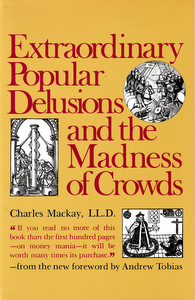 Extraordinary Popular Delusions and the Madness of Crowds by Charles Mackay, 2/5
Argh, I hate abridged books and would never have purchased this if I’d known it only contained the first (and arguably, most boring) 100 pages of the complete book, whose unabridged summary deceptively appears on the back of this one. I was promised stories about alchemy, mesmerism, witch burnings and crusades, but all this slim collection contains is esoteric accounts of early stock market crashes. I found these to be almost incomprehensible, thanks to all the economic terminology, but an accountant, stock trader or student of finance might find them very interesting.
Why I read it: What can I say, the cover appealed to me and it was almost free.
Conversations with Casals
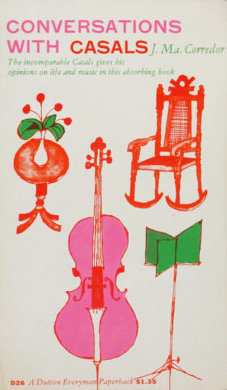 Conversations with Casals by J. Ma. Corredor, translated from the French by André Mangeot, 3/5
Because this book contains a lot of opinions but lacks a corresponding amount of supportive reasoning for said opinions, its value will directly correspond to the reader’s estimation of Casals. As someone previously unfamiliar with the famous cellist and conductor but very familiar with the appeal to authority fallacy, the aspect of the book that I enjoyed most was not the insight into Casals’ world view, but all the name dropping of other famous musicians and composers. My favourite anecdote was when, refusing to perform a Dvořák concerto with a conductor who called it “horrible music,” Casals turned to Debussy for support, who responded “Come on, if you wanted to play, you could play.” Casals was greatly pained by the response but I was greatly amused.
Why I read it: I love the following quote by Casals and when I saw a book about him, hoped to read more in the same vein.
I am perhaps the oldest musician in the world. I am an old man but in many senses a very young man. And this is what I want you to be, young, young all your life, and to say things to the world that are true.
The Ra Expeditions
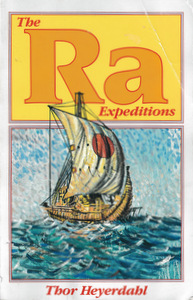 The Ra Expeditions by Thor Heyerdahl, 4/5
Heyerdahl is at it again, living out a real-life adventure story as he sails across the Atlantic in a boat made of reeds and rope. I love how the author researches and resurrects ancient technology, but I didn’t find this book to be as fresh and compelling as his account of the Kon-Tiki expedition. This was just a bit more calculated and agenda-driven, lacking the magical sense of adventure and soul that infused Heyerdahl’s earlier portrayal of his journey aboard the famous balsa wood raft. I suspect it was the Kon-Tiki fame and corresponding sense of responsibility that stole away some of the spontaneity of his earlier adventures.
N.B. I would suggest nobody buy this 1988 Scribner Laidlaw edition, which not only lacks the original photographs but, annoyingly, still includes captions for them.
Why I read it: My brother intended to reread it during our trip to Norway, but I hijacked it.

I took this photo of the Ra II while visiting the Kon-Tiki Museum in Oslo, Norway (March 2016).
Armed Response
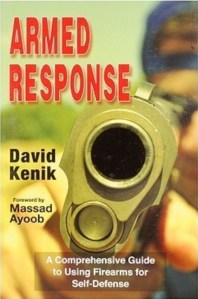 Armed Response: A Comprehensive Guide to Using Firearms for Self-Defense by David Kenik, 2/5
There is a distinctly self-published feel to this book which doesn’t really inspire confidence (call me snobby, but I think the cover text shouldn’t be more colorful than the pictures inside). However, it does provide a very basic overview of equipment and skills necessary for the responsible concealed carrier. I don’t know much about the topic, so I can’t put my finger on what exactly the book is missing, but it felt light on information–there is a disappointing lack of legal guidelines and very little advice about tactics. Also, you do have to get past the author’s gun geekery and a bit of self-importance that reminds me of some of the more embarrassing scenes from Mall Cop. Kenik swears he’s not paranoid (never a hopeful sign), but he does seem borderline. For example, he actually recommends writing “detailed notes of all relevant class lectures, videos, books and magazine articles” and mailing them to yourself so “the envelope can be opened in court to prove what knowledge you possessed at a given date” (14). Hmmmm… Or you could maybe not do that and be ok too?
Why I read it: it was a birthday present (buying a gun has been on my to-do list for years).
The Meaning of It All
 The Meaning of It All: Thoughts of a Citizen-Scientist by Richard P. Feynman, 4/5
The rare combination of humility and genius is as beautiful as it is surprising, especially when encountered in one of the greatest physicists of the modern age. These three lectures, given at the University of Washington in 1963, explore a variety of unscientific topics–from politics to religion–and surprisingly, do not provide any answers. What they do give, however, is the opportunity to see non-scientific issues from the point of view of a scientific genius. This point of view is very different from the arrogant, condescending, closed-minded attitude that comes across from many figures in popular science, who seem to feel that their expertise in a narrow field qualifies them to make pronouncements on everything. In fact, the emotion that stands out most in these lectures is doubt. Not a lazy, depressing, hopeless sort of doubt, but a humble, searching doubt that fuels relentless curiosity. Feynman seems unwaveringly respectful of opinions and beliefs that contradict his own, while applying a formidable intellect and rational approach to the less scientific aspects of human existence.
Why I read it: I’ve enjoyed the two other books by Feynman I’ve read (QED and Six Easy Pieces) and jumped at the chance to read a less challenging book by him when I came across it in Henderson Books.
Tread Lightly
 Tread Lightly: Form, Footwear, and the Quest for Injury-Free Running by Peter Larson and Bill Katovsky, 2/5
The authors are passionate about their topic but I feel this book contributes little to a discussion that is already very much lacking in scientific research and consensus among experts (or at least was in 2012, when it was written). In an approach reminiscent of the average college essayist, Larson and Katovsky cite a steady stream of inconclusive scientific studies and often-contradictory information that they do not have the expertise to interpret. Slap on some weak conclusions and the reader is left with a few interesting facts and no real guidance on how to apply them.
Why I read it: My dad mentioned it in conversation.
Mörder Guss Reims
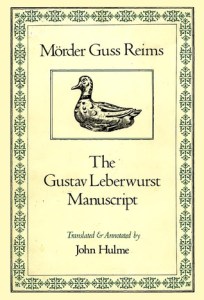 Mörder Guss Reims: The Gustav Leberwurst Manuscript, translated and annotated by John Hulme, 5/5
Inspired by Mots d’Heures: Gousses, Rames, these German verses sound, when read aloud, like Mother Goose rhymes being spoken in accented English.
You can give it a try if you’re in private (or not easily embarrassed):
Little Bo-peep has lost her sheep,
And doesn’t know where to find them;
Leave them alone, and they will come home,
Bringing their tails behind them.
Liesel Bopp hieb es Schloss der schieb
An Dutzend Noor, wer zu Feind dem,
Lief dem Aal ohn’ an Tee willkomm Ohm;
Brenken der Teil Spee ein dem.
Compared to the French version of this concept, I found the rhymes much easier to recognize in German. I also liked that this edition had all the English verses in the back, so I didn’t have to resort to Google for translations nearly as often.
Why I read it: while researching Mots d’Heures, I learned about this book and bought a copy immediately. I sing in German a lot (in fact, this weekend I’m performing in Bach’s St. John Passion), so this is great practice and fun.
The Book of Shrigley
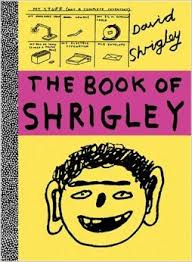 The Book of Shrigley by David Shrigley, 3/5
This collection of Shrigley’s messy, misspelled, dark and unpredictably humorous art seems less accessible than his What the Hell are You Doing? The Essential David Shrigley. “Less accessible” is a fancy way of saying that I didn’t really “get” a lot of the stuff in this book (which you might find a bit ironic if you read my last review of his work). Perhaps I also didn’t enjoy this as much because I went into it expecting to be surprised and delighted, an approach that never seems to work well for me.
Why I read it: My library only has Shrigley’s books in e-book form (which I hate), so I picked this up at Easton’s Books, hoping it would be as funny as the last thing by him that I read.
Mots D’Heaures: Gousses, Rames
 Mots d’Heaures: Gousses, Rames: The d’Antin Manuscript edited and annotated by Luis d’Antin Van Rooten, 5/5
This might be the strangest and most ingenious premise for a book I have ever seen–even after reading it, I still don’t really see how it’s possible. It is a collection of poems written in French that, when read aloud, sound like Mother Goose rhymes being read in English with a thick French accent. The author supplies entertaining footnotes that attempt, with varying degrees of success, to make sense of the “original” French.
Here’s an example for “Little Bo Peep”:
Little Bo Peep
has lost her sheep
and doesn’t know where to find them;
leave them alone and they will come home
wagging their tails behind them.
Lille beau pipe
Ocelot serre chypre
En douzaine aux verres tuf indemne
Livre de melons un dé huile qu’aux mômes
Eau à guigne d’air telle baie indemne.
Why I read it: My friend, Alison (whose own book, Entropy Academy, is soon to be released), gave this book to me while I was taking a French language class. Hearing the verses read aloud in her English accent was a hilariously bizarre experience.
N.B. There is a German version of this concept called Mörder Guss Reims.
Good Food, Great Medicine
 Good Food, Great Medicine: A Mediterranean Diet and Lifestyle Guide (Third Edition) by Miles Hassell, MD, and Mea Hassell, 4/5
This homey guide to healthy living contains all the information I imagine one could possibly need about the Mediterranean diet and lifestyle, including medical research, advice on nutrition, sleeping habits and exercise, and a large collection of recipes. The authors’ approach is good-humored, unpatronizing and realistic–well-suited to the common-sense advice they give and the varying amounts of commitment they can expect from their readers. I haven’t tried any of the recipes, which is why I give the book four stars instead of five.
Eat more simple, natural food that is close to its original form and eat less prepackaged, processed or sugary junk…thanks in part, I guess, to a relatively healthy upbringing, most of this book fit into the “well, duh!” category for me and it is the duh-factor that I find most convincing about the Mediterranean lifestyle. This is no silver bullet, no gimmicky fad diet; it can’t be boiled down to “oh, I don’t eat carbs” or “I count calories” or “I fast intermittently” or “I only eat raw food,” etc. Unfortunately, there’s nothing very sexy about a well-balanced, natural, sustainable approach to eating that requires lots of common sense and self-control.
Self-control–there’s the rub. From both observation and first-hand experience, I’ve found that lack of self-control and lack of motivation, not lack of information, are at the root of unhealthy, excessive eating habits. Knowledge may be power but it isn’t will power. I can read a million studies about how doing x lowers your risk of dying by 35% and not doing y makes you 20% less likely to get cancer, but when I stop reading, it’s often because I need to put Nutella on my toast while it’s still warm. Still, we all make decisions every day that affect our health, whether positively or negatively; for me, this book’s value is in helping me make a few better, more informed, eating decisions than I might have made before. In this way, I hope to continue refining my approach to eating from merely counting calories to emphasizing those foods that are both good for me and make me feel good.
Why I read it: my dad had some heart trouble last year and his doctor recommended this book to him.
A picture quote I made:


