
Category: Book Reviews
Mots D’Heaures: Gousses, Rames
 Mots d’Heaures: Gousses, Rames: The d’Antin Manuscript edited and annotated by Luis d’Antin Van Rooten, 5/5
This might be the strangest and most ingenious premise for a book I have ever seen–even after reading it, I still don’t really see how it’s possible. It is a collection of poems written in French that, when read aloud, sound like Mother Goose rhymes being read in English with a thick French accent. The author supplies entertaining footnotes that attempt, with varying degrees of success, to make sense of the “original” French.
Here’s an example for “Little Bo Peep”:
Little Bo Peep
has lost her sheep
and doesn’t know where to find them;
leave them alone and they will come home
wagging their tails behind them.
Lille beau pipe
Ocelot serre chypre
En douzaine aux verres tuf indemne
Livre de melons un dé huile qu’aux mômes
Eau à guigne d’air telle baie indemne.
Why I read it: My friend, Alison (whose own book, Entropy Academy, is soon to be released), gave this book to me while I was taking a French language class. Hearing the verses read aloud in her English accent was a hilariously bizarre experience.
N.B. There is a German version of this concept called Mörder Guss Reims.
Good Food, Great Medicine
 Good Food, Great Medicine: A Mediterranean Diet and Lifestyle Guide (Third Edition) by Miles Hassell, MD, and Mea Hassell, 4/5
This homey guide to healthy living contains all the information I imagine one could possibly need about the Mediterranean diet and lifestyle, including medical research, advice on nutrition, sleeping habits and exercise, and a large collection of recipes. The authors’ approach is good-humored, unpatronizing and realistic–well-suited to the common-sense advice they give and the varying amounts of commitment they can expect from their readers. I haven’t tried any of the recipes, which is why I give the book four stars instead of five.
Eat more simple, natural food that is close to its original form and eat less prepackaged, processed or sugary junk…thanks in part, I guess, to a relatively healthy upbringing, most of this book fit into the “well, duh!” category for me and it is the duh-factor that I find most convincing about the Mediterranean lifestyle. This is no silver bullet, no gimmicky fad diet; it can’t be boiled down to “oh, I don’t eat carbs” or “I count calories” or “I fast intermittently” or “I only eat raw food,” etc. Unfortunately, there’s nothing very sexy about a well-balanced, natural, sustainable approach to eating that requires lots of common sense and self-control.
Self-control–there’s the rub. From both observation and first-hand experience, I’ve found that lack of self-control and lack of motivation, not lack of information, are at the root of unhealthy, excessive eating habits. Knowledge may be power but it isn’t will power. I can read a million studies about how doing x lowers your risk of dying by 35% and not doing y makes you 20% less likely to get cancer, but when I stop reading, it’s often because I need to put Nutella on my toast while it’s still warm. Still, we all make decisions every day that affect our health, whether positively or negatively; for me, this book’s value is in helping me make a few better, more informed, eating decisions than I might have made before. In this way, I hope to continue refining my approach to eating from merely counting calories to emphasizing those foods that are both good for me and make me feel good.
Why I read it: my dad had some heart trouble last year and his doctor recommended this book to him.
A picture quote I made:

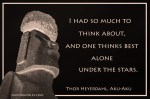
Aku-Aku
 Aku-Aku: The Secret of Easter Island by Thor Heyerdahl, 5/5
This account of the first serious archaeological expedition to Easter Island could not be more exciting if it were set on a different planet entirely. Heyerdahl and his crew unearthed ancient statues, carvings and structures that had never been seen by outsiders before and some of their finds amazed the native residents as much as themselves. Even second-hand, the thrill of exploration and discovery was intoxicating. I did experience moral qualms caused by the author’s sometimes manipulative approach to wheedling secrets out of the islanders and it was a bit disturbing how willingly they seemed to trade their ancient artifacts for cigarettes. Still, it wasn’t a completely one-sided relationship–the expedition uncovered new statues, shed light on the island’s history, corroborated some of the local legends and encouraged the native people to remember their past and even revive some almost-forgotten traditional skills.
Why I read it: I’ve been an admirer of Heyerdahl since reading Kon-Tiki and wanted to read this book also before visiting the Kon-Tiki museum in Oslo, Norway, with my brother next month.
A picture quote I made:
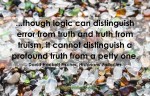
Historians’ Fallacies
 Historians’ Fallacies: Toward a Logic of Historical Thought by David Hackett Fischer, 5/5
Fallacies everywhere! Browsing through eleven categories of faulty reasoning, all illustrated by examples from published works of historical scholarship, made me feel like a kid in a candy shop. My initial reservation–that it isn’t very respectable to do nothing but pick apart the works of one’s colleagues–was satisfactorily addressed in Fischer’s deliciously cogent introduction to the book. Here, the author acknowledges the dual impossibility and necessity of defining a logical approach to the study of history and justifies his negative method with the respectable goal “to extract from these mistakes [in other historians’ reasoning] a few rough rules of procedure” (xviii).
Though some may find his approach off-puttingly critical, the author is no intellectual slouch–many of the fallacies he addresses are so subtle that I am impressed he could identify them at all, much less find relevant examples in the wild. Though the topic is very specific, the application is broad–historians aren’t the only ones who are susceptible to fallacies of question-framing, factual verification, factual significance, generalization, narration, causation, motivation, composition, analogy, semantical distortion and substantive distraction.
Why I read it: The title caught my eye as I was browsing through Easton’s Books. The owner was so surprised that someone was actually interested in the book (he’d almost thrown it out, thinking no one would ever buy it) that he gave me a discount and said I’d made his day.
A picture quote I made:
A Modest Proposal and Other Satires
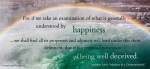
 A Modest Proposal and Other Satires by Jonathan Swift, 4/5
Swift combines wit, humour and venom in this collection of satires that attack everything from organized religion to politicians and fellow writers. The 18th-century language and references to now-obscure people and issues do not hinder this book’s continued relevance and, in my opinion, even enhance the timelessness of Swift’s observations–one of my favourite parts of reading very old literature is realizing how little people’s basic natures change with the passage of time.
Why I read it: One of Dad’s coworkers cited “A Modest Proposal” as his all-time favourite piece of literature, which made me curious to read it. Also, I’ve been meaning to read Gulliver’s Travels for quite a while and I thought it was in this collection (which it wasn’t).
I made a couple picture quotes for this book:

Why Grizzly Bears Should Wear Underpants
 Why Grizzly Bears Should Wear Underpants by Matthew Inman (aka The Oatmeal), 4/5
Recklessly funny, Inman doesn’t hold back at all in this collection of comics which tackles topics from commuting via polar bear to eating Play-Doh. This book is definitely not for the sensitive soul–while he considerately pixelates most of the cartoon privates, the author does somehow manage to invent euphemisms that are more offensive than the real thing.
[Why I read it: I’m on an Inman binge.]
My Dog: The Paradox
 My Dog: The Paradox: A Lovable Discourse about Man’s Best Friend, by Matthew Inman (aka The Oatmeal), 3/5
This book contains only one comic, so it is more of a novelty than anything. However, it is still pretty cute and I recognise his cartoon dog’s infectious enthusiasm in my own mutt (though mine certainly uses fewer swearwords).
[Why I read it: ordered all of Inman’s stuff from the library at once, then read it in one sitting.]
How to Tell if Your Cat is Plotting to Kill You
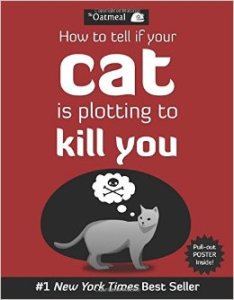 How to Tell if Your Cat is Plotting to Kill You by Matthew Inman (aka The Oatmeal), 4/5
A laugh-out-loud-funny collection of cat-themed comics from The Oatmeal.
[Why I read it: Reading Inman’s The Terrible and Wonderful Reasons Why I Run Long Distances reminded me that he has other hilarious books out there that I hadn’t read yet.]
The Dispossessed
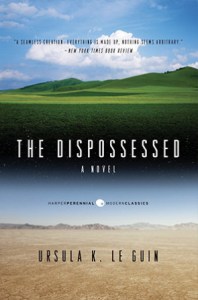 The Dispossessed by Ursula K. Le Guin, 2/5
Le Guin’s exploration of that inherently contradictory concept, an anarchist society, felt pointless and unbelievable, probably because anarchy itself (even the idealized, fictional version portrayed in this book) seems ridiculously illogical, unrealistic and childish, as I understand it. Is the government oppressive? Get rid of all forms of authority! Do the rich exploit the poor? Get rid of all possessions! Is anarchy failing? Apply more anarchy!
My main problem is not necessarily with Le Guin’s portrayal of anarchy in the book (though I did find that pretty implausible) but that when it inevitably starts to unravel, she falls back on more anarchy as the answer. It’s as if rebellion was a cause itself, not something to be employed in the service of a cause. Her attempts to extract some sort of deep philosophical meaning from the simple fact that a society of rebels will inevitably become a regime to be rebelled against itself did not resonate with me at all.
Another reason I didn’t enjoy reading this book is that I dislike feeling preached-at and reading fiction that contains fake science and sexual themes, all of which are prominent features of The Dispossessed and annoyed me enough to ruin any chance of achieving suspension of disbelief.
[Why I read it: Jan from choir recommended Le Guin to me a couple years ago and my friend Sarah mentioned on Facebook that she’s a huge fan.]
The Terrible and Wonderful Reasons Why I Run Long Distances
 The Terrible and Wonderful Reasons Why I Run Long Distances by Matthew Inman (aka The Oatmeal), 5/5
Inman’s reasons for running may be much more terrible and wonderful than my own (just as his conception of “long distances” is much longer), but a lot of this hilarious book resonated with me. On a side note: I’ve never read a collection of comics containing more illustrations of Nutella.
[Why I read it: I enjoy Inman’s webcomic, The Oatmeal, and this book came up in conversation with one of Dad’s coworkers. I’d actually almost bought it in a store just a few days previous before remembering that 5 Very Good Reasons to Punch a Dolphin in the Mouth was collecting dust on my shelf after being read just once. I hit the library up instead, which I guess makes me a bad fan.]
 OmniRambles