
Tagged: Nonfiction
Verbal Judo
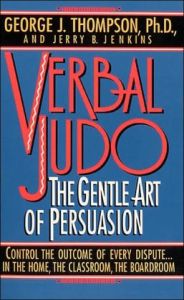 Verbal Judo: The Gentle Art of Persuasion by George J. Thompson, Ph.D., and Jerry B. Jenkins, 4/5
This book contains some helpful, commonsense advice about communicating that I think would be especially useful for parents and other people in leadership roles. Of course, the author is a bit full of it and there are endless acronyms and 5-steps to this and 9-stages of that, but the big emphasis is on the concept of empathy and its related technique–paraphrasing. There is also a helpful list of “Eleven Things Never to Say to Anyone (And How to Respond If Some Idiot Says Them to You),” which includes my personal favourites: “Come here!” (usually shouted threateningly) and “Calm down!” (“BUT I AM CALM!!!”).
[Why I read it: Came across it while sorting through some of my Dad’s books.]
Fermat’s Last Theorem
 Fermat’s Last Theorem: Unlocking the Secret of an Ancient Mathematical Problem by Amir D. Aczel, 2/5
In around 1637, Fermat hinted that he had “discovered a truly marvelous proof” that an + bn = cn cannot be true for n>2. Proving this deceptively simple theory required the contributions of dozens of mathematicians over a span of some 350 years. Unfortunately, while biographical aspects of the story are competently told, the author is unable or unwilling to explain important mathematical concepts in layman’s terms. If the following paragraph makes sense to you, then you probably fit the target audience of this little book:
Here, a periodic function could be conceived as having a periodicity both along the real axis and along the imaginary axis. Poincaré went even further and posited the existence of functions with a wider array of symmetries. These were functions that remained unchanged when the complex variable z was changed according to f(z)——>f(az+b/cz+d). Here the elements a, b, c, d, arranged as a matrix, formed an algebraic group. This means that there are infinitely many possible variations. They all commute with each other and the function f is invariant under this group of transformations. Poincaré called such weird functions automorphic forms (82).
If, like me, you were completely nonplussed by that description, then the only thing of value you will likely get from this book is a deeper understanding of the fact that concise ≠ comprehensible.
[Why I read it: I came across it while sorting through some of my Dad’s books.]
American Shaolin
 American Shaolin: Flying Kicks, Buddhist Monks, and the Legend of Iron Crotch: An Odyssey in the New China by Matthew Polly, 3/5
This memoir of an American college dropout who transforms from bullied to badass by studying kung fu with Shaolin monks in China is a fun read, if a little bit less interesting, less believable and dirtier than the author’s later book Tapped Out.
[Why I read it: I enjoyed the author’s other book a lot.]
Better Than Before
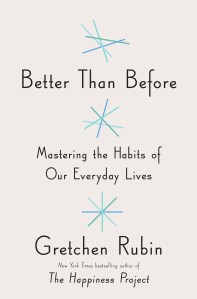 Better Than Before: Mastering the Habits of Our Everyday Lives by Gretchen Rubin, 3/5
They say that opposites attract, in which case I suspect that I may be very similar to the author, who I found to be thoroughly grating. Perhaps it’s her approach to the topic, which is somehow both overly analytical and overly anecdotal, or perhaps it’s because studying how to make habits seems pointless to me (surely the hard part is deciding what habits to have, not how to keep them up?). I knew I was in trouble when Rubin’s first attempt (of many) to organize her readers into overly-tidy categories failed to resonate with me–am I an Upholder, Questioner, Obliger, or Rebel? Does it even matter? At any rate, I felt so little interest in this book that I had a difficult time finishing it and remember practically nothing about it now. It has joined the growing ranks of faceless self-help books that have made the New York Times Best Seller list but not an impression on me.
[Why I read it: my friend Joy recommended it to me.]
Man’s Search for Meaning
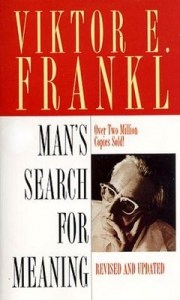 Man’s Search for Meaning by Viktor E. Frankl, 5/5
When a psychiatrist who endured the German concentration camps of WWII has something to say about happiness and the meaning of life, you can bet it’s something worth paying attention to. Frankl’s thoughts on the bigger questions in life are woven into the first part of this short book–an account of the author’s experiences and observations in Auschwitz and other concentration camps. An introduction to the foundations of logotherapy (the author’s approach to psychotherapy) comprise the second part of the book, in which Frankl’s ideas really come into focus.
Frankl’s refreshing premise is that “man’s search for meaning is the primary motivation in his life” (121) and that “A man’s concern, even his despair, over the worthwhileness of life is an existential distress but by no means a mental disease” (125). The author’s theory of the meaning of life encompasses the complexities of human existence with startling simplicity:
As each situation in life represents a challenge to man and presents a problem for him to solve, the question of the meaning of life may actually be reversed. Ultimately, man should not ask what the meaning of his life is, but rather he must recognize that it is he who is asked. In a word, each man is questioned by life; and he can only answer to life by answering for his own life; to life he can only respond by being responsible (131).
I have seldom been moved as this book moved me, right from the preface, which contains this bit of wisdom that alone would make the book worth reading:
Don’t aim at success–the more you aim at it and make it a target, the more you are going to miss it. For success, like happiness, cannot be pursued; it must ensue, and it only does so as the unintended side-effect of one’s personal dedication to a cause greater than oneself or as the by-product of one’s surrender to a person other than oneself. Happiness must happen, and the same holds for success: you have to let it happen by not caring about it. I want you to listen to what your conscience commands you to do and go on to carry it out to the best of your knowledge. Then you will live to see that in the long run–in the long run, I say!–success will follow you precisely because you had forgotten to think of it (17).
[Why I read it: it was mentioned in Your Money or Your Life and the title sounded interesting.]
Tapped Out
 Tapped Out: Rear Naked Chokes, the Octagon, and the Last Emperor: An Odyssey in Mixed Martial Arts by Matthew Polly, 5/5
This entertaining account of a middle-aged writer’s transformation from overweight fixer-upper with a distant background in kung fu to competent mixed martial artist is impossible to put down–I started it at 2am last night, meaning to read just a little before falling asleep, and the next thing I knew it was 2.5 hours later and I was on the last page. Polly is a good writer with a great sense of humour and seems to know how to embellish a story without exaggerating it all out of proportion. Famous figures in MMA appear throughout and I’ll admit to a few fan-girl squeals along the way. Probably the fact that I’ve been doing a lot of kickboxing, grappling and Brazilian jiu-jitsu this year made the book even more enjoyable–a lot of Polly’s experiences as a beginner were hilariously relatable. I enjoyed the book so much that I’ve already ordered Polly’s American Shaolin from the library.
[Why I read it: I came across it while looking for BJJ books in the library database.]
Back Home
 Back Home by Bill Mauldin, 2/5
Tedious political ramblings accompany this collection of aged cartoons by celebrated WWII cartoonist Bill Mauldin, who obviously had a rough transition back to a civilian career after the war. I’ve always been put off by political cartoons in general because they tend to over-simplify complicated issues, mindlessly ridicule opposing viewpoints and, crucially, are usually not even funny. The cartoons in this book are no exception and, I think, would appeal to few readers besides fans of Mauldin and those who are interested in an inside view of one person’s perspective of the political climate in post-WWII United States.
[Why I read it: I recognized Mauldin’s name and liked what I had previously seen of his army cartoons.]
Crap Towns
 Crap Towns: The 50 Worst Places to Live in the UK, edited by Sam Jordison and Dan Kieran, 3/5
Towns filled with soulless concrete architecture and jobless, shell suit-wearing inhabitants are prominent features in this entertaining collection of complaints and critiques (many of them written and submitted by each town’s own inhabitants). Almost more entertaining than the variety of inventive insults and tongue-in-cheek taunts are the rebuttals by MPs and county council members, which are hilarious in corresponding degree to their seriousness.
[Why I read it: the title caught my eye as I was browsing in the thrift store.]
The Organized Mind
 The Organized Mind: Thinking Straight in the Age of Information Overload by Daniel J. Levitin, 4/5
I didn’t enjoy reading this book very much; it does not seem well focused, does not flow very well and flip-flops annoyingly between information that is too technical to be useful and organizational ideas that are too simplistic. In one paragraph, the author explains that the enzyme catechol-O-methyltransferase regulates dompamine and noradrenaline in the prefrontal cortex, in another he suggests the not-exactly-earth-shattering idea of writing things down instead of trying to remember everything.
That said, there were still a lot of very interesting concepts in this book and several of the things I learned merited being read aloud to the family or being brought up in conversation over the last few days. For example, it should be common knowledge by now that multitasking is not a thing, but did you know that watching TV while studying can actually cause the information you learn to be stored in the wrong part of your brain? That’s powerful stuff. Or that humans naturally tend toward a bimodal sleeping pattern that includes two four or five hour chunks, separated by an hour or two of wakefulness in the middle of the night and supplemented by an afternoon nap?
In my opinion, this book can’t hold a candle to Thinking Fast and Slow by Daniel Kahneman (who, along with his partner Amos Tversky, is referenced quite often in The Organized Mind), but Levitin compensates for a sub-ideal reading experience by the fascinating and varied topics he explores.
[Why I read it: My friend, Joy, recommended it to me.]
Law of Connection
 Law of Connection: The Science of Using NLP to Create Ideal Personal and Professional Relationships by Michael J. Losier, 2/5
Losier is off to a bad start right from the subtitle of this unsubstantial book, which contains nothing scientific that can be used towards the patently ridiculous goal of creating “ideal” relationships. Starting with a hokey 15-question quiz to establish your communication style as visual, auditory, kinesthetic or digital, Losier quickly moves to generic descriptions of the styles and canned keywords and phrases for each that can be used to create “rapport.” Perhaps it’s a digital thing, but I’m pretty sure my brain intuitively understands that “how does this look to you?” “how does this sound to you?” “how do you feel about this?” and “what do you think about this?” all mean approximately the same thing. I highly doubt that I’d feel some magical connection with someone who has figured out my communication style and altered the wording of their question accordingly. The whole exercise is kind of self-defeating anyway–what happens if everyone tries to suit everyone else’s communication style? How could you figure out someone’s style if they were choosing their vocabulary based on what they think your style is?
As far as identifying nonverbal characteristics of the different communication styles, Losier often succumbs to that well-known “Facebook quiz” technique of creating generic descriptions that would apply equally to a variety of styles. I’m pretty sure it’s not just visual communicators who would be annoyed if you started and ended meetings late, or just auditory communicators who would prefer you not to speak to them in a harsh tone, or just kinesthetic communicators who would be hurt by feeling excluded, or just digital communicators who would like to be acknowledged for their contributions.
Since the book doesn’t contain much information about the concepts of neuro-linguistic programming in general, I checked out the relevant Wikipedia article and was not surprised to find it labeled a “largely discredited psuedoscience.”
[Why I read it: it was recommended to me by my friend, Joy.]
 OmniRambles