
Tagged: Nonfiction
Miracles
 Miracles: A Preliminary Study by C.S. Lewis, 5/5
It’s like no one told C.S. Lewis that you can’t prove the existence of God, so he just does. And that is merely to lay the foundation for his main topic, which I actually found much less interesting and convincing than the preliminary discussions–the man does not shirk an intellectual challenge. Though I have occasionally sensed some antagonism from him towards science, in this book he cheerfully tackles both the known and unknown with the grace, focus and rigorous logic that make me sometimes fear that I tend to put more faith in him than in God. Of course, no matter how hard one tries to be open-minded and logical, it cannot be too difficult a task to convince someone of something they already believe. With that in mind, I would love to know how this book is perceived by people with different backgrounds and beliefs than me.
Why I read it: C.S. Lewis is one of my favourite authors and thankfully, every time I think I’ve read all his books I come across a new one.
Film Directing
 Film Directing Shot by Shot: Visualizing from Concept to Screen by Steven D. Katz, 4/5
This book offers a fascinating glimpse behind the scenes of the film director’s craft, laying out the many tools, visualisation strategies, camera angles, movements and stagings that are available to the person intent on transferring a story from script to film. The book format is obviously not ideal for the topic and it is up to the reader to imagine how a shot might flow between the still images that are provided, but the author is a clear communicator and most of the concepts are not difficult to understand.
Why I read it: I came across it while browsing through books at the thrift store and thought it looked interesting.
The New Toughness Training for Sports
 The New Toughness Training for Sports: Mental, Emotional, and Physical Conditioning from One of the World’s Premier Sports Psychologists by James E. Loehr, ED.D., 4/5
For the casual participant in competitive sports, this book is the literary equivalent of that annoying person who gives you really hard, practical advice when maybe all you wanted was some encouragement and affirmation (I don’t actually know anyone like that, so That Person is probably me). While I was put off by all the self-assessment, soul-searching, diary-keeping, essay-writing, plans, logs and mantras Loehr recommends, they do seem like a plausible way to at least take your mind off negative emotions, clarify your commitment to your sport and get focused.
Defining “toughness” as “the ability to consistently perform toward the upper range of your talent and skill regardless of competitive circumstances” (5), Loehr explores the concepts of Real Self vs Performer Self and how your mental and emotional habits affect your Ideal Performance State. One of the most interesting ideas in this book is wave-making–achieving growth through alternating phases of stress and recovery (mental, emotional and physical). This is something I’d already figured out on some level, but never seen put into words. Also, Loehr’s clarification of just how much stress is healthy was very helpful. I’ve long thought that the whole “no pain no gain” mentality is a bit simplistic and possibly dangerous for people with over-achieving personalities; yes, you should push yourself, but going too far just to make a point is a bad long-term strategy. Loehr distinguishes between discomfort and pain, identifying the first as stress that toughens and the second as a symptom of overtraining.
My first impression of this book was not good, but as I dip into it again to write this review, I start to suspect that it might reward a slower, more thoughtful reading than the first one I gave it. It contains a lot of information, but all very concisely communicated, which can give the impression of shallowness during a quick reading. If it wasn’t overdue at the library, I’d read it again, but perhaps I will buy a copy instead.
Why I read it: Stephan Kesting mentioned it on grapplearts.com as one of his favorite sports psychology books (along with Wrestling Tough).
Elmore Leonard’s 10 Rules of Writing
 Elmore Leonard’s 10 Rules of Writing by Elmore Leonard, 4/5
It’s a bit backwards that a short essay about writing is my first introduction to this author, however Leonard’s fascinating goal to “remain invisible” in his writing and the many similarities between his philosophies and those of screenwriter William Goldman, make me very eager to read more by him.
Why I read it: I very much enjoyed the TV show Justified, which was based on some of Leonard’s short stories. The show’s dialogue was especially good, so I am curious how much of that is a reflection of the source material (judging from this essay, I’m guessing a lot). Also, in researching Leonard, I found that his novels have been the inspiration for many movies, such as Mr. Majestyk, 3:10 to Yuma and Jackie Brown, which makes him even more interesting.
Wrestling Tough
 Wrestling Tough: Dominate Mentally on the Matt by Mike Chapman, 4/5
Filled with true stories of hard work, heart and the historic wins and losses of legendary wrestlers, this book helps put the small scrapes and bruises from my once-a-week wrestling class into perspective. Chapman provides an inspiring introduction to the wrestling greats and an in-depth exploration of the mental characteristics they seem to share with each other (and accomplished athletes in all sports). Probably the most useful thing I learned from this book is how important the mental game is–even someone who has put in the hard work to develop a talent can lose to a less talented person who wants it more. It’s not just about the physical moves, it’s about commitment, focus and knowing what you want.
While the book has a lot to offer, it frustratingly spends much more time describing winning qualities than explaining how to actually acquire them. Also, there is a logical weakness to the author’s approach–just because you can find examples of winners who have a certain attribute doesn’t mean that there aren’t winners who lack that attribute, or even losers who have it in buckets. In order to be truly compelling, I feel the book would have to focus not just on the characteristics of successful athletes, but how they differ from their less successful fellows.
Why I read it: Stephan Kesting mentioned it on grapplearts.com as one of his favorite sports psychology books, which put it on my radar. Trying to get in a good mental space for an upcoming BJJ tournament moved it up on my list.
Steal Like An Artist
 Steal Like An Artist: 10 Things Nobody Told You About Being Creative by Austin Kleon, 5/5
The 10 points about creativity that form the backbone of this little book are deceptively simple (even unimpressive) at first glance. Happily, my first impression was wrong–the author uses this list merely as a starting point for an encouraging and inspiring discussion about artistic creativity. Reading this book first normalised, then challenged, many of the negative feelings that have caused me in the past to describe myself as an uncreative person.
- Steal like an artist.
It’s refreshing to hear someone creative admit that “every new idea is just a mashup or a remix of one or more previous ideas” (9). - Don’t wait until you know who you are to get started.
- Write the book you want to read.
This is so much more inspiring than the advice to “write what you know.” - Use your hands.
- Side projects and hobbies are important.
Having a wide variety of interests can be difficult and it’s sometimes tempting to feel like a loser for not focusing on just one. Kleon doesn’t make a particularly convincing case for his advice of “don’t throw any of yourself away” (68), but I do like the idea that “what unifies your work is the fact that you made it” (72). - The secret: Do good work and share it with people.
- Geography is no longer our master.
- Be nice. (The world is a small town.)
- Be boring. (It’s the only way to get work done.)
It may not be living the dream, but having a boring day job can give you the financial freedom to pursue creative endeavors. Kleon points out that, contrary to instinct, “establishing and keeping a routine can be even more important than having a lot of time” when it comes to being creative (124). - Creativity is subtraction.
Why I read it: Imgur user morganic mentioned this book in a comment on a photography post.
Subterranean Britain
 Subterranean Britain: Aspects of Underground Archaeology, edited by Harriet Crawford, 3/5
This strange collection of essays taught me more than I ever thought I wanted to know about prehistoric mining and Irish souterrains. As always, it’s humbling to read about prehistoric people knowing how to do stuff that I wouldn’t have the first clue about. Though generally interesting, readable, and accompanied by helpful illustrations and photos, many of the essays did seem a bit outdated, even to my untrained eye.
Why I read it: I feel a slight connection to the topic as a result of visiting the awe-inspiring Winspit Quarry in England and there was a $5/bag sale at the used book store.

Winspit Quarry, 2014 ©omnirambles.com
How to Solve It
 How to Solve It: A New Aspect of Mathematical Method by G. Polya, 3/5
This ambitious book tackles the fascinating topic of heuristics (practical problem-solving techniques) by focusing on a variety of naturally-occurring questions that can lead to solutions and discoveries in mathematics and other fields. Using mathematical examples that I found challenging and somewhat inaccessible despite their stated simplicity, Polya demonstrates how questions like “What is the unknown?” “Do you know a related problem?” and “Did you use all the data?” can guide a potential problem-solver toward common-sense solutions even to problems that might seem dauntingly complicated at first. Unfortunately, the book is both very dry and very confusingly organized–I never quite understood the layout and cross-references. However, it is still a good resource on a surprisingly little-addressed topic.
Confession: I didn’t even attempt to complete the problems at the back of the book–even if I was smart enough to do them, I’ve forgotten most of the math I ever learned and my main reading time is right before falling asleep, which is not really conducive to mental acuity.
Why I read it: it was mentioned in The Organized Mind.
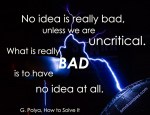
A picture quote I made:
Love Factually
 Love Factually: 10 Proven Steps from I Wish to I Do by Duana C. Welsh, PHD, 2/5
I’ve always suspected that I belong to one of the thin ends on the bell curve of normality, so perhaps I should not have been so surprised that reading this book was like reading placards at the zoo about weird animal mating rituals. In this case, the strange animal is a human being who is definitely sure that being married is the key to their happiness and isn’t too hung up on the minor details, like exactly who to marry or why. After all, if you’re determined to find a spouse, Welch argues that it’s just a simple case of creating a list of more or less arbitrary criteria that can be used to sort through participants in a tireless grind of date-interviews that goes on until you find someone who is either a) if you are a woman, a man who pays for everything and is infatuated with you thanks to your hard-to-get attitude or b) if you are a man, a woman who can be convinced to love you and is as young and beautiful as your status and economic resources merit.
As a guide to getting what you already know you want in a relationship, this book is both practical and disturbingly plausible. But for people who not only don’t know what they want, but doubt even the possibility of being able to predict what will actually make them happy, this book is worse than useless–it’s nauseating.
Why I read it: it was a gift from a family member.
Excerpts from Extraordinary Popular Delusions and the Madness of Crowds
Excerpts from  Extraordinary Popular Delusions and the Madness of Crowds by Charles Mackay, 2/5
Argh, I hate abridged books and would never have purchased this if I’d known it only contained the first (and arguably, most boring) 100 pages of the complete book, whose unabridged summary deceptively appears on the back of this one. I was promised stories about alchemy, mesmerism, witch burnings and crusades, but all this slim collection contains is esoteric accounts of early stock market crashes. I found these to be almost incomprehensible, thanks to all the economic terminology, but an accountant, stock trader or student of finance might find them very interesting.
Why I read it: What can I say, the cover appealed to me and it was almost free.
 OmniRambles