
The New Toughness Training for Sports
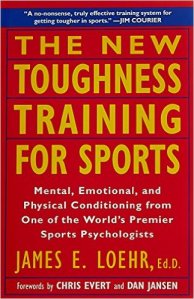 The New Toughness Training for Sports: Mental, Emotional, and Physical Conditioning from One of the World’s Premier Sports Psychologists by James E. Loehr, ED.D., 4/5
For the casual participant in competitive sports, this book is the literary equivalent of that annoying person who gives you really hard, practical advice when maybe all you wanted was some encouragement and affirmation (I don’t actually know anyone like that, so That Person is probably me). While I was put off by all the self-assessment, soul-searching, diary-keeping, essay-writing, plans, logs and mantras Loehr recommends, they do seem like a plausible way to at least take your mind off negative emotions, clarify your commitment to your sport and get focused.
Defining “toughness” as “the ability to consistently perform toward the upper range of your talent and skill regardless of competitive circumstances” (5), Loehr explores the concepts of Real Self vs Performer Self and how your mental and emotional habits affect your Ideal Performance State. One of the most interesting ideas in this book is wave-making–achieving growth through alternating phases of stress and recovery (mental, emotional and physical). This is something I’d already figured out on some level, but never seen put into words. Also, Loehr’s clarification of just how much stress is healthy was very helpful. I’ve long thought that the whole “no pain no gain” mentality is a bit simplistic and possibly dangerous for people with over-achieving personalities; yes, you should push yourself, but going too far just to make a point is a bad long-term strategy. Loehr distinguishes between discomfort and pain, identifying the first as stress that toughens and the second as a symptom of overtraining.
My first impression of this book was not good, but as I dip into it again to write this review, I start to suspect that it might reward a slower, more thoughtful reading than the first one I gave it. It contains a lot of information, but all very concisely communicated, which can give the impression of shallowness during a quick reading. If it wasn’t overdue at the library, I’d read it again, but perhaps I will buy a copy instead.
Why I read it: Stephan Kesting mentioned it on grapplearts.com as one of his favorite sports psychology books (along with Wrestling Tough).
 Elmore Leonard’s 10 Rules of Writing by Elmore Leonard, 4/5
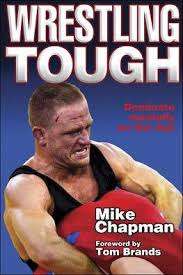 Wrestling Tough: Dominate Mentally on the Matt by Mike Chapman, 4/5
 The Song of Roland, translated by Frederick Goldin, 5/5
 Rebecca by Daphne du Maurier, 4/5
 The Song of Roland, translated by Frederick Bliss Luquiens, 5/5
 Steal Like An Artist: 10 Things Nobody Told You About Being Creative by Austin Kleon, 5/5
 The Official Dictionary of Sarcasm: A Lexicon for Those of Us Who Are Better and Smarter Than the Rest of You by James Napoli, 1/5
 Subterranean Britain: Aspects of Underground Archaeology, edited by Harriet Crawford, 3/5

 OmniRambles