
Tagged: Nonfiction
The Last Lecture
 The Last Lecture by Randy Pausch with Jeffrey Zaslow, 2/5
Is it the mystery of death or mere crass curiosity that makes people so fascinated by “last words”? For whatever reason, the appeal is undeniable. However, it is also undeniable that everyone dies and, heartless as it may sound, imminent death is no philosophical or literary credential. Mostly according to himself, Pausch was a great success as a human being: intelligent, successful, hard-working, loved and loving…but this short book somehow still left ample opportunity for me to repeatedly wonder when it was going to get profound, insightful, or helpful in any way. It felt rather like a Wikipedia article written about someone, not because they had such a noteworthy effect on the world that it deserved lasting mention, but merely because they died. (Interestingly, I later looked up Pausch’s Wikipedia article and that is almost exactly what happened–it was created the month he got his terminal diagnosis, not at any time during his career). Perhaps people who are dealing with life-threatening illness would have a different perspective, but I felt this book had very little to offer besides voyeuristic appeal, though I’m sure that as a memoir for his family, it is beyond value.
Why I read it: My gym friend, Tyler, thought I might enjoy it and lent me his copy.
The Book of Five Rings
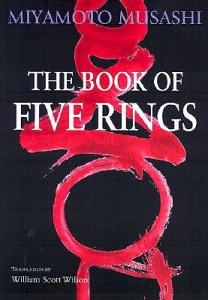 The Book of Five Rings by Miyamoto Musashi, translated by William Scott Wilson, 5/5
It is absolutely stunning how relevant this book remains to today’s students of combat sports, though it was written almost 400 years ago for Japanese swordsmen. I recognize so many of the techniques and concepts that Musashi describes from my own kickboxing, Brazilian jiu-jitsu and MMA sparring experiences. In fact, I believe such review and recognition is likely where this work’s main interest and value lies–I certainly don’t feel able to learn subtle martial arts concepts from a book (certainly not from a picture-less book!), but it is fascinating to see what I have learned from my coaches and through experience reflected on the page. Perhaps this is why the ever-practical Musashi ends each lesson with a comment like “You should make efforts in this,” or “You should practice this well.”
Why I read it: I came across Musashi’s “21 Rules of Life” online, read a bit about him and remembered that though I had given my brother a beautifully illustrated copy of The Book of Five Rings many years ago, I had never actually gotten around to reading it myself.
The Five Languages of Apology
 The Five Languages of Apology: How to Experience Healing in All Your Relationships by Gary Chapman and Jennifer Thomas, 4/5
Making and receiving apologies has always seemed like a fairly natural part of human interaction to me, so I’ve never given the topic much thought. However, I was recently very confused to be told plaintively by someone that “so-and-so has never apologized to me in twenty years!” What was so confusing about this comment? Well “so-and-so” had recently made an unexpected and unsolicited apology to me! Was I to believe this same person had purposefully withheld all apologies from someone else, or was there some other communication issue at play?
It turns out that different people have different expectations when it comes to what makes a sincere apology. According to this book, if one or more of the five “languages” of apology is lacking, the whole effort can fail to register with the recipient as a sincere apology, no matter how genuine it was intended to be.
- Expressing Regret: “I am sorry.”
- Accepting Responsibility: “I was wrong.”
- Making Restitution: “What can I do to make it right?”
- Genuinely Repenting: “I’ll try not to do that again.”
- Requesting Forgiveness: “Will you please forgive me?”
I feel that the use of the word “languages” to describe these five aspects is a too-obvious effort to tie this book in with Chapman’s The Five Love Languages, but it is undeniably helpful to know what shortcomings could cause an apology to ring untrue. While the main focus of the book is on how to make sure your apology meets the intended recipient’s subconscious criteria, it is also interesting to understand that just because an apology doesn’t cover the aspect that is most important to you, doesn’t necessarily mean that it is insincere.
Another very interesting point the authors make is that, while forgiveness is a decision, trust is an emotion (213). You can choose to forgive someone, but trust should be earned. Forgiveness doesn’t mean forgetting what someone has done, making light of their bad actions, or going back to the way things were, but it does mean giving your relationship with them a chance to heal and grow.
Why I read it: my sister recommended it and I’m always interested in learning to be a better communicator.
The Nicomachean Ethics of Aristotle
 The Nicomachean Ethics of Aristotle, translated by Sir David Ross, 3/5
It took several attempts over a span of many months for me to get through this short book, in which Aristotle addresses topics of timeless interest, such as happiness, virtue, and friendship. The difficulty of this book lies, for me, not so much in the complexity of the ideas but in the general lack of reasoning provided to support them. A few moments of profundity are obscured by mundane observations, personal opinions (unsupported by fact) and attempts to force nebulous concepts into various organizational schemes. At first, I felt frustrated and disappointed that the Nicomachean Ethics, similar to Plato’s Phaedo, did not meet my expectations. However, after reading the Wikipedia article and a helpful lecture on the topic, it became clearer to me that this book’s value is more in the framework it provides for discussion and thought than for any definitive claims it makes. To me, it represents just the beginnings of thought on a complicated topic, made more remarkable by its age and practical, community-centered perspective on morality. Though its broader themes are difficult to grasp, it does reward a casual reading with the always-fascinating insight that human nature has not changed over thousands of years, and occasional gems like this:
But we must not follow those who advise us, being men, to think of human things, and, being mortal, of mortal things, but must, so far as we can, make ourselves immortal, and strain every nerve to live in accordance with the best thing in us; for even if it be small in bulk, much more does it in power and worth surpass everything (265).
Why I read it: C.S. Lewis referenced it in The Abolition of Man so I recognized the title while book shopping in Wales.
Wired to Eat
 Wired to Eat: Turn Off Cravings, Rewire Your Appetite for Weight Loss, and Determine the Foods that Work for You by Robb Wolf, 3/5
If lack of information is the reason you struggle with weight loss, then you may find this book to be life-changing–it certainly contains a lot of information. If lack of motivation is what’s holding you back, then you may find this book to be helpful–its tone is very motivational. However, if you are already familiar with the ultimate weight loss triumvirate Sleep More, Move More, Eat Less Processed Food, but you simply lack the self control to put it into practice, then you will likely find this to be just another useless diet book.
Many of Wolf’s observations are in line with my personal experience, especially that junk food makes you feel hungrier beyond reason and hyper-palatable, highly-processed foods are pure evil. However, I think of these facts as incidental to weight loss; in other words, learning them was simply the by-product of successful weight loss and maintenance in my case, not the cause. If knowledge gained through personal experience is insufficiently motivating, how much less is knowledge gained from merely reading a book? Such pessimistic practicalities aside, Wolf does his best to get his readers fired up and seems genuinely motivated to help people. His use of pop science/psychology is purposeful at least, though somewhat nauseating, and I respect his unusual advice that each person find the foods that work for them (within limits, obviously) instead of slavishly following some one-size-fits-all diet/religion. However, I feel that Wolf does not make nearly as convincing, scientific or detailed a case for the paleo diet as Good Food, Great Medicine makes for the Mediterranean diet (with the added benefit of much less hype and pop science).
Why I read it: My boyfriend thought it sounded interesting but I thought it sounded sketchy, so I read it first to save him time in case it sucked.
Treasure Hunting Northwest
 Treasure Hunting Northwest by Ruby El Hult, 3/5
This follow-up book to Lost Mines and Treasures of the Pacific Northwest is shorter, more elegantly written and can stand alone.
Why I read it: the title caught my eye in a used bookstore.
Lost Mines and Treasures of the Pacific Northwest
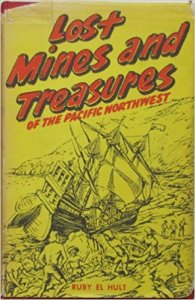 Lost Mines and Treasures of the Pacific Northwest by Ruby El Hult, 3/5
This book, written in 1957 about events that largely took place in the late 1800s, occupies a strange middle ground both methodologically and temporally. Not only was the author’s research ability limited to the pre-Information Age resources of her time, but there was the further complication of the existence of personal accounts from living people who were within a generation or two of original events (close enough to be convincing, but not close enough to be reliable). Thus, the book is an awkward mix of fanciful hearsay and dry research that takes a few chapters to get into the spirit of. Whether entirely true or not, these stories provide interesting insight into the early history of the Pacific Northwest and the world of pioneers, pirates and prospectors.
Why I read it: The sequel, Treasure Hunting Northwest caught my eye in a used bookstore so I thought I’d better buy the original too.
Never Stop Pushing
 Never Stop Pushing: My Life from a Wyoming Farm to the Olympic Medals Stand by Rulon Gardner with Bob Schaller, 3/5
Life is tough but Rulon Gardner is tougher. His story proves that success does not always require a fortuitous alignment of luck, talent and circumstance–success can be the prize of those who are simply too stubborn and too strong to settle for less. This book is certainly not going to win any literary awards, but it is an inspiring account of hard work and good character put to the test on an international stage.
Why I read it: my wrestler boyfriend got me excited about the story, showed me the famous Gardner vs Karelin gold medal match and lent me his well-worn copy of the book.
The Elements of Reasoning
 The Elements of Reasoning by David A. Conway and Ronald Munson, 2/5
This book provides an introduction to informal logic, focusing mostly on valid and invalid ways arguments can be formed, along with a brief look at common fallacies and errors in reasoning. The argument forms seem contrived and the analysis methods limited–it is hard to imagine a use for these concepts outside of a classroom and the book is certainly not written in a way meant to smooth the transition from academic thought exercise to real life. In fact, the whole tone of the book is very dry and dead, which is a pity because the topic is fascinating and I have seen it treated in much more interesting and lively ways. A good teacher could bring it to life, perhaps, and also provide insight on the numerous thought exercises that the authors leave unanswered.
Why I read it: I wanted to learn about the symbols used in formal logic (only a few of which are covered in this book) and the title caught my eye at the thrift store.
Crap Taxidermy
 Crap Taxidermy by Kat Su, 3/5
Equal parts gross, funny and WTF? This small collection of images makes a fun novelty gift, but I think it’s more suited to its original website format: www.crappytaxidermy.com.
Why I read it: Came across it on Imgur and got a copy for my boyfriend’s dad (who does good taxidermy, not the crap kind).

