Good Food, Great Medicine: A Mediterranean Diet and Lifestyle Guide (Third Edition) by Miles Hassell, MD, and Mea Hassell, 4/5
This homey guide to healthy living contains all the information I imagine one could possibly need about the Mediterranean diet and lifestyle, including medical research, advice on nutrition, sleeping habits and exercise, and a large collection of recipes. The authors’ approach is good-humored, unpatronizing and realistic–well-suited to the common-sense advice they give and the varying amounts of commitment they can expect from their readers. I haven’t tried any of the recipes, which is why I give the book four stars instead of five.
Eat more simple, natural food that is close to its original form and eat less prepackaged, processed or sugary junk…thanks in part, I guess, to a relatively healthy upbringing, most of this book fit into the “well, duh!” category for me and it is the duh-factor that I find most convincing about the Mediterranean lifestyle. This is no silver bullet, no gimmicky fad diet; it can’t be boiled down to “oh, I don’t eat carbs” or “I count calories” or “I fast intermittently” or “I only eat raw food,” etc. Unfortunately, there’s nothing very sexy about a well-balanced, natural, sustainable approach to eating that requires lots of common sense and self-control.
Self-control–there’s the rub. From both observation and first-hand experience, I’ve found that lack of self-control and lack of motivation, not lack of information, are at the root of unhealthy, excessive eating habits. Knowledge may be power but it isn’t will power. I can read a million studies about how doing x lowers your risk of dying by 35% and not doing y makes you 20% less likely to get cancer, but when I stop reading, it’s often because I need to put Nutella on my toast while it’s still warm. Still, we all make decisions every day that affect our health, whether positively or negatively; for me, this book’s value is in helping me make a few better, more informed, eating decisions than I might have made before. In this way, I hope to continue refining my approach to eating from merely counting calories to emphasizing those foods that are both good for me and make me feel good.
Why I read it: my dad had some heart trouble last year and his doctor recommended this book to him.
A picture quote I made:


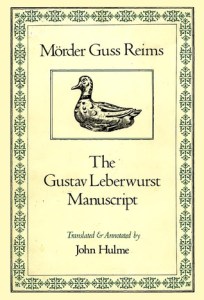 Mörder Guss Reims: The Gustav Leberwurst Manuscript, translated and annotated by John Hulme, 5/5