
Category: Reviews
Night
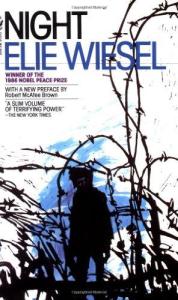 Night by Elie Wiesel, 5/5
This firsthand account of a Jewish teenager’s experience in four German concentration camps during World War II is short, stark and brutal. While most other historical accounts from this era that I have read contain some sliver of hope, faith, humanity, and closure, there is none to be found in Wiesel’s testimony. Presumably these elements are explored in the following, fictional, books of the trilogy, Dawn and Day. There are many disturbing and moving scenes in this book, but strangely, the thing that hit me most was the author’s brief mention of electrical fences around the camp. Some irrational part of me pictures the Holocaust as happening in the dark and distant past, before modern civilization. Realizing that something as thoroughly modern as an electric fence was used to contain innocent men, women and children, 11 million of whom were doomed to die, brings the horror of the Holocaust back to the very near past, where it belongs.
Why I read it: My boyfriend and I found the battered little paperback in a box of his high school relics. If it’s still not required reading, it should be.
When God Laughs
 When God Laughs by Jack London, 4/5
The short story has never been one of my favorite literary forms, so I was not exactly jazzed to crack open what I thought was a Jack London novel to find a collection of twelve shorter works under one title. They say a brief speech requires much more effort to create than a long one and I can only assume that even the best novelists face a similar challenge when it comes to crafting shorter works. My mild pessimism was wasted in this case, however, because most of these stories were captivating–full of vivid characters and a variety of dramatic plots and settings. It is a testament to the author’s skill that I could become so emotionally invested in stories ranging from just ten to forty-two pages long.
Why I read it: Just trying to read through the old books on my shelf!
Show Your Work!
 Show Your Work! 10 Ways to Share Your Creativity and Get Discovered by Austin Kleon, 3/5
This is a helpful little book for anyone who struggles with the culture of self-obsession and inauthenticity that the Instagram era seems to encourage. Social networking can be a great tool for creating opportunities and growing business, but for some people, their internet persona easily takes on a faux life of its own that stifles real, personal growth.
Kleon addresses this issue in part by shifting the focus from product (ultimately, your ideal version of self) to process (your life experiences). Instead of just showing your artwork, you show your art work (33): the real-life, behind-the-scenes depiction of what you learn about what you love, in the spirit of true sharing not self-aggrandisement. His approach is genuine, carefree, messy, organic and much more likely to stimulate personal and professional growth, as well as lasting and meaningful connections with others, than any contrived attempt to impress could achieve.
While the book’s organization is a bit all over the place, it loosely expands on the following 10 rules:
- You don’t have to be a genius.
- Think process, not product.
- Share something small every day.
- Open up your cabinet of curiosities.
- Tell good stories.
- Teach what you know.
- Don’t turn into human spam.
- Learn to take a punch.
- Sell out.
- Stick around.
Why I read it: My library was discarding it and I remembered liking Kleon’s previous book.
Slain by the Doones
 Slain by the Doones by R.D. Blackmore, 1/5
I love the old classic Lorna Doone, so I was very excited to spot what appeared to be its sequel on the shelves of a small, local thrift store. Unfortunately, the book turned out to be a collection of terribly-written short stories, only one of which had a connection to Blackmore’s earlier (and much better) novel. I have read a lot of late 19th-century literature with no comprehension issues, but I found some parts of this collection quite difficult to understand, presumably due to the author’s use of then-trendy references and short-lived terminology. While it’s understandable that the passage of time can be less than kind to certain writing styles, there really is no excuse for the lame plots that made these short stories a chore to get through. At least it’s pretty, though!
The Edge of the World
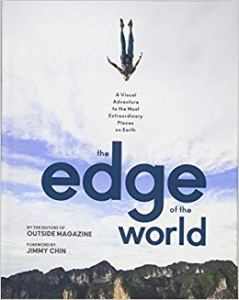 The Edge of the World: A Visual Adventure to the Most Extraordinary Places on Earth, by the editors of Outside Magazine, 5/5
What’s not to like about a collection of high-quality action photos accompanied by descriptions that provide interesting context from the photographers’ perspectives?
Why I read it: Part of an armload of photography books I checked out of the library.
Summertime
 Summertime by Denis Mackail, 5/5
When I selected this unassuming novel from my stacks of unread vintage books, I didn’t know what to expect. Delightfully, it turned out to be a sweet little romance, full of naive characters, 1920’s charm and dialogue that is occasionally very witty. Author Denis Mackail may be unknown now, but he was popular when it mattered most (during his lifetime) and since he published one novel every year from 1920-1938, I’m optimistic that more of his works will eventually find their way into my collection.
Why I read it: Just one more step towards the goal of having read every book I own!
Castles
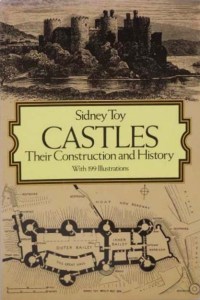 Castles: Their Construction and History by Sidney Toy, 2/5
Never has a book more sadly lacked a glossary! In retrospect, I should have created one of my own as I encountered endless, undefined technical terms like “barbican,” “corbel,” and “machicolation.” Because the author is very good at describing castles in painstaking detail and creating architectural drawings, this book has historical value as a record of the condition of various castles at the time of the author’s visits (pre-1939). Unfortunately, however, Sidney Toy is more focused on presenting data than interpreting it, so there is very little narrative flow or sense of the bigger picture as far as castles’ construction and history in general is concerned.
Why I read it: With several castles on the itinerary for a recent trip to Ireland, I was hoping to gain some knowledge on the subject, but this book was disappointingly unhelpful.
In the Garden of Beasts
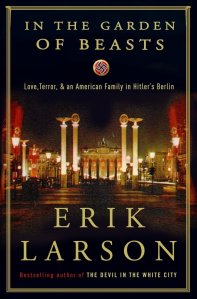 In the Garden of Beasts: Love, Terror, and an American Family in Hitler’s Berlin by Erik Larson, 5/5
It’s been a long time since I picked up a book that I couldn’t put down again (especially a nonfiction one), but I read this for 3 hours straight one morning and finished it almost in one sitting. This true story takes place in an odd slice of history–the years directly preceding the outbreak of WWII, as Hitler consolidated his power in Germany and gradually revealed the extent of his aspirations to the tentative but growing concern of the rest of the world. The characters on whom the story focuses are even more odd: an elderly academic, appointed in desperation to the role of American Ambassador to Germany when more qualified men turned it down, and his free-spirited daughter who lets few opportunities to party and sleep with the enemy slip through her fingers, despite the delicacy of her family’s situation in Nazi Germany. Even more interesting than the political twists and turns of this turbulent time are the many appearances of famous and infamous entities, portrayed from a more personal, intimate perspective than the hard, cold light that history usually shines on them. Author Erik Larson somehow achieves a well-researched tone without diminishing the natural drama of events.
There were, as might be expected, many horrifying things in this book. What was unexpected to me, however, was the source of this horror. I was most shocked, not by Hitler and his Nazis’ iconic atrocities, but by the greedy, irresponsible, antisemitic attitudes documented in the behavior of many U.S. politicians and other high-profile citizens. Many influential policy-makers were more than willing to identify a so-called “Jewish Problem” in the U.S. and seemed more interested in Germany’s ability to repay high-interest war loans than any human rights concerns. Wealth and social prestige, unbelievably, seemed to be acceptable qualifications for positions of world-event-affecting influence and politicians trusted by the U.S. public to guide their country in perilous times floundered without coordinated priorities or plans. Hindsight, as they say, is 20/20, but knowing in retrospect the millions of lives that were at stake makes the outcome of events documented in this book seem even more tragic.
Why I read it: My friend, Peggy, passed it on to me.
14 Minutes
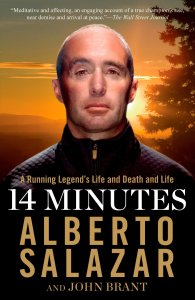 14 Minutes: A Running Legend’s Life and Death and Life by Alberto Salazar and John Brant, 5/5
Salazar’s life-story is every bit the page-turner that the book’s title suggests. It was fascinating to get a glimpse into the obsession that drives world-class athletes, but I was even more interested in how Salazar dealt with injury, set-backs, losses and depression to establish a thriving post-competitive career in a non-lucrative sport.
Why I read it: My friend, Peggy, passed it on to me.
2018 Stats
In 2018 I read twenty-five books, fourteen of which were nonfiction, nine fiction, and two poetry. This is nowhere near my pre-martial-arts numbers, but coming off a 75% decrease in reading since 2016, it is exciting to finally have a year that doesn’t represent a downward trend from the one before!
I read 1 book written in the 1800s
2 books written between 1900-1949
6 books written between 1950-1999
16 books written between 2000-2018
Books that I rated 1 star: 0 (0%)
2 stars: 7 (28%)
3 stars: 5 (20%)
4 stars: 5 (20%)
5 stars: 8 (32%)
 OmniRambles