
Tagged: memoir
Of Men and Mountains

Of Men and Mountains by William O. Douglas, 3/5
This simple, wholesome memoir is a love letter to Washington state’s Cascade mountains and the character-building, spirit-refreshing experiences while exploring them that had a profound effect on Supreme Court justice William O. Douglas throughout his life.
Why I read it: I snagged it from my mother-in-law’s donation pile and read it at night to combat pregnancy-induced insomnia.
A Walk in the Woods
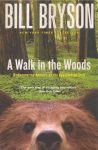
A Walk in the Woods: Rediscovering America on the Appalachian Trail by Bill Bryson, 2/5
Numerous reader recommendations on social media, the subtitle’s promise, and four (!) introductory pages of hyperbolic blurbs made me expect an uplifting, insightful and hilarious account of thru-hiking the Appalachian Trail, with a strong human interest aspect. I could not have been more mistaken in every single way. Over the course of the first half of the book, Bryson hikes less than a quarter of the trail (p. 162) and even that is not continuous; he skips a large portion of Tennessee because interactions with “stupid” cab drivers and, of all things, the state’s history of anti-evolutionary legislature, gave him “a powerful urge not to be this far south any longer” (p.108).
The second half of the book sees the author driving to different parts of the trail for day hikes, seemingly desperate to scrape together enough bleak and preachy anecdotes to earn his book advance. Most of his depictions of the people he encounters along the way are snarky, shallow, and mean-spirited. Trail-related material is generously padded with smug forays into armchair activism, including endless dire predictions about the environment and the imminent demise of various species of plants and animals that, twenty-five years after publication, seem overblown (at least, in the cases I paused to look into further).
The last straw, for me, was when Bryson took a rare break from obsessing about bears and how dangerous and fast and numerous and hungry for hikers they are to express his disapproval of guns and unironically comment “Goodness knows what the world is coming to when park rangers carry service revolvers” (p. 168). At that point, I realized that, much like how Bill Bryson had tried and failed to thru-hike the Appalachian Trail, I had tried and failed to like his book about it.
Why I read it: an oft-mentioned entry in the comments on an Instagram post about favorite (or most meaningful–I can’t remember which) books.
Clanlands
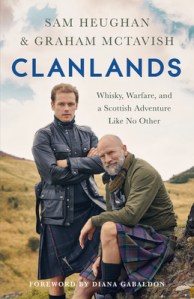
Clanlands: Whisky, Warfare, and a Scottish Adventure Like No Other by Sam Heughan and Graham McTavish, 2/5
From a literary perspective, it’s frankly shocking that something so closely resembling a shared Google Doc rough draft somehow survived the publishing process and exists in book form. Unpolished, unfocused, and overflowing with “cringe,” this book waffles between authors’ perspectives just like it waffles between travelogue, memoir, history and reality TV pitch. There were a few humorous moments and interesting historical facts, but I don’t think it has much to offer anyone outside of its target audience–Heughligans and fans of Outlander. Perhaps surprisingly, given my opinion of the book, I did enjoy its associated TV show, Men in Kilts.
Why I read it: my mother-in-law generously lent me her brand new copy while we were on a hunting trip.
Autumn
 Autumn by Karl Ove Knausgaard, translated by Ingvild Burkey, 3/5
Reading this collection of short essays, mostly on such prosaic topics as “apples” and “plastic bags,” is a calming and grounding experience. Knausgaard combines the sensibilities of a sophisticated writer with the wide-eyed wonder of a child, rendering even the most commonplace subject somehow remarkable. The simple and honest manner in which the author’s thoughts and everyday life experiences permeate the text give one a sense of voyeurism without its intrinsic guilt; as if someone has left their curtains open solely to warm the hearts of passersby in the dark.
Why I read it: a recommendation by my sister, Anna.
The Best Life Stories
 The Best Life Stories: 150 Real-life tales of resilience, joy and hope–all 150 words or less! collected by Reader’s Digest, 5/5
I enjoyed the wide variety of writing styles, perspectives and meaningful experiences represented in this concise collection. The fact that these stories were collected from the general public via Facebook just goes to show that you don’t have to be a famous writer, poet or personality to express beautiful insights about the human experience.
Why I read it: found it while wandering through the library looking for something light and inspirational to read while cutting weight for my first MMA fight.
Never Stop Pushing
 Never Stop Pushing: My Life from a Wyoming Farm to the Olympic Medals Stand by Rulon Gardner with Bob Schaller, 3/5
Life is tough but Rulon Gardner is tougher. His story proves that success does not always require a fortuitous alignment of luck, talent and circumstance–success can be the prize of those who are simply too stubborn and too strong to settle for less. This book is certainly not going to win any literary awards, but it is an inspiring account of hard work and good character put to the test on an international stage.
Why I read it: my wrestler boyfriend got me excited about the story, showed me the famous Gardner vs Karelin gold medal match and lent me his well-worn copy of the book.
American Shaolin
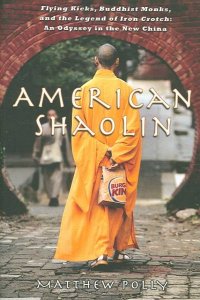 American Shaolin: Flying Kicks, Buddhist Monks, and the Legend of Iron Crotch: An Odyssey in the New China by Matthew Polly, 3/5
This memoir of an American college dropout who transforms from bullied to badass by studying kung fu with Shaolin monks in China is a fun read, if a little bit less interesting, less believable and dirtier than the author’s later book Tapped Out.
[Why I read it: I enjoyed the author’s other book a lot.]
Man’s Search for Meaning
 Man’s Search for Meaning by Viktor E. Frankl, 5/5
When a psychiatrist who endured the German concentration camps of WWII has something to say about happiness and the meaning of life, you can bet it’s something worth paying attention to. Frankl’s thoughts on the bigger questions in life are woven into the first part of this short book–an account of the author’s experiences and observations in Auschwitz and other concentration camps. An introduction to the foundations of logotherapy (the author’s approach to psychotherapy) comprise the second part of the book, in which Frankl’s ideas really come into focus.
Frankl’s refreshing premise is that “man’s search for meaning is the primary motivation in his life” (121) and that “A man’s concern, even his despair, over the worthwhileness of life is an existential distress but by no means a mental disease” (125). The author’s theory of the meaning of life encompasses the complexities of human existence with startling simplicity:
As each situation in life represents a challenge to man and presents a problem for him to solve, the question of the meaning of life may actually be reversed. Ultimately, man should not ask what the meaning of his life is, but rather he must recognize that it is he who is asked. In a word, each man is questioned by life; and he can only answer to life by answering for his own life; to life he can only respond by being responsible (131).
I have seldom been moved as this book moved me, right from the preface, which contains this bit of wisdom that alone would make the book worth reading:
Don’t aim at success–the more you aim at it and make it a target, the more you are going to miss it. For success, like happiness, cannot be pursued; it must ensue, and it only does so as the unintended side-effect of one’s personal dedication to a cause greater than oneself or as the by-product of one’s surrender to a person other than oneself. Happiness must happen, and the same holds for success: you have to let it happen by not caring about it. I want you to listen to what your conscience commands you to do and go on to carry it out to the best of your knowledge. Then you will live to see that in the long run–in the long run, I say!–success will follow you precisely because you had forgotten to think of it (17).
[Why I read it: it was mentioned in Your Money or Your Life and the title sounded interesting.]
Tapped Out
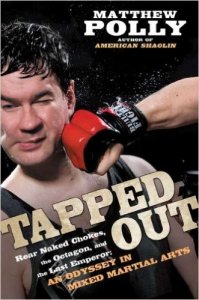 Tapped Out: Rear Naked Chokes, the Octagon, and the Last Emperor: An Odyssey in Mixed Martial Arts by Matthew Polly, 5/5
This entertaining account of a middle-aged writer’s transformation from overweight fixer-upper with a distant background in kung fu to competent mixed martial artist is impossible to put down–I started it at 2am last night, meaning to read just a little before falling asleep, and the next thing I knew it was 2.5 hours later and I was on the last page. Polly is a good writer with a great sense of humour and seems to know how to embellish a story without exaggerating it all out of proportion. Famous figures in MMA appear throughout and I’ll admit to a few fan-girl squeals along the way. Probably the fact that I’ve been doing a lot of kickboxing, grappling and Brazilian jiu-jitsu this year made the book even more enjoyable–a lot of Polly’s experiences as a beginner were hilariously relatable. I enjoyed the book so much that I’ve already ordered Polly’s American Shaolin from the library.
[Why I read it: I came across it while looking for BJJ books in the library database.]
As You Wish
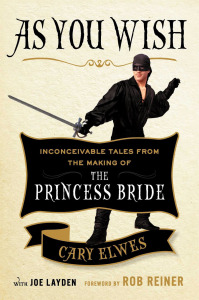 As You Wish: Inconceivable Tales from the Making of The Princess Bride by Cary Elwes with Joe Layden, 2/5
This underwhelming book, written by “Wesley” from the movie The Princess Bride, does contain some entertaining stories but consists mostly of uninteresting prose meant more to beef up the word count than to communicate anything insightful. Along with intensely boring descriptions of how many chairs were at the first table read and exactly what kind of sandwiches were provided, is a tiresome quantity of trite tributes to the general awesomeness of everyone involved with the film. And Elwes is not the only one spouting sweet nothings about the rest of the cast: there are also numerous interviews with relevant people who mostly seem to have nothing very meaningful to say and say it in a very generic way. Even worse, these interviews are set apart from the main text in grey boxes that fragment the reading experience, making it disjointed and annoying. All in all, I’d say the few really interesting anecdotes it contains make the book worth reading for fans of the movie, but they shouldn’t expect too much.
[Why I read it: I saw the title while ordering The Princess Bride novel at the library.]
 OmniRambles