
Tagged: fiction
All My Puny Sorrows
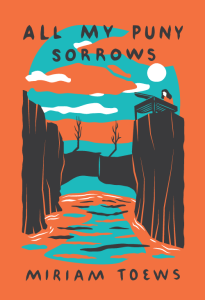 All My Puny Sorrows by Miriam Toews, 5/5
All my words are insufficient to convey how exquisite this semi-autobiographical novel is; I am reduced to a string of mere adjectives…raw, beautiful, funny, insightful, uplifting, bittersweet…none of which can fully capture this story of two sisters, one a struggling writer with a history of failed relationships and the other a beautiful concert pianist who possesses everything happiness requires…except the will to live. Intensely personal, defiantly human, undeniably humorous, this book is a masterpiece and a privilege to read.
Why I read it: The first chapter is in McSweeney’s No. 48.
The Songlines
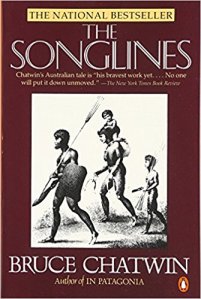 The Songlines by Bruce Chatwin, 4/5
A semi-fictitious scholar named Bruce (who, in sharing the author’s name, not-so-clearly provides literary license) explores the concept of “Songlines” or “Dreaming-tracks,” a musical interpretation of geography by which Aboriginal Australians understand the creation of the world and their place in it. Vivid characters and landscapes, described in short paragraphs with Chatwin’s succinct prose, have the power to transport the reader almost as surely as any vehicle to foreign lands.
Why I read it: I recognized the title in the thriftstore from reading Chatwin’s In Patagonia.
McSweeney’s No. 48
 McSweeney’s No. 48, 4/5
I tend to have a difficult time enjoying modern literature, but this curated collection of writings was just light and varied enough to be interesting. Sure, there were the dark, unsettling, claustrophobic stories and the bafflingly artistic tales that I am apparently not smart enough to understand, and the gross story by the enlightened author who thinks writing about sex is soooo avant-garde. Thankfully, though, there were also a selection of entertaining, skillfully written pieces that kept me interested and appreciative.
Why I read it: Stumbled across it in the library and recognized the name from their website, where I remembered reading some funny open letters.
Sophie’s World
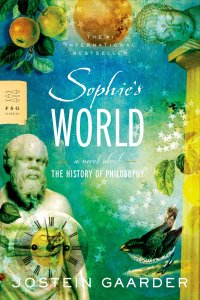 Sophie’s World: A Novel About the History of Philosophy by Jostein Gaarder, translated by Paulette Møller, 2/5
The most thought-provoking aspect of this reading experience was simply trying to understand how a book featuring such peculiarly bad writing could be published at all, much less become an “international bestseller.” Half of it consists of dialogue between two-dimensional characters, so stilted and unnatural it has to be read to be believed. The other half reads like increasingly vague course descriptions for philosophy classes taught by someone who considers Wikipedia articles to be the pinnacle of literary accomplishment through the ages. In my experience, fiction writing this bad generally relies on themes like sex, mystery or fantasy to attract readers, so I guess in a twisted way this book’s very existence is a testament to the powerful appeal of philosophical ideas and the ubiquity of existential angst.
Why I read it: recommended to me by a gym friend.
Adulthood is a Myth
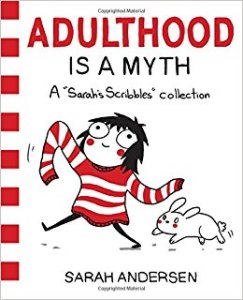 Adulthood is a Myth: A “Sarah’s Scribbles” collection, by Sarah Andersen, 5/5
Big Mushy Happy Lump
 Big Mushy Happy Lump: A “Sarah’s Scribbles” Collection by Sarah Andersen, 5/5
I love the Sarah’s Scribbles webcomic and this book is more of the same laughs. My boyfriend looked at the first illustration, of a small girl with big eyes cozied up in a comically huge hoodie, and was like “This is written about you?” Then he turned to the first comic, about procrastination, and was like “This is written about you!”
Why I read it: saw it advertised on the webcomic site.
Chitty-Chitty-Bang-Bang
 Chitty-Chitty-Bang-Bang: The Magical Car by Ian Fleming, 2/5
A strange little story, with a spindly plot and uneven tone that is sometimes fanciful and sometimes much too serious for the children that are presumably its audience. I did like the playful illustrations by John Burningham, which are quintessentially 1960s. Surprisingly, there is very little resemblance to the 1968 film, which I love (though it turns out that what I love about it is probably Roald Dahl’s influence, not Fleming’s inspiration).
Why I read it: my sister thought I might enjoy it.
Tarzan of the Apes
 Tarzan of the Apes by Edgar Rice Burroughs, 4/5
This is a bittersweet little story, written with the refined yet melodramatic style (and casual racism) that characterizes a lot of literature from the early 1900s. Like most people, I was already familiar with the characters and story line, but I recognized very little of pop culture Tarzan in this original tale.
The edition is noteworthy because it is printed in landscape format, supposedly making it easier to read in bed. I really enjoyed the novelty, but didn’t think it was any easier to read lying down than a normal book.
Why I read it: A lovely birthday gift from one of my brothers and his family.
Jonathan Wild
 The History of the Life of the Late Mr. Jonathan Wild the Great by Henry Fielding, 2/5
This peculiarly depressing little satire flips traditional concepts of morality on its head by recasting infamous 18th-century thief Jonathan Wild as a “Great Man,” deriding all honest men as “that pitiful order of mortals who are in contempt called good-natured; being indeed sent into the world by nature with the same design with which men put little fish into a pike-pond in order to be devoured by that voracious water-hero” (73). There are a few hilarious moments but overall Fielding’s satirical style is a bit strained and tedious.
Why I read it: I can’t remember where I picked this book up from, but it probably ended up in the pile beside my bed because I really enjoyed Fielding’s Tom Jones.
Four Novels of the 1970s
 Four Novels of the 1970s: Fifty-Two Pickup, Swag, Unknown Man No. 89 and The Switch by Elmore Leonard, 1/5
I made it most of the way through the first novel in this collection and, while I admired the film-noir mood and punchy dialogue, eventually gave up because it was just too R-rated for me. Given that I enjoy watching a lot of R-rated movies, this might seem strange, but there’s just something about books–I get a bad feeling from reading things in print that wouldn’t phase me to watch on film.
I suspect that Fifty-Two Pickup might be one of Leonard’s roughest books and I might have had better luck with some of his more comedic works, but I just don’t feel motivated to give them a try at this point.
Why I read it: Got a batch of Elmore Leonard books out of the library to read, starting with his 10 Rules of Writing.
 OmniRambles