
Tagged: 5/5
The Best Life Stories
 The Best Life Stories: 150 Real-life tales of resilience, joy and hope–all 150 words or less! collected by Reader’s Digest, 5/5
I enjoyed the wide variety of writing styles, perspectives and meaningful experiences represented in this concise collection. The fact that these stories were collected from the general public via Facebook just goes to show that you don’t have to be a famous writer, poet or personality to express beautiful insights about the human experience.
Why I read it: found it while wandering through the library looking for something light and inspirational to read while cutting weight for my first MMA fight.
The Book of Five Rings
 The Book of Five Rings by Miyamoto Musashi, translated by William Scott Wilson, 5/5
It is absolutely stunning how relevant this book remains to today’s students of combat sports, though it was written almost 400 years ago for Japanese swordsmen. I recognize so many of the techniques and concepts that Musashi describes from my own kickboxing, Brazilian jiu-jitsu and MMA sparring experiences. In fact, I believe such review and recognition is likely where this work’s main interest and value lies–I certainly don’t feel able to learn subtle martial arts concepts from a book (certainly not from a picture-less book!), but it is fascinating to see what I have learned from my coaches and through experience reflected on the page. Perhaps this is why the ever-practical Musashi ends each lesson with a comment like “You should make efforts in this,” or “You should practice this well.”
Why I read it: I came across Musashi’s “21 Rules of Life” online, read a bit about him and remembered that though I had given my brother a beautifully illustrated copy of The Book of Five Rings many years ago, I had never actually gotten around to reading it myself.
Adulthood is a Myth
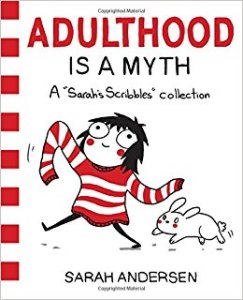 Adulthood is a Myth: A “Sarah’s Scribbles” collection, by Sarah Andersen, 5/5
Big Mushy Happy Lump
 Big Mushy Happy Lump: A “Sarah’s Scribbles” Collection by Sarah Andersen, 5/5
I love the Sarah’s Scribbles webcomic and this book is more of the same laughs. My boyfriend looked at the first illustration, of a small girl with big eyes cozied up in a comically huge hoodie, and was like “This is written about you?” Then he turned to the first comic, about procrastination, and was like “This is written about you!”
Why I read it: saw it advertised on the webcomic site.
The Five Love Languages
 The Five Love Languages: How to Express Heartfelt Commitment to Your Mate by Gary Chapman, 5/5
It took an effort to get past the cringe-worthy cover and subtitle, but this book is well-written and explores concepts that can apply to a variety of relationships besides marriage (such as between friends, family members, or people who are dating). Using common sense and many examples from his years of experience as a marriage counselor, Gary Chapman proposes that, while everyone needs to feel loved, each individual tends to recognize and express love in primarily one of five ways: words of affirmation, quality time, receiving gifts, acts of service and physical touch. Two people with loving intentions who speak different “languages” can be left each feeling uncared for and confused as to why their expressions of love aren’t accepted as such. Chapman encourages people in relationships to notice which of the five categories their partner might belong to and adjust their own behavior accordingly. It seems to me that this could be a bit forced and awkward in some cases, especially if the other person knows you very well and notices that you start acting out of character. I think it makes more sense for everyone to learn each other’s love languages, not so that they can necessarily speak them, but so that they can appreciate love in its different forms. For example, if someone prefers to hear affirming words, they should learn to appreciate the love of a person who makes time for them or quietly does helpful things. Or if a person wants their partner to show they care by giving them gifts, they should also realize that a kind word or touch can be equally meaningful and heartfelt expressions of love.
Why I read it: One of my sisters said it was interesting and it is important to me that the people I care about feel loved.
Basic Ridercourse
 Basic Ridercourse by the Motorcycle Safety Foundation, 5/5
This handbook has a straightforward, yet appealing layout and presents a lot of basic information about operating a motorcycle. I appreciated how it focused on safety without being patronizing about it.
Why I read it: Lent to me by friends who ride.
The Total Dirt Rider Manual
 The Total Dirt Rider Manual by Pete Peterson and the editors of Dirt Rider, 5/5
Well-illustrated and written with a healthy dose of humor, this book seems about as helpful as it is possible for a book about something like dirt biking to be.
Why I read it: Lent me by a friend who rides, doubtless as an elaborate set-up for asking if I forgot to read the part about “not falling off the bike” when I wipe out for the first time.
Wit and Wonder
 Wit and Wonder: Poetry with Rhythm and Rhyme by James D. Herren, 5/5
When the author, a fellow fan of Stephen Fry’s The Ode Less Travelled, asked me out of the blue to review his newly self-published e-book of poetry, I felt a bit worried about balancing the responsibilities of being both a Very Nice Person and an Honest Book Reviewer. Thankfully, this moral dilemma was postponed to another time–I wholeheartedly love Herren’s poetry, finding it to be unpretentious, heartfelt and skillfully written. There is something in it for everyone–I kept pausing to read certain poems aloud to family members and even sent a couple screenshots to my sister on the east coast. When print copies of Wit and Wonder become available in April, I plan to buy one for my private library, as well as one for my family’s library and one to give a friend (something to look forward to, Alison B.). For those of you who aren’t quite as addicted to the smell of fresh ink as I am, the e-book is available now on Amazon through this link.
I tried to pick out a favourite poem to include in this review, but I liked too many of them to narrow it down to one. So I decided to pick out two that illustrated the range of tone and style in this collection, but they contrasted too much to appear side-by-side. So I finally narrowed it down to three (which is pretty good, given that there are 148 poems to choose from).
Acrobatics
I juggled the bills —
and my family, and job —
all while keeping a roof on our heads,
then I threw in a dance,
and a dash of romance,
for my wife who was juggling kids.
Dare
Away with words.
Fling wild.
Crash in a dazzling way.
Dance on the shoulders of giants.
Mock them with your brilliance.
Rise.
Fall.
Shine.
Think
The things I think are sometimes not
the things I think I thought I thought.
I thought I heard a dinosaur
but that was just my father’s snore.
I thought I saw a crocodile
but it was just my sister’s smile.
I thought I heard a dying cat —
my mother’s singing, only that.
I thought the world was torn apart
but that was just my brother’s fart.
I think it would be fun if you
could think of things the way I do.
Miracles
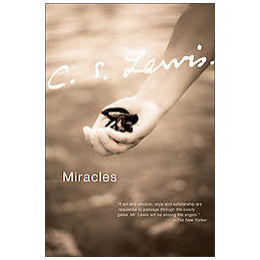 Miracles: A Preliminary Study by C.S. Lewis, 5/5
It’s like no one told C.S. Lewis that you can’t prove the existence of God, so he just does. And that is merely to lay the foundation for his main topic, which I actually found much less interesting and convincing than the preliminary discussions–the man does not shirk an intellectual challenge. Though I have occasionally sensed some antagonism from him towards science, in this book he cheerfully tackles both the known and unknown with the grace, focus and rigorous logic that make me sometimes fear that I tend to put more faith in him than in God. Of course, no matter how hard one tries to be open-minded and logical, it cannot be too difficult a task to convince someone of something they already believe. With that in mind, I would love to know how this book is perceived by people with different backgrounds and beliefs than me.
Why I read it: C.S. Lewis is one of my favourite authors and thankfully, every time I think I’ve read all his books I come across a new one.
The Works of Oscar Wilde
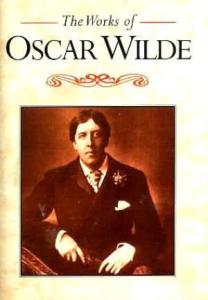 The Works of Oscar Wilde by Oscar Wilde, 5/5
Oscar Wilde is one of my favorite authors and I have read (and re-read) his major works, such as the entrancing novella, The Picture of Dorian Gray, and the impossibly witty play The Importance of Being Earnest. However, there were a few of his short stories, plays and poems that I’d never encountered before, so this collection was a delightful mix of old favourites and new discoveries.
Why I read it: this collection was a birthday present from my dad.

