
Tagged: 4/5
The New Toughness Training for Sports
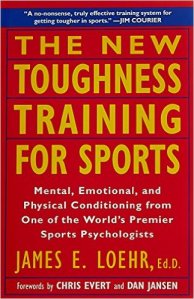 The New Toughness Training for Sports: Mental, Emotional, and Physical Conditioning from One of the World’s Premier Sports Psychologists by James E. Loehr, ED.D., 4/5
For the casual participant in competitive sports, this book is the literary equivalent of that annoying person who gives you really hard, practical advice when maybe all you wanted was some encouragement and affirmation (I don’t actually know anyone like that, so That Person is probably me). While I was put off by all the self-assessment, soul-searching, diary-keeping, essay-writing, plans, logs and mantras Loehr recommends, they do seem like a plausible way to at least take your mind off negative emotions, clarify your commitment to your sport and get focused.
Defining “toughness” as “the ability to consistently perform toward the upper range of your talent and skill regardless of competitive circumstances” (5), Loehr explores the concepts of Real Self vs Performer Self and how your mental and emotional habits affect your Ideal Performance State. One of the most interesting ideas in this book is wave-making–achieving growth through alternating phases of stress and recovery (mental, emotional and physical). This is something I’d already figured out on some level, but never seen put into words. Also, Loehr’s clarification of just how much stress is healthy was very helpful. I’ve long thought that the whole “no pain no gain” mentality is a bit simplistic and possibly dangerous for people with over-achieving personalities; yes, you should push yourself, but going too far just to make a point is a bad long-term strategy. Loehr distinguishes between discomfort and pain, identifying the first as stress that toughens and the second as a symptom of overtraining.
My first impression of this book was not good, but as I dip into it again to write this review, I start to suspect that it might reward a slower, more thoughtful reading than the first one I gave it. It contains a lot of information, but all very concisely communicated, which can give the impression of shallowness during a quick reading. If it wasn’t overdue at the library, I’d read it again, but perhaps I will buy a copy instead.
Why I read it: Stephan Kesting mentioned it on grapplearts.com as one of his favorite sports psychology books (along with Wrestling Tough).
Elmore Leonard’s 10 Rules of Writing
 Elmore Leonard’s 10 Rules of Writing by Elmore Leonard, 4/5
It’s a bit backwards that a short essay about writing is my first introduction to this author, however Leonard’s fascinating goal to “remain invisible” in his writing and the many similarities between his philosophies and those of screenwriter William Goldman, make me very eager to read more by him.
Why I read it: I very much enjoyed the TV show Justified, which was based on some of Leonard’s short stories. The show’s dialogue was especially good, so I am curious how much of that is a reflection of the source material (judging from this essay, I’m guessing a lot). Also, in researching Leonard, I found that his novels have been the inspiration for many movies, such as Mr. Majestyk, 3:10 to Yuma and Jackie Brown, which makes him even more interesting.
Wrestling Tough
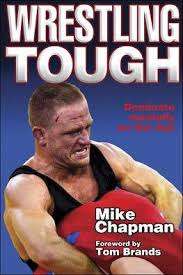 Wrestling Tough: Dominate Mentally on the Matt by Mike Chapman, 4/5
Filled with true stories of hard work, heart and the historic wins and losses of legendary wrestlers, this book helps put the small scrapes and bruises from my once-a-week wrestling class into perspective. Chapman provides an inspiring introduction to the wrestling greats and an in-depth exploration of the mental characteristics they seem to share with each other (and accomplished athletes in all sports). Probably the most useful thing I learned from this book is how important the mental game is–even someone who has put in the hard work to develop a talent can lose to a less talented person who wants it more. It’s not just about the physical moves, it’s about commitment, focus and knowing what you want.
While the book has a lot to offer, it frustratingly spends much more time describing winning qualities than explaining how to actually acquire them. Also, there is a logical weakness to the author’s approach–just because you can find examples of winners who have a certain attribute doesn’t mean that there aren’t winners who lack that attribute, or even losers who have it in buckets. In order to be truly compelling, I feel the book would have to focus not just on the characteristics of successful athletes, but how they differ from their less successful fellows.
Why I read it: Stephan Kesting mentioned it on grapplearts.com as one of his favorite sports psychology books, which put it on my radar. Trying to get in a good mental space for an upcoming BJJ tournament moved it up on my list.
Rebecca
 Rebecca by Daphne du Maurier, 4/5
This classic psychological thriller, with its unsettling, gothic atmosphere and ambiguously motivated characters, proves that “slow-burner” and “page-turner” are not mutually exclusive terms. Du Maurier knows how to reveal just enough to keep her readers hooked without letting them quite know what is going on. Ultimately, the characters seem a bit thin and the plot somewhat unsubstantial and uneven, but it’s the kind of book that will keep you up at night (reading, that is).
Why I read it: my mom watched the film versions, then got the book out of the library and enjoyed it.
Jasotron: 2012
 Jasotron: 2012: A FoxTrot Collection by Bill Amend, 4/5
Usually I’m not a big fan of humor that relies on pop cultural references, but Amend is legitimately funny at times and obviously a huge nerd, which is all I require in a cartoonist.
Why I read it: my brother got it out of the library and it ended up in my gym bag, fulfilling the important role of “backup book” (in case of unforeseen boredom). I ended up reading half of it while waiting at a Jack in the Box drive-thru for some idiot to collect their $60 order.
The Eustace Diamonds
 The Eustace Diamonds by Anthony Trollope, 4/5
Think Pride and Prejudice in reverse, minus the likeable characters and written by a man. I loved it! There was lots of gold digging, emotional manipulation, proposals of marriage, retractions of proposals of marriage, thievery and lies, all presented with the quaint respectability that permeates 19th-century British literature.
Why I read it: I wanted to try something by Trollope that wasn’t from his Chronicles of Barsetshire.
The Ra Expeditions
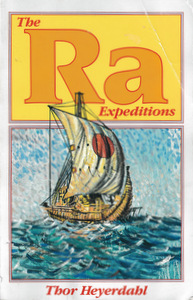 The Ra Expeditions by Thor Heyerdahl, 4/5
Heyerdahl is at it again, living out a real-life adventure story as he sails across the Atlantic in a boat made of reeds and rope. I love how the author researches and resurrects ancient technology, but I didn’t find this book to be as fresh and compelling as his account of the Kon-Tiki expedition. This was just a bit more calculated and agenda-driven, lacking the magical sense of adventure and soul that infused Heyerdahl’s earlier portrayal of his journey aboard the famous balsa wood raft. I suspect it was the Kon-Tiki fame and corresponding sense of responsibility that stole away some of the spontaneity of his earlier adventures.
N.B. I would suggest nobody buy this 1988 Scribner Laidlaw edition, which not only lacks the original photographs but, annoyingly, still includes captions for them.
Why I read it: My brother intended to reread it during our trip to Norway, but I hijacked it.

I took this photo of the Ra II while visiting the Kon-Tiki Museum in Oslo, Norway (March 2016).
The Meaning of It All
 The Meaning of It All: Thoughts of a Citizen-Scientist by Richard P. Feynman, 4/5
The rare combination of humility and genius is as beautiful as it is surprising, especially when encountered in one of the greatest physicists of the modern age. These three lectures, given at the University of Washington in 1963, explore a variety of unscientific topics–from politics to religion–and surprisingly, do not provide any answers. What they do give, however, is the opportunity to see non-scientific issues from the point of view of a scientific genius. This point of view is very different from the arrogant, condescending, closed-minded attitude that comes across from many figures in popular science, who seem to feel that their expertise in a narrow field qualifies them to make pronouncements on everything. In fact, the emotion that stands out most in these lectures is doubt. Not a lazy, depressing, hopeless sort of doubt, but a humble, searching doubt that fuels relentless curiosity. Feynman seems unwaveringly respectful of opinions and beliefs that contradict his own, while applying a formidable intellect and rational approach to the less scientific aspects of human existence.
Why I read it: I’ve enjoyed the two other books by Feynman I’ve read (QED and Six Easy Pieces) and jumped at the chance to read a less challenging book by him when I came across it in Henderson Books.
Good Food, Great Medicine
 Good Food, Great Medicine: A Mediterranean Diet and Lifestyle Guide (Third Edition) by Miles Hassell, MD, and Mea Hassell, 4/5
This homey guide to healthy living contains all the information I imagine one could possibly need about the Mediterranean diet and lifestyle, including medical research, advice on nutrition, sleeping habits and exercise, and a large collection of recipes. The authors’ approach is good-humored, unpatronizing and realistic–well-suited to the common-sense advice they give and the varying amounts of commitment they can expect from their readers. I haven’t tried any of the recipes, which is why I give the book four stars instead of five.
Eat more simple, natural food that is close to its original form and eat less prepackaged, processed or sugary junk…thanks in part, I guess, to a relatively healthy upbringing, most of this book fit into the “well, duh!” category for me and it is the duh-factor that I find most convincing about the Mediterranean lifestyle. This is no silver bullet, no gimmicky fad diet; it can’t be boiled down to “oh, I don’t eat carbs” or “I count calories” or “I fast intermittently” or “I only eat raw food,” etc. Unfortunately, there’s nothing very sexy about a well-balanced, natural, sustainable approach to eating that requires lots of common sense and self-control.
Self-control–there’s the rub. From both observation and first-hand experience, I’ve found that lack of self-control and lack of motivation, not lack of information, are at the root of unhealthy, excessive eating habits. Knowledge may be power but it isn’t will power. I can read a million studies about how doing x lowers your risk of dying by 35% and not doing y makes you 20% less likely to get cancer, but when I stop reading, it’s often because I need to put Nutella on my toast while it’s still warm. Still, we all make decisions every day that affect our health, whether positively or negatively; for me, this book’s value is in helping me make a few better, more informed, eating decisions than I might have made before. In this way, I hope to continue refining my approach to eating from merely counting calories to emphasizing those foods that are both good for me and make me feel good.
Why I read it: my dad had some heart trouble last year and his doctor recommended this book to him.
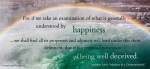
A picture quote I made:

A Modest Proposal and Other Satires
 A Modest Proposal and Other Satires by Jonathan Swift, 4/5
Swift combines wit, humour and venom in this collection of satires that attack everything from organized religion to politicians and fellow writers. The 18th-century language and references to now-obscure people and issues do not hinder this book’s continued relevance and, in my opinion, even enhance the timelessness of Swift’s observations–one of my favourite parts of reading very old literature is realizing how little people’s basic natures change with the passage of time.
Why I read it: One of Dad’s coworkers cited “A Modest Proposal” as his all-time favourite piece of literature, which made me curious to read it. Also, I’ve been meaning to read Gulliver’s Travels for quite a while and I thought it was in this collection (which it wasn’t).
I made a couple picture quotes for this book:

 OmniRambles