
Tagged: 4/5
All the Light We Cannot See

All the Light We Cannot See: A Novel by Anthony Doerr, 4/5
I could complain that this story lost me a bit near the end, but that could very well be a symptom of the pure exhaustion I was feeling at 1am, after reading the entire book in one day. While I can’t claim to be as emotionally traumatized (in a good way) as other reviewers seem to be, I did find this to be a well-crafted and beautifully-written work of historical fiction. I especially appreciated how the author was able to keep my interest equally in both the main character’s story arcs, despite switching between them for the bulk of the book in a way that would be annoying if not so thoughtfully done. A prominent MacGuffin and too little time spent weaving the two character’s stories together after they finally met, is all that keeps this from being a classic, in my opinion.
Why I read it: an oft-mentioned entry in the comments on an Instagram post about favorite (or most meaningful–I can’t remember which) books.
Save the Cat! Writes a Novel

Save the Cat! Writes a Novel: The Last Book on Novel Writing You’ll Ever Need by Jessica Brody, 4/5
Inspired by Blake Snyder’s “Save the Cat!” formula for screenwriting, author Jessica Brody breaks down the 15 basic plot points necessary for each of the 10 genres into which all stories can be categorized. Numerous examples and detailed breakdowns of famous novels are provided, making this a convincing, if somewhat tedious read.
Do I think it is necessary to follow a formula while writing a novel? Of course not. Does it steal the magic a bit to identify the unexpectedly unvaried elements that so many stories have in common? Yes, it does. But I can imagine that this handbook could be a lifesaver for a new or struggling author, or anyone looking to troubleshoot plot/pacing issues.
Why I read it: it was on a list of recommended resources for writers on my Instagram feed.
The Midnight Library
The Midnight Library: A Novel by Matt Haig, 4/5
It feels petty to complain that this deeply meaningful novel about existential crisis and regret boils down to a few cliches and wraps up a little too tidily–the fact remains that I read it greedily in one sitting, shedding a few tears in the process. I couldn’t shake an intense feeling that it was written just for me, which I’m sure is exactly how many other readers feel and is a testament to the author’s writing skill and insight into the mental struggles of modern existence.
Why I read it: an oft-mentioned entry in the comments on an Instagram post about favorite (or most meaningful–I can’t remember which) books.
100 Poems

100 Poems by Seamus Heaney, 4/5
I love that this collection of poems was hand-selected by Heaney’s wife and children after his death, not just to include his most loved and famous works, but ones that held personal significance and memories for his family as well. With that in mind, it felt like a privilege to read this collection and made it easier to focus on what I personally found beautiful and resonant, rather than feeling the need to make a value judgement about what I did not understand or connect with. One of my favorite moments was in the poem “Mossbawn: Sunlight,” when a baker is described as dusting the board with “a goose’s wing” (32).
On a separate topic, I want to take this opportunity to send some bad energy towards the fellow library user who felt that it was reasonable to make distracting pencil marks throughout the entire book. I erased every single one.
Why I read it: The author was featured on an episode of Antiques Road Trip and I was surprised that I had never heard of such a famous and beloved poet before.
Extreme Birds

Extreme Birds: the world’s most extraordinary and bizarre birds by Dominic Couzens, 4/5
This book delivers exactly what is promised on its front cover, packed with strange and astonishing facts that I expect would interest anyone (not just people who are into birds).
Why I read it: my husband bought it at a bookstore for some unknown reason.
Extreme Ownership
Extreme Ownership: How U.S. Navy Seals Lead and Win by Jocko Willink and Leif Babin, 4/5
This book’s layout is flawless: each chapter starts with an engaging war story, extracts a leadership principle for further analysis, and concludes with a real-life application to business. My only complaint is that the authors often stop short in each example of exploring the actual results of their approach, sometimes failing to address the outcome altogether and other times glossing over it with vague descriptions of generic success. The question left, for me, is not whether the authors are effective hammers, but what scenarios realistically constitute appropriate nails.
Why I read it: It’s been on my radar for quite a while.
The Art of Impossible

The Art of Impossible: A Peak Performance Primer by Steven Kotler, 4/5
The author believes that the average person can achieve groundbreaking results by finding and fulfilling their life passion, a process that he attempts to reduce into a series of replicable steps through analysis of the “flow” state, the characteristics of high achievers (in whose company he firmly places himself, with less-than-convincing self-deprecation), and grossly over-simplified neuroscience.
Ironically, this book both poses and fails its own test. Kotler attempts the impossible and succeeds in writing a book that is slightly unlikable, painfully over-systematized, and, crucially, ascribes prescriptive value to what I strongly suspect are merely descriptive (if well-researched and insightful) observations. This last failing is a pervasive one in the self-help genre and, if the author had promised less, it would be easier to focus instead on the book’s many positive aspects.
While I strongly doubt that one could make long-lasting and meaningful life changes merely from following the steps in this book, it does provide some helpful ideas to fine-tune and recognize good character qualities and habits that already exist and to understand a little of the brain chemistry behind concepts like motivation, creativity, and fear.
Why I read it: a recommendation from a gym friend.
Many Dimensions
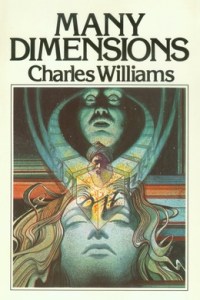
Many Dimensions by Charles Williams, 4/5
This spellbinding book must not be judged by this later edition’s psychedelic cover art or by a mere summary of its bizarre plot, in which an infinitely divisible holy relic empowers its keepers to travel through time and space. The story is, in fact, much more sophisticated than you might expect–peopled with interesting characters and exploring (often humorously) the political, social, and ethical ramifications of such an object’s existence. I felt the plot was a little weak towards the end, or it would have been a 5/5 for me.
Why I read it: I am working my way through Charles Williams’ seven supernatural novels.
Scars and Stripes

Scars and Stripes: An Unapologetically American Story of Fighting the Taliban, UFC Warriors, and Myself by Tim Kennedy and Nick Palmisciano, 4/5
At some point (I don’t even remember when), I got it in my head that Tim Kennedy was kind of an obnoxious d-bag, so I had zero interest in reading what I was sure would be an obnoxious and terribly-written autobiography. I wouldn’t have even known it existed if my husband hadn’t listened to the audio book and then proceeded to tell me stories from it until I ordered it from the library just to get him to shut up.
I couldn’t put it down. In about one chapter, I went from “eh, it’s ok for what it is” to staying up late into the night trying to find a slightly boring spot to stop reading. It’s not great literature, but man, is it great stories!
Why I read it: a recommendation from my husband.
The View from Saturday

The View from Saturday by E.L. Konigsburg, 4/5
A nuanced and well-written story, told from the perspectives of four individual middle schoolers and their teacher, who discover the transformative power of love and friendship as they compete in an academic bowl. Even though it is written for younger readers, the author doesn’t talk down or preach. This, combined with the varying first person perspectives and nonlinear timeline make for a challenging and meaningful reading experience at any age.
Why I read it: a recommendation from one of my students.

