Robinson Crusoe

robinson crusoe daniel defoe classics clubRobinson Crusoe by Daniel Defoe, 2/5

I have been familiar with the story of Robinson Crusoe since childhood, thanks to one of those tiny children’s abridgments that is equal parts text and illustrations, so I was pretty excited to finally get around to reading the real thing.  Surprisingly, I did not much enjoy this famous novel.

I was irritated, first off, to learn from the introduction that the author’s main talent lay in the believability of his straightforward writing style, which he used indiscriminately in the creation of propaganda for countless political pamphlets.  Now, I don’t expect authors of adventure stories to have SAS training, but I do have other criteria for fictional survival tales than “seems true.”  Because Defoe’s writing style is so very factual (which is a nice way of saying dry and prosaically detailed) and his preface to the book claims the title of nonfiction outright, I felt lied-to throughout.  Now this might not seem like a big deal; after all, isn’t all fiction basically a lie and all novelists liars?  But I feel that literature which attempts to coerce suspension of disbelief from its readers through deception lacks the authenticity and magic of literature that facilitates a willing suspension of disbelief.

It is not difficult to imagine that Robinson Crusoe was unprecedented when it was written back in 1719 and inspired a genre to some extent, but I found very little in it to admire and even littler to enjoy.

[Why I read it: Another one of those classics that just never made it onto my list until I found a nice vintage copy at the thrift store.]

How to Talk American

how to talk american jim mad monk crottyHow to Talk American: A Guide to Our Native Tongues by Jim “the Mad Monk” Crotty, 3/5

This haphazard collection of vernacularisms is fun, though not at all up to the standards of a proper dictionary.  I especially enjoyed the words spelled to reflect regional pronunciation, such as “PSDS” (pierced ears), “sssta” (sister), “dreckly” (soon.  “We’ll be at the store dreckly.”), and “tamar” (the day after today).

[Why I read it: came across it in the thrift store and thought it looked interesting.]

Democracy–The God That Failed

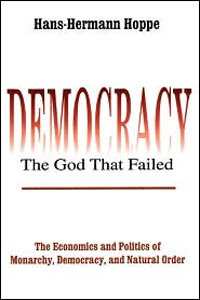
democracy the god that failed hans hermann hoppeDemocracy–The God That Failed: The Economics and Politics of Monarchy, Democracy, and Natural Order by Hans-Hermann Hoppe, 2/5

This series of essays starts out strong, with the author daring to question the hallowed concept of democracy and finding it severely lacking in several easily demonstrable ways.  However, common sense and strong opinions can only take you so far when it comes to formulating complicated theories of politics and economics.  As Hoppe’s ideas became more and more bizarre, I became increasingly angered by his failure to provide convincing supporting arguments or hard data of any kind.  I couldn’t figure out why an obviously intelligent academic would present his opinions so insultingly, through shallow reasoning, cheap rhetoric and gross oversimplification.  After quite a lot of teeth gnashing, I finally realised the problem was identified right in the first sentence of the book’s introduction: the essays were originally speeches written for Libertarian conferences.  The whole point was to fire up sympathetic audiences, not necessarily to convince anyone of anything.  I wish I’d known this ahead of time, because maybe then I’d have been spared the prospect of Hoppe’s horrifying “solution” to the problem of democracy: an “anarchic” private law society, overseen by military-grade private insurance corporations.

[Why I read it: it came up in conversation with my brother.]

Rich Dad’s Guide to Investing

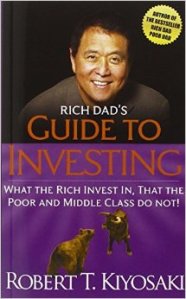
rich dads guide to investing robert t kiyosakiRich Dad’s Guide to Investing: What the Rich Invest In, That the Poor and Middle Class Do Not! by Robert T. Kiyosaki, 2/5

Given this book’s large size, I hoped to find a lot of helpful, practical information in it that would help me learn the basic concepts and vocabulary of investing and perhaps give some direction on how to best invest any “excess” cash I might accumulate.  Disappointingly, Kiyosaki’s anecdotal style, focus on generalities, and avoidance of technical terminology rendered the book almost completely unhelpful.  There are a couple interesting concepts, such as creating valuable businesses yourself instead of simply investing in other people’s businesses and using your business to purchase assets so that you can stay poor on paper and avoid paying tax.  Unfortunately, much of the information seemed pretty sketchy and the author provides very few examples of his ideas in action.  Overall, this book felt like a waste of time and casts a rather charlatan shade over Kiyosaki’s whole financial self-help enterprise.

[Why I read it: I’ve read several of Kiyosaki’s books and this one looked interesting.]

The Island of Sheep

island of sheep john buchanThe Island of Sheep by John Buchan, 3/5

This charming little story about a simple Norlander who, persecuted by a gang of ruthless criminals, enlists the aid of Richard Hannay and Co. is the last in the series, though why it was not included in The Four Adventures of Richard Hannay collection beats me.  There was much to like about the tale, but it was noticeably rife with clumsy references to Buchan’s other works and suffered from an extremely contrived plot.

[Why I read it: I meant to read it ever since reading the first four books in the Hannay series last year, but we didn’t own a copy then.  My sister got her hands on one somehow, but I wasn’t motivated to read it until she pulled it out recently for my mom, who enjoyed it a lot.]

Got Fight?

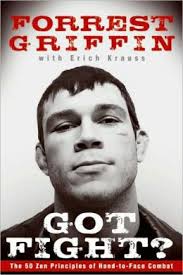
got fight forrest griffinGot Fight? The 50 Zen Principles of Hand-to-Face Combat by Forrest Griffin, with Erich Krauss, 4/5

This in-your-face manliness manifesto was much, much funnier than the front cover lead me to expect, what with its bashed-up author and stupid title (to which Griffin vociferously objected, to his credit).  What it is: an R-rated, surprisingly witty, expletive-filled, laugh-inducing series of ramblings that are mostly centered on martial arts and dubious advice about being a Man.  What it is not: a martial arts how-to guide or factual account of Griffin’s MMA experience.

[Why I read it: I love MMA and pounced on this after my dad picked it up at the thriftstore.]

The Best of Medical Humor

best of medical humor howard j bennettThe Best of Medical Humor: A Collection of Articles, Essays, Poetry, and Letters Published in the Medical Literature, compiled and edited by Howard J. Bennett, M.D., 1/5

This relentlessly unfunny book was a chore to read and there were a couple of times I almost gave up (in retrospect, I wish I had).  Doubtless, having a medical background would have made it more enjoyable, but that does not completely explain the lack of laughs; after all, I’ve largely found that quality humor transcends topic and is recognizable even when it is not entirely understandable (why else would Scottish sitcoms be so enjoyable?).  In this case, though, most of the pieces reminded me of mediocre speech-openers, whose appeal lies mainly in stating the obvious and evoking half-hearted laughs of recognition from an audience who has steeled itself for the extremely boring lecture that is to follow.  The rest of the book mostly contains stuffy parodies of medical writing, which I imagine would seem most funny if you came across them unexpectedly in a serious medical journal.

In addition, it seems cheap that no single author is more represented in the collection than the compiler himself.  The fact that so much of his own work made it through the rigorous sorting process he describes in the introduction (he read over 800 articles, only choosing ones that could “make him laugh” and were “the best”) is very off-putting.  Things that are more entertaining than someone who fancies himself a comedian include getting a popcorn kernel stuck in your teeth, driving around a corner while holding a very full cup of coffee in one hand and stepping into the shower with a new sunburn.

[Why I read it: found while browsing in the thrift store.]

Tom Jones

the history of tom jones a foundling henry fieldingThe History of Tom Jones, a Foundling by Henry Fielding, 4/5

This charmingly scandalous novel follows the escapades of one Tom Jones, whose good heart and good looks get him into rather more trouble than he seems to deserve.  The author’s moral point of view is unusual and surprisingly modern in that his most spiteful commentary is reserved for those characters that appear saintly on the surface but are truly hypocritical, selfish and devious.  Sins that have historically attracted more outspoken condemnation, such as sexual immorality, dishonesty, and theft, are all tolerantly chalked up to the imperfections of human nature in a manner that, while not condoning such behaviour, does seem surprisingly nonchalant.  Despite its length and the sordidness of some episodes, the book is a light and entertaining read, thanks to the very short chapters, the author’s outspoken [often hilariously so] commitment to not boring the reader, and the artful ease with which the reader is transported between scenes.  Perhaps because I have not read much 18th-century literature, Tom Jones reminds me a good deal of Tristram Shandy (written only 10 years later), but in much the same way that a beautiful rainbow might remind you of an oil puddle.

[Why I read it: It came up in conversation with Tom, a fellow choir member.]

Mockingbird

mockingbird walter tevisMockingbird by Walter Tevis, 5/5

In this touching story, set in an eerily believable dystopian future, Tevis explores what it means to be human–a well-worn topic that somehow finds fresh, new life under his sensitive but sure hand.  I quite liked how the story unfolded when approached with rather less preknowledge than could be gained from the previous sentence, so I will leave this review suitably sparse.  Suffice it to say that the author’s insight into the human condition combines with the book’s accessibility, immediacy and artistic merit to outshine, in my opinion, other novels in the genre, such as Brave New World and 1984.

[Why I read it: A recommendation from my friend, Alison.]


Deeper Thoughts

deeper thoughts jack handeyDeeper Thoughts by Jack Handey, 5/5

This is a hilarious collection of random, unreasonably funny quotes, such as:

“Probably the earliest fly swatters were nothing more than some sort of striking surface attached to the end of a long stick.”

“I wish my name was Todd, because then I could say, ‘Yes, my name’s Todd.  Todd Blankenship.’  Oh, also I wish my last name was Blankenship.”

“Sometimes I think I’d be better off dead.  No, wait.  Not me, you.”

[Why I read it: I came across the book in the thrift store and recognized the author from reading his stuff online.  I bought the book for my brother, Samuel, but had to read it before sending it to him.]