
Category: Reviews
Rich Dad’s Guide to Investing
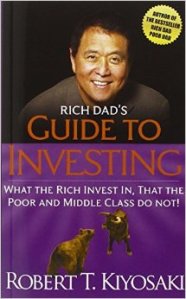 Rich Dad’s Guide to Investing: What the Rich Invest In, That the Poor and Middle Class Do Not! by Robert T. Kiyosaki, 2/5
Given this book’s large size, I hoped to find a lot of helpful, practical information in it that would help me learn the basic concepts and vocabulary of investing and perhaps give some direction on how to best invest any “excess” cash I might accumulate. Disappointingly, Kiyosaki’s anecdotal style, focus on generalities, and avoidance of technical terminology rendered the book almost completely unhelpful. There are a couple interesting concepts, such as creating valuable businesses yourself instead of simply investing in other people’s businesses and using your business to purchase assets so that you can stay poor on paper and avoid paying tax. Unfortunately, much of the information seemed pretty sketchy and the author provides very few examples of his ideas in action. Overall, this book felt like a waste of time and casts a rather charlatan shade over Kiyosaki’s whole financial self-help enterprise.
[Why I read it: I’ve read several of Kiyosaki’s books and this one looked interesting.]
The Island of Sheep
 The Island of Sheep by John Buchan, 3/5
This charming little story about a simple Norlander who, persecuted by a gang of ruthless criminals, enlists the aid of Richard Hannay and Co. is the last in the series, though why it was not included in The Four Adventures of Richard Hannay collection beats me. There was much to like about the tale, but it was noticeably rife with clumsy references to Buchan’s other works and suffered from an extremely contrived plot.
[Why I read it: I meant to read it ever since reading the first four books in the Hannay series last year, but we didn’t own a copy then. My sister got her hands on one somehow, but I wasn’t motivated to read it until she pulled it out recently for my mom, who enjoyed it a lot.]
Got Fight?
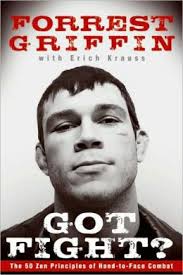 Got Fight? The 50 Zen Principles of Hand-to-Face Combat by Forrest Griffin, with Erich Krauss, 4/5
This in-your-face manliness manifesto was much, much funnier than the front cover lead me to expect, what with its bashed-up author and stupid title (to which Griffin vociferously objected, to his credit). What it is: an R-rated, surprisingly witty, expletive-filled, laugh-inducing series of ramblings that are mostly centered on martial arts and dubious advice about being a Man. What it is not: a martial arts how-to guide or factual account of Griffin’s MMA experience.
[Why I read it: I love MMA and pounced on this after my dad picked it up at the thriftstore.]
The Best of Medical Humor
 The Best of Medical Humor: A Collection of Articles, Essays, Poetry, and Letters Published in the Medical Literature, compiled and edited by Howard J. Bennett, M.D., 1/5
This relentlessly unfunny book was a chore to read and there were a couple of times I almost gave up (in retrospect, I wish I had). Doubtless, having a medical background would have made it more enjoyable, but that does not completely explain the lack of laughs; after all, I’ve largely found that quality humor transcends topic and is recognizable even when it is not entirely understandable (why else would Scottish sitcoms be so enjoyable?). In this case, though, most of the pieces reminded me of mediocre speech-openers, whose appeal lies mainly in stating the obvious and evoking half-hearted laughs of recognition from an audience who has steeled itself for the extremely boring lecture that is to follow. The rest of the book mostly contains stuffy parodies of medical writing, which I imagine would seem most funny if you came across them unexpectedly in a serious medical journal.
In addition, it seems cheap that no single author is more represented in the collection than the compiler himself. The fact that so much of his own work made it through the rigorous sorting process he describes in the introduction (he read over 800 articles, only choosing ones that could “make him laugh” and were “the best”) is very off-putting. Things that are more entertaining than someone who fancies himself a comedian include getting a popcorn kernel stuck in your teeth, driving around a corner while holding a very full cup of coffee in one hand and stepping into the shower with a new sunburn.
[Why I read it: found while browsing in the thrift store.]
Tom Jones
 The History of Tom Jones, a Foundling by Henry Fielding, 4/5
This charmingly scandalous novel follows the escapades of one Tom Jones, whose good heart and good looks get him into rather more trouble than he seems to deserve. The author’s moral point of view is unusual and surprisingly modern in that his most spiteful commentary is reserved for those characters that appear saintly on the surface but are truly hypocritical, selfish and devious. Sins that have historically attracted more outspoken condemnation, such as sexual immorality, dishonesty, and theft, are all tolerantly chalked up to the imperfections of human nature in a manner that, while not condoning such behaviour, does seem surprisingly nonchalant. Despite its length and the sordidness of some episodes, the book is a light and entertaining read, thanks to the very short chapters, the author’s outspoken [often hilariously so] commitment to not boring the reader, and the artful ease with which the reader is transported between scenes. Perhaps because I have not read much 18th-century literature, Tom Jones reminds me a good deal of Tristram Shandy (written only 10 years later), but in much the same way that a beautiful rainbow might remind you of an oil puddle.
[Why I read it: It came up in conversation with Tom, a fellow choir member.]
Mockingbird
 Mockingbird by Walter Tevis, 5/5
In this touching story, set in an eerily believable dystopian future, Tevis explores what it means to be human–a well-worn topic that somehow finds fresh, new life under his sensitive but sure hand. I quite liked how the story unfolded when approached with rather less preknowledge than could be gained from the previous sentence, so I will leave this review suitably sparse. Suffice it to say that the author’s insight into the human condition combines with the book’s accessibility, immediacy and artistic merit to outshine, in my opinion, other novels in the genre, such as Brave New World and 1984.
[Why I read it: A recommendation from my friend, Alison.]
Deeper Thoughts
 Deeper Thoughts by Jack Handey, 5/5
This is a hilarious collection of random, unreasonably funny quotes, such as:
“Probably the earliest fly swatters were nothing more than some sort of striking surface attached to the end of a long stick.”
“I wish my name was Todd, because then I could say, ‘Yes, my name’s Todd. Todd Blankenship.’ Oh, also I wish my last name was Blankenship.”
“Sometimes I think I’d be better off dead. No, wait. Not me, you.”
[Why I read it: I came across the book in the thrift store and recognized the author from reading his stuff online. I bought the book for my brother, Samuel, but had to read it before sending it to him.]
Alex & Me
 Alex & Me: How a Scientist and a Parrot Uncovered a Hidden World of Animal Intelligence–and Formed a Deep Bond in the Process by Irene M. Pepperberg, 2/5
Readers looking for more than a heartwarming animal story will be disappointed by this relentlessly unscientific book. Pepperberg spends more time complaining about being unappreciated by the scientific community, blatantly anthropomorphizing her parrot and giving unsubstantiated anecdotes of Alex’s human-like behaviour than providing anything of academic interest. I was annoyed right from the beginning of the punishingly emotive first chapter, which is all about the emotional trauma that Alex’s death caused the author. Pepperberg appreciatively quotes a letter from a lady who said the parrot’s demise caused her as much grief as the death of her only child, even though this long-distance sympathiser had never even met Pepperberg or Alex! Now that’s just crazy talk, but the author treats it as a matter of course. While some interesting comments are made about the model/rival method of teaching (where the learner observes two trainers interacting), no satisfying explanation is given of the time between Alex being taught, with difficulty, his first word and Alex spontaneously spouting grammatically correct, complete sentences in response to complex social scenarios. Given Pepperberg’s credentials, I can only assume that she is a legitimate scientist, but this book is not at all convincing.
[Why I read it: frustratingly, this book has been sitting by my bed for so long that I can’t even remember why I ordered it from the library in the first place. I think it might have been mentioned in some other book I read.]
Daniel Deronda
 Daniel Deronda by George Eliot, 4/5
This novel is unexpectedly strange and deeply psychological–not at all your typical 19th-century fare. The author flouts expectations in almost all aspects of the book, from the construction and flow of the plot, to the characters, their motivations and their relationships with each other. Most immediately noticeable is the relative absence of the eponymous Daniel Deronda throughout the first half of the story; instead, the author focuses extensively on Gwendolen Harleth, a flawed character who is as beautiful and vivacious as she is small-minded and self-centred. Many of the character traits that a more romantic author, such as Jane Austen, would employ in the creation of a heroine are used by Eliot to create an anti-heroine whose faults are unsettling in their similarity to the virtues of, say, Eliza Bennet from Pride and Prejudice. Likewise, Deronda, when he does make an appearance, is not at all the dashing hero you might expect but rather introspective, reserved and overly-conscientious. His moral influence on Gwendolen makes for a uniquely uneasy relationship that is at once intensely meaningful and unusually platonic. Other interesting characters abound, many possessing well-developed psyches that render them as complicated yet predictable as real life.
Another unusual aspect of this book is the author’s increasing focus on Jewish culture and Judaism in the second half. Perhaps my general lack of interest in the topic made me more easily bored, but several of the theological and philosophical sections were difficult to get through with a good attitude and I found the Jewish characters to be a little flat and uncharacteristically (for the author) stereotypical. Eliot seemed too eager to incorporate her extensive studies on the topic into the story, which came off as a bit academic and unnatural. Also, the concept that an innate sense of national identity can survive in someone, independent of their upbringing, does not seem plausible to me and I felt the story suffered as a result of the author’s reliance on this idea. All in all, though, this book is well worth reading and truly stands alone in its genre, though some of the unusual aspects that constitute its strengths also contribute to its weaknesses.
[Why I read it: I watched the BBC miniseries (because it had Edward Fox in it) and enjoyed it enough to want to check the book out.]
One More Thing
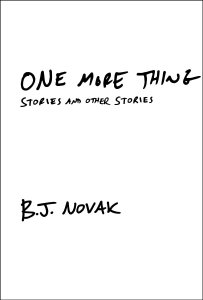 One More Thing: Stories and Other Stories by B.J. Novak, 4/5
A great sense of comedic timing, a keen eye for observation and a healthy appreciation for the potential absurdity of the ordinary combine to make this collection of short stories, poems and miscellanea an entertaining and thought-provoking (but mostly entertaining) experience. My favourite story was probably “The Man Who Invented the Calendar” though “The Girl Who Gave Great Advice” was also hilarious. If Novak writes more, I will definitely read more.
[Why I read it: Book Guy Reviews’ enthusiastic write-up of this book was convincing.]
 OmniRambles