
Category: Reviews
Your Money or Your Life
 Your Money or Your Life: 9 Steps to Transforming Your Relationship with Money and Achieving Financial Independence by Vicki Robin and Joe Dominguez with Monique Tilford, 3/5
Comparing this book to Robert Kiyosaki’s Rich Dad series, it soon becomes clear that the concept of financial independence means different things to different people. To some, such as Kiyosaki, it seems to mean being able to live a luxurious lifestyle, supported by more money than they could possibly spend. Unfortunately, this seems to coincide with dedicating your life to the all-engrossing pursuit of ever-increasing income, which at the end doesn’t really look like independence to me. To those who see financial independence more as freedom from obsessive worry over money, Your Money or Your Life asks a question that Kiyosaki would find completely nonsensical: How much money is enough? It turns out that, thanks to some inexplicable vagary of the human condition, more and more money does not necessarily equal more and more happiness. The authors argue convincingly that peak fulfillment occurs when we have enough money for the things we need and a little bit more. By this metric, financial independence is achieved when one’s passive income covers these basic expenses and little luxuries.
Given the mindless consumerism endemic to the average American, it is no surprise that the authors would choose to focus on the low-hanging fruit of lowering expenses rather than the more complicated issue of creating passive income. Similar to keeping a food diary in order to lose weight, the mere act of tracking expenses, realizing the expended life-energy they represent and assessing the resulting feelings of fulfillment or lack thereof could be a relatively painless way to increase savings, lower debt and create a healthier relationship with money. However, my personal saving rate is already so high and my expenses so low (my three main hobbies–reading, exercising and surfing the internet–cost less than most people’s coffee habit) that I don’t think any life-changing revelations would come out of applying the book’s method for tracking finances.
I am much more interested in developing sources of passive income, which is a topic that is not addressed very well in this book. This was very disappointing and surprising, since passive income plays such a huge part in the book’s own description of financial independence. The authors’ main (basically, only) advice is simply to buy U.S. treasury bonds. As far as I can understand, you’d have to tie up about $350k in 30-year treasury bonds in order to make just $10k a year at the current 2.87% yield. I don’t see how this could be a viable path to financial independence for most people, but I guess I need to do more research.
[Why I read it: It was mentioned in a book review of Rich Dad, Poor Dad by Trent Hamm on The Simple Dollar blog.]
Present Concerns
 Present Concerns: A Compelling Collection of Timely, Journalistic Essays by C.S. Lewis, 4/5
The necessarily limited length of these articles means that Lewis doesn’t have time to fully develop and defend his opinions, but they are still a joy to read and cover a stimulating variety of topics (in addition to the ever-present subject of Christianity) such as history, philosophy, education, and morality. Some of the essays have not aged well and some would be of little interest to the average reader, but overall they are a nice supplement to Lewis’ more in-depth works.
[Why I read it: It seems that just when I think I’ve read everything C.S. Lewis ever wrote, something else turns up. I think I picked this unfamiliar title up at some used bookstore or other.]
The Book of Hours
 The Book of Hours by Davis Bunn, 2/5
I don’t think I’d ever read a “Christian romance” before, but now I feel as if I’ve read every single one ever written. Almost everything about this book was cliched, from the handsome widower trying to escape his grief to the beautiful and independent female doctor who develops an immediate (and spoiler temporary) disliking for him. To be fair, the archetypes were intrinsically appealing, it was a lot less preachy than could be expected, and there were even some artistic touches: an insightful sentiment here and there, or a deft description. But ultimately, nothing could compensate for deficiencies of plot and characterization, which were contrived, worn-out and predictable all around. The plot was especially lame–a Nancy Drew take on National Treasure with some “Touched by an Angel” thrown in; however, as an antidote to my last read, Kafka, it was not entirely unwelcome.
[Why I read it: my brother’s mother-in-law thought I might enjoy it and thoughtfully gave me a copy. There was no dust cover, so I thought it was historical fiction…]
The Metamorphosis and Other Stories
 The Metamorphosis and Other Stories by Franz Kafka, translated by Stanley Appelbaum, 2/5
I’m not sure which of these five short stories were worse, the three that made some sort of sense or the two that didn’t. The first piece, “The Judgement,” initially impressed me with Kafka’s more than competent writing skill and eye for detail. However, the end of what could only be loosely termed a “story” left me bewildered. Still trusting, I reread the main bits carefully, thinking that perhaps I’d missed some important detail or was simply not smart enough to understand. Finally, I resorted to the relevant Wikipedia article. Now I have a pretty good nose for bullshit and my eyes started watering with the stench almost immediately. Is the story a commentary on the conflict between a world of “vital existence in which probability and reservation rule” and a world “in which every step has an incalculable importance because it is taken under the horizon of an absolute summons to the road,” or is it a load of old bollocks imparting nothing but the vague flavour of some unspecified psychosis? Since I’ve cleverly managed to include my answer to that question inside the question itself, we’ll move right along to the other “chocolate chips” in this raisin cookie.
“The Metamorphosis” was the most readable piece–a miserably surreal little tale that left me feeling depressed and wondering why the author even bothered with it. “In the Penal Colony” was even more unpleasant, but the hint of deep psychological meaning and political commentary made it feel less pointless, at least. “A Report to an Academy,” the story of an ape who became a man, was almost funny and probably the least off-putting work in the collection, though nothing that would make an author famous. Finally that nonsensical nightmare “A Country Doctor,” which might as well have been included in its original German for all the sense it made.
Nothing makes one feel quite like an ignoramus as much as not “getting” a famous literary work. However, my first exposure to Kafka gives me the distinct sense that his fame comes from the self-congratulation of literary critics, psychologists and scholars who find endless theses in his tangled writings, only brought to the public eye through tireless promotion (one could almost say, exploitation) by his rather sketchy friend, Max Brod.
[Why I read it: Another one of those classics that didn’t make it onto my reading list until I came across it in the thrift store. I actually started reading it while in the middle of Forrest Griffin’s Be Ready When the Sh*t Goes Down because I needed something else (for obvious reasons) to fill the hour between doors opening and the start of Ax Fighting #51 (featuring martial artists, not crazed lumberjacks, unfortunately).]
Be Ready When the Sh*t Goes Down
Be Ready When the Sh*t Goes Down: A Survival Guide to the Apocalypse by Forrest Griffin and Erich Krauss, 3/5

 This book is extremely crude and full of hilariously bad advice, but is also somehow endearingly funny. Definitely not a book you’d want to read in public or, for that matter, send your mom and little sister to pick up for you at the library (true story)…
[Why I read it: I enjoyed Griffin’s other book Got Fight.]
Robinson Crusoe
 Robinson Crusoe by Daniel Defoe, 2/5
I have been familiar with the story of Robinson Crusoe since childhood, thanks to one of those tiny children’s abridgments that is equal parts text and illustrations, so I was pretty excited to finally get around to reading the real thing. Surprisingly, I did not much enjoy this famous novel.
I was irritated, first off, to learn from the introduction that the author’s main talent lay in the believability of his straightforward writing style, which he used indiscriminately in the creation of propaganda for countless political pamphlets. Now, I don’t expect authors of adventure stories to have SAS training, but I do have other criteria for fictional survival tales than “seems true.” Because Defoe’s writing style is so very factual (which is a nice way of saying dry and prosaically detailed) and his preface to the book claims the title of nonfiction outright, I felt lied-to throughout. Now this might not seem like a big deal; after all, isn’t all fiction basically a lie and all novelists liars? But I feel that literature which attempts to coerce suspension of disbelief from its readers through deception lacks the authenticity and magic of literature that facilitates a willing suspension of disbelief.
It is not difficult to imagine that Robinson Crusoe was unprecedented when it was written back in 1719 and inspired a genre to some extent, but I found very little in it to admire and even littler to enjoy.
[Why I read it: Another one of those classics that just never made it onto my list until I found a nice vintage copy at the thrift store.]
How to Talk American
 How to Talk American: A Guide to Our Native Tongues by Jim “the Mad Monk” Crotty, 3/5
This haphazard collection of vernacularisms is fun, though not at all up to the standards of a proper dictionary. I especially enjoyed the words spelled to reflect regional pronunciation, such as “PSDS” (pierced ears), “sssta” (sister), “dreckly” (soon. “We’ll be at the store dreckly.”), and “tamar” (the day after today).
[Why I read it: came across it in the thrift store and thought it looked interesting.]
Democracy–The God That Failed
 Democracy–The God That Failed: The Economics and Politics of Monarchy, Democracy, and Natural Order by Hans-Hermann Hoppe, 2/5
This series of essays starts out strong, with the author daring to question the hallowed concept of democracy and finding it severely lacking in several easily demonstrable ways. However, common sense and strong opinions can only take you so far when it comes to formulating complicated theories of politics and economics. As Hoppe’s ideas became more and more bizarre, I became increasingly angered by his failure to provide convincing supporting arguments or hard data of any kind. I couldn’t figure out why an obviously intelligent academic would present his opinions so insultingly, through shallow reasoning, cheap rhetoric and gross oversimplification. After quite a lot of teeth gnashing, I finally realised the problem was identified right in the first sentence of the book’s introduction: the essays were originally speeches written for Libertarian conferences. The whole point was to fire up sympathetic audiences, not necessarily to convince anyone of anything. I wish I’d known this ahead of time, because maybe then I’d have been spared the prospect of Hoppe’s horrifying “solution” to the problem of democracy: an “anarchic” private law society, overseen by military-grade private insurance corporations.
[Why I read it: it came up in conversation with my brother.]
Rich Dad’s Guide to Investing
 Rich Dad’s Guide to Investing: What the Rich Invest In, That the Poor and Middle Class Do Not! by Robert T. Kiyosaki, 2/5
Given this book’s large size, I hoped to find a lot of helpful, practical information in it that would help me learn the basic concepts and vocabulary of investing and perhaps give some direction on how to best invest any “excess” cash I might accumulate. Disappointingly, Kiyosaki’s anecdotal style, focus on generalities, and avoidance of technical terminology rendered the book almost completely unhelpful. There are a couple interesting concepts, such as creating valuable businesses yourself instead of simply investing in other people’s businesses and using your business to purchase assets so that you can stay poor on paper and avoid paying tax. Unfortunately, much of the information seemed pretty sketchy and the author provides very few examples of his ideas in action. Overall, this book felt like a waste of time and casts a rather charlatan shade over Kiyosaki’s whole financial self-help enterprise.
[Why I read it: I’ve read several of Kiyosaki’s books and this one looked interesting.]
The Island of Sheep
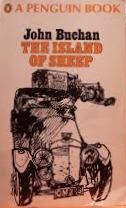 The Island of Sheep by John Buchan, 3/5
This charming little story about a simple Norlander who, persecuted by a gang of ruthless criminals, enlists the aid of Richard Hannay and Co. is the last in the series, though why it was not included in The Four Adventures of Richard Hannay collection beats me. There was much to like about the tale, but it was noticeably rife with clumsy references to Buchan’s other works and suffered from an extremely contrived plot.
[Why I read it: I meant to read it ever since reading the first four books in the Hannay series last year, but we didn’t own a copy then. My sister got her hands on one somehow, but I wasn’t motivated to read it until she pulled it out recently for my mom, who enjoyed it a lot.]

