
Category: Book Reviews
Tapped Out
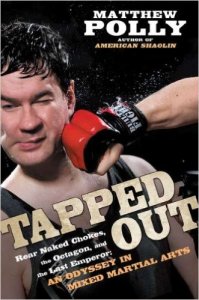 Tapped Out: Rear Naked Chokes, the Octagon, and the Last Emperor: An Odyssey in Mixed Martial Arts by Matthew Polly, 5/5
This entertaining account of a middle-aged writer’s transformation from overweight fixer-upper with a distant background in kung fu to competent mixed martial artist is impossible to put down–I started it at 2am last night, meaning to read just a little before falling asleep, and the next thing I knew it was 2.5 hours later and I was on the last page. Polly is a good writer with a great sense of humour and seems to know how to embellish a story without exaggerating it all out of proportion. Famous figures in MMA appear throughout and I’ll admit to a few fan-girl squeals along the way. Probably the fact that I’ve been doing a lot of kickboxing, grappling and Brazilian jiu-jitsu this year made the book even more enjoyable–a lot of Polly’s experiences as a beginner were hilariously relatable. I enjoyed the book so much that I’ve already ordered Polly’s American Shaolin from the library.
[Why I read it: I came across it while looking for BJJ books in the library database.]
Niccolò Rising
 Niccolò Rising by Dorothy Dunnett, 2/5
This dense historical fiction starts with a barrage of names and characters reminiscent of the panic-inducing first chapter of Tolstoy’s War and Peace. Unfortunately, the barrage doesn’t seem to let up and I spent most of the book feeling both unable and unwilling to follow all the subtle intrigues and sift through previous pages for hints about who that one guy is and what on earth his cryptic comments mean. At first, I blamed myself for reading too quickly or not being smart enough to understand the intricacies of the story. Then, I started to suspect that the author was responsible for the frustrating obscurity with which the book tangled along and purposefully used inscrutable characters to half-hint at important aspects of the plot through scenes and conversations that would only make sense in retrospect (if then).
In addition, I didn’t feel that the author did a very good job of integrating the story with its historical setting in 15th-century Bruges. The characters didn’t feel real, the dialogues all felt very modern and there were those dreaded episodes where “history” happens, G. A. Henty style–the story is paused so that a dry list of historical events can take place, consisting of stuff like Duke So and So having a battle with ex-King What’s His Name over some historical province that I can’t be bothered to take out an atlas to locate. For a story that hinges on character development (this is only the first of eight books in the series about Niccolò, a bastard dyer’s apprentice who makes his way to the top of the food chain), there wasn’t much development. Yes, some of the characters were complicated, but mostly because they acted unpredictably and inconsistently. Dunnett seems to think that it’s deep to make a character act out of character, but if the action is not a result of believable motives and growth, then the effect is off-putting, not illuminating. I didn’t really like or understand many of the characters in the book and certainly can’t face reading the second book in the series.
Now, I am no fan of historical fiction in general, so I can understand that Dunnett has many loyal admirers and I can even imagine a reader who might adore this book: someone with a long attention span, lots of free time and an unhealthy interest in the prosaic details of historical economics and politics (or at least, a willingness to be bribed into tolerance of these details by the promise of a sex scene or two).
[Why I read it: it was passed on to me in defeat by Tom from choir (whose reference in conversation to Tom Jones happily inspired me to read that classic), who in turn received it from fellow choir member Paula.]
Back Home
 Back Home by Bill Mauldin, 2/5
Tedious political ramblings accompany this collection of aged cartoons by celebrated WWII cartoonist Bill Mauldin, who obviously had a rough transition back to a civilian career after the war. I’ve always been put off by political cartoons in general because they tend to over-simplify complicated issues, mindlessly ridicule opposing viewpoints and, crucially, are usually not even funny. The cartoons in this book are no exception and, I think, would appeal to few readers besides fans of Mauldin and those who are interested in an inside view of one person’s perspective of the political climate in post-WWII United States.
[Why I read it: I recognized Mauldin’s name and liked what I had previously seen of his army cartoons.]
The Runagates Club
 The Runagates Club by John Buchan, 3/5
The twelve short stories in this collection rely a little too much on the supernatural for my taste, but are still good fun and feature such familiar friends as Sir Richard Hannay, John Palliser-Yeates, Lord Lamancha and Sir Edward Leithen.
[Why I read it: I love Buchan and added this book to the pile by my bed after I saw a family member reading it.]
The Wombles
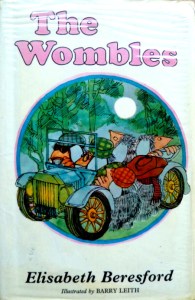 The Wombles by Elisabeth Beresford, 4/5
I may be twenty years older than the target audience, but I still enjoyed reading this charming British children’s classic.
[Why I read it: I recognized the title while browsing in the thrift store.]
Crap Towns
 Crap Towns: The 50 Worst Places to Live in the UK, edited by Sam Jordison and Dan Kieran, 3/5
Towns filled with soulless concrete architecture and jobless, shell suit-wearing inhabitants are prominent features in this entertaining collection of complaints and critiques (many of them written and submitted by each town’s own inhabitants). Almost more entertaining than the variety of inventive insults and tongue-in-cheek taunts are the rebuttals by MPs and county council members, which are hilarious in corresponding degree to their seriousness.
[Why I read it: the title caught my eye as I was browsing in the thrift store.]
The Organized Mind
 The Organized Mind: Thinking Straight in the Age of Information Overload by Daniel J. Levitin, 4/5
I didn’t enjoy reading this book very much; it does not seem well focused, does not flow very well and flip-flops annoyingly between information that is too technical to be useful and organizational ideas that are too simplistic. In one paragraph, the author explains that the enzyme catechol-O-methyltransferase regulates dompamine and noradrenaline in the prefrontal cortex, in another he suggests the not-exactly-earth-shattering idea of writing things down instead of trying to remember everything.
That said, there were still a lot of very interesting concepts in this book and several of the things I learned merited being read aloud to the family or being brought up in conversation over the last few days. For example, it should be common knowledge by now that multitasking is not a thing, but did you know that watching TV while studying can actually cause the information you learn to be stored in the wrong part of your brain? That’s powerful stuff. Or that humans naturally tend toward a bimodal sleeping pattern that includes two four or five hour chunks, separated by an hour or two of wakefulness in the middle of the night and supplemented by an afternoon nap?
In my opinion, this book can’t hold a candle to Thinking Fast and Slow by Daniel Kahneman (who, along with his partner Amos Tversky, is referenced quite often in The Organized Mind), but Levitin compensates for a sub-ideal reading experience by the fascinating and varied topics he explores.
[Why I read it: My friend, Joy, recommended it to me.]
Law of Connection
 Law of Connection: The Science of Using NLP to Create Ideal Personal and Professional Relationships by Michael J. Losier, 2/5
Losier is off to a bad start right from the subtitle of this unsubstantial book, which contains nothing scientific that can be used towards the patently ridiculous goal of creating “ideal” relationships. Starting with a hokey 15-question quiz to establish your communication style as visual, auditory, kinesthetic or digital, Losier quickly moves to generic descriptions of the styles and canned keywords and phrases for each that can be used to create “rapport.” Perhaps it’s a digital thing, but I’m pretty sure my brain intuitively understands that “how does this look to you?” “how does this sound to you?” “how do you feel about this?” and “what do you think about this?” all mean approximately the same thing. I highly doubt that I’d feel some magical connection with someone who has figured out my communication style and altered the wording of their question accordingly. The whole exercise is kind of self-defeating anyway–what happens if everyone tries to suit everyone else’s communication style? How could you figure out someone’s style if they were choosing their vocabulary based on what they think your style is?
As far as identifying nonverbal characteristics of the different communication styles, Losier often succumbs to that well-known “Facebook quiz” technique of creating generic descriptions that would apply equally to a variety of styles. I’m pretty sure it’s not just visual communicators who would be annoyed if you started and ended meetings late, or just auditory communicators who would prefer you not to speak to them in a harsh tone, or just kinesthetic communicators who would be hurt by feeling excluded, or just digital communicators who would like to be acknowledged for their contributions.
Since the book doesn’t contain much information about the concepts of neuro-linguistic programming in general, I checked out the relevant Wikipedia article and was not surprised to find it labeled a “largely discredited psuedoscience.”
[Why I read it: it was recommended to me by my friend, Joy.]
Born to Run
 Born to Run: A Hidden Tribe, Superathletes, and the Greatest Race the World Has Never Seen by Christopher McDougall, 4/5
It’s no wonder this entertaining tale is a bestseller that helped fuel the natural running craze–it has all the right ingredients: a mysterious Mexican tribe renowned for long-distance running ability, a legendary and equally mysterious American runner who gained their trust, superhuman athletes running ultramarathons in unbelievably punishing conditions, scientific evidence that natural running is…well…natural, and all told from an intoxicating “everyman” perspective that makes you feel that you too could learn to run forever.
As an inspiring story, I give it full points. But. As an ethnography or scientific case for natural running, not so much.
Yes, I am an unattractively skeptical person, but I’ve been burned before (see The Long Walk and The Third Eye) and something definitely smells fishy about this book. It is an issue of trust and McDougall doesn’t exactly make it easy for the suspicious reader. Thanks to the paucity of corroborating material online and the book’s lack of citations, endnotes, and pictures, one must simply trust that McDougall is telling a true story and not succumbing unduly to the temptation to sensationalize, romanticize and otherwise manipulate the truth. The author’s background in journalism is not enough to assuage my suspicion that much was sacrificed in the interest of The Story.
McDougall’s case for natural running features interviews with various experts in the field and interesting statistics/studies, but his approach is one-sided, oversimplifying a complicated topic that is still much debated and far from resolved. Also, if “a little learning is a dangerous thing” then readers beware–there is very little technical, practical information to arm the newly-inspired disciple of natural running. However, the author undoubtedly achieves what seems to be his main goals–general entertainment and inspiration.
[Why I read it: My dad was sorting through some of his books and thought I might be interested.]
The Illustrated Gormenghast Trilogy
 Titus Groan, Gormenghast and Titus Alone by Mervyn Peake, 3/5
Possessing the writing style of an orphan love child of J.R.R. Tolkien and Charles Dickens, Peake sees the world through rotting-salmon colored glasses and creates a gloomy trilogy that is, for all its sprawling imaginativeness, unsettlingly grim and ghastly. Perhaps readers who are less sensitive to words’ connotations, sounds, and tastes would be less disturbed, but I was continually galled by Peake’s preference for off-putting, unpleasant language. The opening paragraph alone contains several good examples: the castle of Gormenghast is surrounded by “mean dwellings that swarmed like an epidemic around its outer walls” and one of its towers, “patched unevenly with black ivy, arose like a mutilated finger from among the fists of knuckled masonry and pointed blasphemously at heaven.”
So what, you might think, he’s just describing a creepy old castle. But no, almost everything is treated similarly. A candelabrum is “like a vast spider suspended by a metal chord,” a character’s teeth are like “two brand new rows of gravestones,” the morning sky is “awakening air quilled with blood,” and a lone cloud is “like a wing ripped from the body of an eagle.” Almost all of the characters are portrayed repellently and most posses gross names such as Rottcodd, Mr. Flay, Swelter, Steerpike, Nannie Slagg, Doctor Prunesquallor, Lord Sepulchrave Groan, Sourdust…and many more. It is not often that a reader is presented with so many characters and so few of them likeable.
The first two novels are partly redeemed, in my mind, by their vivid portrayal of many memorable characters and an imaginative setting for a plot that contains several exciting episodes and a few moving ones. I think the first two books are much stronger without the third, which was disjointed–almost incomprehensible at times–and ended poorly (it is not surprising to learn that it was cobbled together from the manuscripts of a dying author).
My review would not feel complete without mentioning Peake’s skilled illustrations, which were scattered generously throughout the text. It is so unusual to encounter an author who is capable of drawing what he writes (I always felt sorry for Tolkien in this respect). Also noteworthy is the author’s prodigious vocabulary. Between pages 309 and 793 (the trilogy is almost a thousand pages long, but it took me a while to realize that the strange words were going to keep popping up, then even longer to get tired of writing them down), I encountered no fewer than 23 very unusual words, 16 of which I am almost absolutely sure I’ve never seen in print before. For the curious, here are the 16 words with links to definitions: liana, canalized, spilth’d, daedal, abactina, lacuna, umbrageous, anile, cruddled, gracile, marcid, oriflamme, purdah, titivating, humus and mulcted.
[Why I read it: I enjoyed the BBC miniseries based on the first two books.]
 OmniRambles