
Category: Book Reviews
The Don Flows Home to the Sea
 The Don Flows Home to the Sea by Mikhail Sholokhov, translated from the Russian by Stephen Garry, 2/5
Like other Russian novels I’ve read, this one contains a dizzying array of characters–41 to be exact, according to its “Key to Principal Characters.” This unwieldy list appears at the beginning of the book and is much less helpful than you might expect since it is organized by last name. Once you’ve scanned from “Astakhov, Stepan” to “Zykov, Prokhor,” you’ve likely either forgotten who you were searching for altogether, or why you were interested in the first place. Add to that a writing style that jerks from unrelatable dialogue, to flowery descriptions of scenery, to endless, dry accounts of military movements associated with the Russian Civil War of 1917-1922, and it makes for a very tedious reading experience indeed.
Fortunately, the drama heightened as the story progressed and I felt more invested in the characters and their experiences during the last 400 pages than the first 400. Judging by this trend, I can only assume that if I’d known beforehand that this novel forms the second half of a four-volume work (preceded by And Quiet Flows the Don) and read these books in order, I would have enjoyed it a lot more. It was very interesting to learn about the Russian Civil War from an “inside” point of view, though it is difficult to know to what extent personal bias and political constraints affected the author’s depiction of historical events. I perceived a clear anti-Communist perspective throughout and the author was awarded the 1965 Nobel Prize in Literature, but the novel is considered a work of socialist realism and won a Stalin Prize, which seems very contradictory. If anyone can explain this to me, I’d appreciate it!
Why I read it: This copy belonged to my grandfather and has been on the shelf for years. Since I’m trying to read through all my old books, it seemed like a satisfying one to accomplish.
Trader Horn
 Trader Horn: Being the Life and Works of Alfred Aloysius Horn, the works written by himself at the age of seventy-three and the life, with such of his philosophy as is the gift of age and experience taken down here and edited by Ethelreda Lewis, 3/5
It’s safe to assume that everyone has a story to tell by the age of seventy-three, but not everyone was a trader who explored central Africa in the late 1800s. As such, “Trader Horn” fully deserves to have his life adventures immortalized in print and lovers of tall tales will have no quibble with his fantastical stories and idiosyncratic writing style. However, readers, like me, who prefer a clear separation between fact and fiction, will struggle to distinguish between the two in this book. At first, I wrongly suspected the author was not even a real person, but further research did not necessarily inspire confidence in the historical accuracy of someone who, for example, embellished even their own age in the book’s subtitle (he was sixty-seven at the time of publication, according to Ian Cutler’s excellent and very detailed article). The fact that editor Ethelreda Lewis was a novelist, not a historian or biographer, and that Horn aspired to be a novelist as well, further muddies the waters. While this sort of factual ambiguity does not make for a very enjoyable reading experience in my opinion, I’m glad that Horn’s life story was preserved instead of being lost forever.
Why I read it: Making progress in my efforts to ensure my collection of old books is more than purely decorative.
Into the Wild
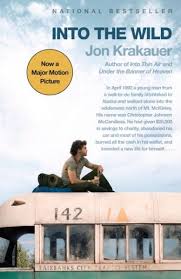 Into the Wild by Jon Krakauer, 3/5
I have never read a more enjoyable book about a less likeable person. In fact, I could not put it down and finished it in one day; the story had all the fascination and horror of a slow-motion train wreck. I’m generally a big fan of people doing their own thing, and if your thing is starving to death in an abandoned bus 30 miles from a major highway in a poorly-planned attempt to commune with the essence of Existence or whatever, that’s fine. But what is not fine is being a melodramatic, inconsistent, ignorant, self-righteous douchebag who hurts the people who care for you. Or renaming yourself in all seriousness “Alexander Supertramp.” That is also not fine.
Big shout-out to author Jon Krakauer, who is not only a fantastic writer, but, despite obviously feeling sympathetic towards his ill-fated protagonist, did not refrain from revealing unflattering facts and details about him. I hope Krakauer made a ton of money off the movie (which I will not be watching).
Why I read it: Found it in my boyfriend’s old high school stuff.
Tribe
 Tribe: On Homecoming and Belonging by Sebastian Junger, 4/5
Disjointed, unscholarly, easily debatable and offering no real solutions, this book nevertheless makes a tiny but very specific contribution towards understanding the complexities of U.S. mental health issues. Junger postulates that mental health declines as societies lose their tribal features, becoming more complex, prosperous, elitist and individualistic. Further, he attempts to prove that people’s resilience actually increases in troubled times, when society temporarily becomes more communal and egalitarian. His final claim is that long-term PTSD in soldiers is not so much caused by wartime trauma, but the difficulty of transitioning between these two cultures.
Junger makes some controversial statements and is up-front about his book’s origin (a Vanity Fair article) and purpose (nonacademic). Because of this, I feel Tribe transcends its pop-psychology characteristics and can be forgiven for feeling like a very preliminary exploration of a complex topic.
Why I read it: When the title was recommended separately to me by two of my brothers, I knew it was worth checking out.
Night
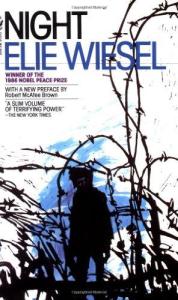 Night by Elie Wiesel, 5/5
This firsthand account of a Jewish teenager’s experience in four German concentration camps during World War II is short, stark and brutal. While most other historical accounts from this era that I have read contain some sliver of hope, faith, humanity, and closure, there is none to be found in Wiesel’s testimony. Presumably these elements are explored in the following, fictional, books of the trilogy, Dawn and Day. There are many disturbing and moving scenes in this book, but strangely, the thing that hit me most was the author’s brief mention of electrical fences around the camp. Some irrational part of me pictures the Holocaust as happening in the dark and distant past, before modern civilization. Realizing that something as thoroughly modern as an electric fence was used to contain innocent men, women and children, 11 million of whom were doomed to die, brings the horror of the Holocaust back to the very near past, where it belongs.
Why I read it: My boyfriend and I found the battered little paperback in a box of his high school relics. If it’s still not required reading, it should be.
When God Laughs
 When God Laughs by Jack London, 4/5
The short story has never been one of my favorite literary forms, so I was not exactly jazzed to crack open what I thought was a Jack London novel to find a collection of twelve shorter works under one title. They say a brief speech requires much more effort to create than a long one and I can only assume that even the best novelists face a similar challenge when it comes to crafting shorter works. My mild pessimism was wasted in this case, however, because most of these stories were captivating–full of vivid characters and a variety of dramatic plots and settings. It is a testament to the author’s skill that I could become so emotionally invested in stories ranging from just ten to forty-two pages long.
Why I read it: Just trying to read through the old books on my shelf!
Show Your Work!
 Show Your Work! 10 Ways to Share Your Creativity and Get Discovered by Austin Kleon, 3/5
This is a helpful little book for anyone who struggles with the culture of self-obsession and inauthenticity that the Instagram era seems to encourage. Social networking can be a great tool for creating opportunities and growing business, but for some people, their internet persona easily takes on a faux life of its own that stifles real, personal growth.
Kleon addresses this issue in part by shifting the focus from product (ultimately, your ideal version of self) to process (your life experiences). Instead of just showing your artwork, you show your art work (33): the real-life, behind-the-scenes depiction of what you learn about what you love, in the spirit of true sharing not self-aggrandisement. His approach is genuine, carefree, messy, organic and much more likely to stimulate personal and professional growth, as well as lasting and meaningful connections with others, than any contrived attempt to impress could achieve.
While the book’s organization is a bit all over the place, it loosely expands on the following 10 rules:
- You don’t have to be a genius.
- Think process, not product.
- Share something small every day.
- Open up your cabinet of curiosities.
- Tell good stories.
- Teach what you know.
- Don’t turn into human spam.
- Learn to take a punch.
- Sell out.
- Stick around.
Why I read it: My library was discarding it and I remembered liking Kleon’s previous book.
Slain by the Doones
 Slain by the Doones by R.D. Blackmore, 1/5
I love the old classic Lorna Doone, so I was very excited to spot what appeared to be its sequel on the shelves of a small, local thrift store. Unfortunately, the book turned out to be a collection of terribly-written short stories, only one of which had a connection to Blackmore’s earlier (and much better) novel. I have read a lot of late 19th-century literature with no comprehension issues, but I found some parts of this collection quite difficult to understand, presumably due to the author’s use of then-trendy references and short-lived terminology. While it’s understandable that the passage of time can be less than kind to certain writing styles, there really is no excuse for the lame plots that made these short stories a chore to get through. At least it’s pretty, though!
The Edge of the World
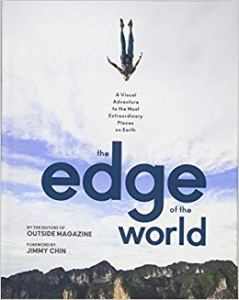 The Edge of the World: A Visual Adventure to the Most Extraordinary Places on Earth, by the editors of Outside Magazine, 5/5
What’s not to like about a collection of high-quality action photos accompanied by descriptions that provide interesting context from the photographers’ perspectives?
Why I read it: Part of an armload of photography books I checked out of the library.
Summertime
 Summertime by Denis Mackail, 5/5
When I selected this unassuming novel from my stacks of unread vintage books, I didn’t know what to expect. Delightfully, it turned out to be a sweet little romance, full of naive characters, 1920’s charm and dialogue that is occasionally very witty. Author Denis Mackail may be unknown now, but he was popular when it mattered most (during his lifetime) and since he published one novel every year from 1920-1938, I’m optimistic that more of his works will eventually find their way into my collection.
Why I read it: Just one more step towards the goal of having read every book I own!
 OmniRambles