
Tagged: Nonfiction
Cracking Cases
 Cracking Cases: The Science of Solving Crimes by Dr. Henry C. Lee, with Thomas W. O’Neil, 3/5
Impeccably-credentialed forensic scientist Henry Lee uses five sensational cases to illustrate basics of forensic science and police procedure. Each case is the subject of a detailed description that covers requisite back-stories, overview of the investigation, forensic analysis, descriptions of the trial and result. At the conclusion of each case, Lee focuses in more detail on a specific aspect of forensic science relevant to the case, such as bloodstain pattern analysis, DNA analysis, time of death, and gun shot residue.
Two of this book’s strongest aspects are the author’s obvious expertise and ability to write about sensational material in an un-sensational manner. This book did not feel mercenary in intent and did not leave me with the dirty feeling that much true-crime literature engenders. Given that English is not his first language, writing idiosyncrasies are forgivable; but less forgivable is the dryness of the more technical sections, distracting asides, and the unsatisfactory number of photos and diagrams. I think this FBI-affiliated review of the book provides a very good assessment of its strengths and weaknesses.
[Why I read it: This is a topic that interest me, partly because it puts in a new light the police-procedural TV shows I like to watch. Browsing through the library, this book had me at “Woodchipper Murder Case.”]
Stumbling on Happiness
 Stumbling on Happiness by Daniel Gilbert, 2/5
This lightweight, unsatisfying book, written for an audience that can most charitably be described as extremely credulous, undemanding and allergic to anything requiring mental rigour, is a great example of what I hate about pop science. Alternating between a tone of forced humour and relentless summarization of psychological studies in the style of a college research paper, Gilbert gleefully explores humankind’s failings when it comes to remembering past events and predicting future ones (especially with regard to their impact on future happiness). For no apparent reason, he seems to consider psychological subjects’ reports of their current feelings as almost infallibly reliable (though the concept of “current” could itself be the topic of discussion), while devaluing reports of remembered and predicted happiness. In the book, he doesn’t explore the methodology of most of the studies he cites, so you are forced to take it on trust that the studies are reliable, in addition to trusting his own interpretation of the results. Many of the examples he uses seem open to other, conflicting interpretations, which he does not acknowledge or explain. Gilbert’s final conclusion, that we should consult the current feelings of people who are having experiences we hope to have in the future, in order to find out their real potential to make us happy or unhappy, is as unsatisfying as it is impractical.
It is understandable that some simplification and ambiguity is necessary when writing on a complex topic for the average audience, but I feel that Gilbert oversimplifies to the point of ridiculousness. I have no doubt that, in conversation, he would be convincing, enlightening and entertaining, but a book is not a conversation; if something seems wrong or raises questions, I have very little recourse (since I am not a psychology expert). Ironically, the experience of reading this book made me very unhappy, which proves some of Gilbert’s points, I guess.
Despite the book’s shortcomings, the average reader would likely enjoy it and even learn some interesting psychological stuff. But for anyone who likes to think or is looking for helpful advice, this book has not a shred of value compared to the mind-blowing excellence that is Daniel Kahneman’s Thinking, Fast and Slow.
[Why I read it: The title caught my eye in the thrift store and I was impressed by the writer’s Harvard credentials and the quote on the cover.]
In Patagonia
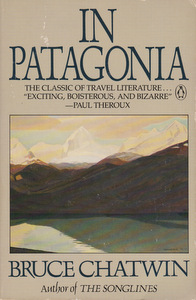 In Patagonia by Bruce Chatwin, 4/5
Short, vignette-like chapters relating Chatwin’s Patagonian travel experiences are loosely, but satisfyingly, tied together by his interest in the extinct mylodon (Giant Ground Sloth), the fate of Butch Cassidy’s Wild Bunch gang, and the life of his sailor uncle, Charley Milward. Chatwin’s keen eye for observation, appreciation of what makes a good story, and concise writing style result in an entertaining work that has literary merit beyond that which armchair travellers generally require.
[Why I read it: the title caught my eye as I browsed books in the thrift store (Patagonia has good connotations for me because of Darwin’s Voyage of the Beagle).]
The Discarded Image
 The Discarded Image: An Introduction to Medieval and Renaissance Literature by C.S. Lewis, 4/5
Readers who aren’t put off by the rather abstruse tour, in chapters three and four, of ancient writers who influenced the medieval mind will be well rewarded by an accessible analysis of what C.S. Lewis calls the medieval “Model of the Universe,” as evinced by the literature of the time. This Model is fascinating in its coherence, aesthetic appeal, contrast with the modern point of view and, especially, comprehensiveness: astronomy, biology, philosophy, physiology, physics, art…none of these topics are left out. Even the most outlandish of medieval beliefs is treated by Lewis with sensitivity, understanding and not a trace of chronological snobbery, though I do wish that many of his claims were more rigorously substantiated.
This book is full of interesting facts and themes that I am, depressingly, forgetting even as I type this review. Some of the most interesting (stripped, in the interest of conciseness, of the discussion and proofs that accompany them) follow:
- According to Lewis, the Medievals were “very credulous of books” and had little or no concept of fact vs fiction when it came to literature (11).
- “I have read a novel which represents all the Pagans of that day [the transitional period considered the source of much medieval thinking, circa 205 to 533AD] as carefree sensualists, and all the Christians as savage ascetics. It is a grave error. They were in some ways far more like each other than either was like a modern man. The leaders on both sides were monotheists, and both admitted almost an infinity of supernatural beings between God and man. Both were highly intellectual, but also (by our standards) highly superstitious” (46).
- “…educated people in the Middle Ages never believed the winged men who represent angels in painting and sculpture to be more than symbols” (71).
- “Medieval art was deficient in perspective, and poetry followed suit. […] The relative size of objects in the visible arts is determined more by the emphasis the artist wishes to lay upon them than by their sizes in the real world or by their distance. Whatever details we are meant to see will be shown whether they would really be visible or not” (101).
- “In all this [literary descriptions of opulence] one may suspect a certain vulgarity of imagination–as if to be a High Fairy were much the same as being a millionaire. Nor does it obviously mend matters to remind ourselves that Heaven and the saints were often pictured in very similar terms. Undoubtedly it is naïf; but the charge of vulgarity perhaps involves a misapprehension. Luxury and material splendour in the modern world need be connected with nothing but money and are also, more often than not, very ugly. But what a medieval man saw in royal or feudal courts and imagined as being outstripped in ‘faerie’ and far outstripped in Heaven, was not so. The architecture, arms, crowns, clothes, horses, and music were nearly all beautiful. They were all symbolical or significant–of sanctity, authority, valour, noble lineage or, at the very worst, of power. They were associated, as modern luxury is not, with graciousness and courtesy. They could therefore be ingenuously admired without degradation for the admirer” (131).
- Medievals lacked a “sense of period” when it came to history: they “pictured the whole past in terms of their own age,” attributing to historical people the same language, clothing, customs, and religious practices as themselves (182). This gave them a feeling of close connection to the past. Such a close connection, in fact, that the perceived reality of the historical stories “forces them presently to see and hear, hence to set down, at first a little more, and then a good deal more, than their book has actually told them. […] If they had been less rapt by what they read they would have reproduced him more faithfully” (212). This tendency to act “like a historian who misrepresents the documents because he feels sure that things must have happened in a certain way” (211) fills me with horror, but that is because the modern conception of “originality” and the value placed on it was simply not an issue in the Middle Ages. “The originality which we regard as a sign of wealth might have seemed to them a confession of poverty. Why make things for oneself like the lonely Robinson Crusoe when there is riches all about you to be had for the taking?” (211).
But my favourite parts of the book are those three night walks where Lewis looks up at the starry sky and helps you to feel what people from the Middle Ages might have felt at the same view (98, 112, 118).
[Why I read it: It’s unusual to find a C.S. Lewis book that I haven’t read, so I was happy to spot this attractive edition on the shelves of Magus Books.]
As I Remember
 As I Remember: An Autobiography by Lillian M. Gilbreth, 2/5
In contrast to the hilarious escapades and fascinating insights of her children’s book, Cheaper by the Dozen, this posthumously-published autobiography of their mother, Lillian Gilbreth, reads like a cross between a calendar of events and an address book. Several things about the autobiography disturbed me, but it was hard to tell which were down to poor editing, which to Lillian herself and which to the practice of the times. I’d guess that the book’s strange layout in disjointed paragraphs and the abundance of careless typos throughout the text were due to lack of editing. The off-putting use of third-person tense was presumably Lillian’s personal choice, and I assume the bone-dry, unimaginative, unsentimental, relentlessly factual writing style was, at least in part, a reflection of her personality. Since female academics and engineers were an oddity at the time, it is possible that she was used to being on the defensive and avoiding displays of vulnerability. Conceivably, this attitude could be the cause of the chilling lack of emotion, personal details, and believable portrayals of relationships in this account, clearly at odds with the Gilbreths’ success and the obvious value they placed on the other people in their lives (even neighbors who were the barest of acquaintances received a mention in her story).
I feel this book failed on two fronts: it wasn’t demonstrative enough to achieve the humanity of a successful autobiography and it wasn’t technical enough to engender any real understanding of the family business (scientific management and efficiency), despite providing exhaustive accounts of business trips, academic papers and books published, lectures given and contracts secured.
[Why I read it: I enjoyed Cheaper by the Dozen very much and wanted to know more about the mother responsible for such a family.]
Phaedo
 Phaedo (On the Soul) by Plato, 4/5
This dialogue presents Plato’s account of the philosophical discussions that occurred amongst Socrates and his friends on the night of the former’s death. Never having read the classical philosophers but awed by a vague awareness of their reputation, I expected the main topic of discussion—the controversial idea of the immortal soul—to be proved by the rigorous application of flawless logic, secular rationality and esoteric thinking.
This assumption caused me some problems as I read through the first 3/4 of the book and found many of the arguments it contains to be…well…unsatisfactory. Questionable assumptions were frequently made and used as the basis for further arguments. Often, issues of linguistics and philosophy seemed muddled up together, with shifting definitions leading to unconvincing conclusions. Some lines of reasoning seemed frankly circular and many explanations seemed to create more questions than they answered.
At first, I was very frustrated with myself, thinking my stupidity surpassed lack of understanding to reach actual disagreement! But as I read on, it became more and more apparent that Plato and Socrates must be famous for something other than infallible reasoning about philosophical issues. In his complex “myth of the afterlife” near the end of the dialogue, Socrates finally gives up all pretense of logic, weaving a strange and wonderful tale of rivers and regions of the earth where souls travel after bodily death.
When I finally reached the following quote, I realized that what I had expected to be a grand testament to human intellectualism was in fact something much more touching and powerful: a dying man’s hopeful affirmation of faith that death is not the end.
Now to insist that those things are just as I’ve related them would not be fitting for a man of intelligence; but that either that or something like it is true about our souls and their dwellings, given that the soul evidently is immortal, that, I think, is fitting and worth risking, for one who believes that it is so—for a noble risk it is—so one should repeat such things to oneself like a spell; which is just why I’ve so prolonged the tale (114d).
[Why I read it: my knowledge of Greek literature is lacking, so when I saw this short book encompassing two famous philosophers at the thrift store, I thought it might be a good place to start.]
Cheaper by the Dozen
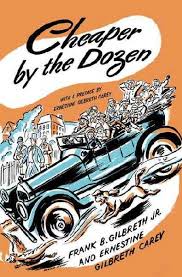 Cheaper by the Dozen by Frank B. Gilbreth Jr. and Ernestine Gilbreth Carey, 5/5
I can’t believe I didn’t get around to reading this classic until now. I think that I had a bad impression of it from my mom, who had a bad impression of it from the movie versions. At any rate, this book is hilarious and, to someone who knows big families or comes from one (like I do), it is utterly believable. It made me laugh so hard that I had to read a couple parts aloud to the family. It would make a great read-aloud book, by the way, if the reader can control the giggles. I’ve requested the much-less-well-known sequel, Belles on Their Toes, from the library, as well as an autobiography of the mother, so I have more Gilbreth escapades to look forward to in future.
[Why I read it: I wanted to find out why a couple family friends found it so amusing that I’d posted Morse code in the bathroom for the kids to learn. It seems Mr. Gilbreth had the same idea, though with a much cleverer execution…]
Kon-Tiki and I
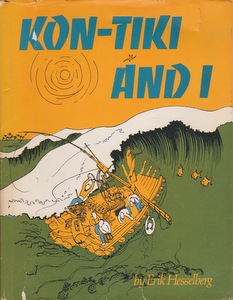 Kon-Tiki and I by Erik Hesselberg, 5/5
This humorous account of the Kon-Tiki expedition is written and illustrated by multi-talented Erik Hesselberg, artist, writer, composer, sculptor, and the only professional sailor aboard the balsa raft during its 4,300 mile journey from Peru to the Polynesian Islands. I only meant to read a few pages of this book before bed, but ended up reading the whole thing in one go, laughing out loud at Hesselberg’s witty observations and admiring his art, which ranges from the sparse, spontaneous lines of caricature to more detailed, scientific drawings of various sea creatures the crew encountered. The book is very accessible and appeals to readers of every age, from children to those older people looking for a fun companion to Heyerdahl’s more in-depth account of the Kon-Tiki expedition.
[Why I read it: my brother recommended it to me.]
Smoke on the Mountain
 Smoke on the Mountain: An Interpretation of the Ten Commandments by Joy Davidman, 2/5
I couldn’t find much to like in this preachy, dated commentary on the Ten Commandments, which joins hundreds of thousands of useless, forgettable sermons on the topic that have been written over the centuries. Davidman does little more than poke at low-hanging fruit, criticizing society’s moral failings in a manner calculated to appeal more to the smugly self-satisfied or the masochistically guilt-ridden than the individual (Christian or non-Christian) who is searching for Truth. Also, the tone of authority with which the author treats issues of theology, anthropology and history does not seem well-supported by any expertise or original thought. The most remarkable aspect of the book is C.S. Lewis’s incredibly graceful foreword, which I think evinces approbation more benevolent than spontaneously appreciative.
[Why I read it: I was curious to learn more about the woman who some consider C.S. Lewis’s intellectual equal and whose death inspired A Grief Observed. Unsurprisingly, my library didn’t have a copy of this book. Surprisingly, they bought a copy when I requested it. Pretty cool.]
QED
 QED: The Strange Theory of Light and Matter by Richard Feynman, 5/5
Most of this book hinges on the bizarre idea of adding amplitude arrows to calculate the probability of certain events happening. Probability equals the square of the length of an arrow, while the arrow’s direction is determined by the ending position of an imaginary stopwatch’s rotating hand, which turns during the event. Surprisingly, this unintuitive concept explains a number of phenomena, from iridescence to why light appears to travel in straight lines to the focusing effect lenses have on light.
Of this book’s four chapters, I found the first two to be challenging but reasonably accessible, while the following two became increasingly confusing as the concepts became more complex and Feynman’s patience for explanations seemed to wear thin (if straightforward explanations are even possible, which I almost doubt). I wish to reread the entire book at a later date and hopefully increase my understanding of the strange concepts it portrays.
[Why I read it: I love reading about quantum physics and have lately been on a Feynman binge.]
 OmniRambles