
Tagged: 3/5
Stalking the Wild Pendulum

Stalking the Wild Pendulum: On the Mechanics of Consciousness by Itzhak Bentov, 3/5
It would be too easy to dismiss this book, with all its talk of holograms, vibrations, and altered states of consciousness, as mere LSD-fueled, new-age nonsense. I think it deserves a closer look, if only to appreciate the author’s admirable accomplishment of developing a comprehensive theory of life, the universe and everything.
Using clear language, helpful chapter summaries, and a reasonable progression of thought, Bentov exploits the mysterious and seemingly unnatural uncertainty that exists at the extreme ends of a pendulum-like or oscillating movement in quantum mechanics to formulate a conception of reality as “a void filled with pulsating fields” (167) that form an “interference pattern or hologram of knowledge information we can call the ‘universal mind'” (157). Into this framework neatly slot the implausible yet persistently-reported human phenomena of telepathy, clairvoyance, out-of-body experience, enlightenment, reincarnation, etc.
Based on my own summary above, this seems the exact type of book that I would mercilessly flay as worthless woo-woo garbage. So why do I think it is actually something special? For one thing, I admire the author’s humble curiosity and undeniable intellect. While acknowledging the deeply unconventional nature of his own ideas and that “few scientists will read this book to the end” (2), he is not defensively anti-science or anti-anything (which is more than can be said for many people). Adding to its appeal, for me, is the fact that this book is the product of living-room discussions with friends and published with their encouragement, not in an attempt to sell something or gain prestige. How many people do you know with whom you could discuss the shape of the universe and the meaning of existence? I, for one, am envious. Any lingering doubts I might have had about this book and its author were dispelled by reading his Wikipedia page, which I refrained from doing earlier to avoid bias. He seems to have been a truly remarkable mind and a contributor of practical value, as well as theoretical, to humanity.
Why I read it: the title caught my eye in a used bookstore, but I didn’t want to spend money without knowing if it was utter nonsense, so I got it from the library later. Now, I wish I had bought it.
Thames Mudlarking

Thames Mudlarking: Searching for London’s Lost Treasures by Jason Sandy and Nick Stevens, 3/5
I appreciated the abundant, high-quality photographs in this slim book, but the text was dry and uninspiring.
Why I read it: Amazon threw this gift for my mother-in-law into a box of other purchases, completely devoid of any wrapping, to be tumbled around like a river rock on its journey to my door. It arrived predictably battered around the edges, but the silver lining was that I was able to take advantage of the exchange window to read it for myself.
Bertram
Bertram; or, The Castle of St. Aldobrand by Charles Robert Maturin, 3/5
Drama is my least favorite literary genre and via ebook is my least favorite method of literary consumption, but my curiosity was adequately rewarded by this obscure, yet affectingly tragic and well-written play from the early 19th century, made available online by the University of Virginia Library.
Why I read it: A dramatic quote from this play, used as a chapter epigraph in The Hidden Hand, piqued my curiosity:
“By hell and all its host, he shall not live.
This is no transient flash of fugitive passion—
His death hath been my life for years of misery—
Which else I had not lived—
Upon that thought, and not on food, I fed,
Upon that thought, and not on sleep, I rested—
I come to do the deed that must be done—
Nor thou, nor sheltering angels, could prevent me.”
The Hidden Hand

The Hidden Hand by Mrs. E.D.E.N. Southworth, 3/5
I was annoyed to realize, after finishing this novel, that I had already read and reviewed it fourteen years ago! Interestingly, I felt pretty much the same about it this time around as I did before. However, this vintage edition was more pleasant than the previous one and did not contain so many italics. There was still an unusual (one might say, excessive) amount of exclamation points, but they did not rankle like before. Perhaps I am mellowing grammatically as the years go by.
Why I read it: a recommendation and loan from my sister.
Adulthood is a Gift!

Adulthood is a Myth Gift! A Celebration of “Sarah’s Scribbles” by Sarah Andersen, 3/5
This fifth book in the “Sarah Scribbles” collection contains some fun comics and fifteen illustrated, short essays of varying interest. I enjoyed learning about the process behind Andersen’s trademark style, even if it did steal a bit of the “magic.”
Why I read it: I visit sarahcandersen.com once in a while to catch up and saw that I was behind a couple books.
Oddball

Oddball by Sarah Andersen, 3/5
The fact that this collection of comics made me lol instead of rofl is a testament to how much I’ve changed as a person over the last few years. What used to be extremely relatable to me as an anxious, single, bookish introvert, has become less so as my sense of identity has shifted more towards being a wife, mother, and active member of the local martial arts community. That said, Sarah Andersen is still hilarious and the amount she can communicate with a few squiggly lines is incredibly impressive.
Why I read it: I visit sarahcandersen.com once in a while to catch up and saw that I was behind a couple books.
Of Men and Mountains

Of Men and Mountains by William O. Douglas, 3/5
This simple, wholesome memoir is a love letter to Washington state’s Cascade mountains and the character-building, spirit-refreshing experiences while exploring them that had a profound effect on Supreme Court justice William O. Douglas throughout his life.
Why I read it: I snagged it from my mother-in-law’s donation pile and read it at night to combat pregnancy-induced insomnia.
How to Win Friends & Influence People
How to Win Friends & Influence People: The Only Book You Need to Lead You to Success by Dale Carnegie, 3/5
In today’s saturated self-help market, it takes a little imagination to understand just how novel and influential this first-of-its-kind work must have been, back in 1936. Carnegie’s “principles” are practical and based on a commonsense understanding of psychology that, though now well-worn, have stood the test of time. Charming anecdotes illustrate the following principles:
Three Fundamental Techniques in Handling People
Principle 1: Don’t criticize, condemn or complain.
Principle 2: Give honest and sincere appreciation.
Principle 3: Arouse in the other person an eager want.
Six Ways to Make People Like You
Principle 1: Become genuinely interested in other people.
Principle 2: Smile
Principle 3: Remember that a person’s name is to that person the sweetest and most important sound in any language.
Principle 4: Be a good listener. Encourage others to talk about themselves.
Principle 5: Talk in terms of the other person’s interests.
Principle 6: Make the other person feel important–and do it sincerely.
Win People to Your Way of Thinking
Principle 1: The only way to get the best of an argument is to avoid it.
Principle 2: Show respect for the other person’s opinions. Never say, “You’re wrong.”
Principle 3: If you are wrong, admit it quickly and emphatically.
Principle 4: Begin in a friendly way.
Principle 5: Get the other person saying “yes, yes” immediately.
Principle 6: Let the other person do a great deal of the talking.
Principle 7: Let the other person feel that the idea is his or hers.
Principle 8: Try honestly to see things from the other person’s point of view.
Principle 9: Be sympathetic with the other person’s ideas and desires.
Principle 10: Appeal to the nobler motives.
Principle 11: Dramatize your ideas.
Principle 12: Throw down a challenge.
Be a Leader
Principle 1: Begin with praise and honest appreciation.
Principle 2: Call attention to people’s mistakes indirectly.
Principle 3: Talk about your own mistakes before criticizing the other person.
Principle 4: Ask questions instead of giving direct orders.
Principle 5: Let the other person save face.
Principle 6: Praise the slightest improvement and praise every improvement. Be “hearty in your approbation and lavish in your praise.”
Principle 7: Give the other person a fine reputation to live up to.
Principle 8: Use encouragement. Make the fault seem easy to correct.
Principle 9: Make the other person happy about doing the thing you suggest.
Why I read it: a recommendation from my sister.
A Penny Saved is Impossible
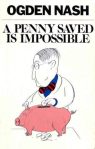
A Penny Saved is Impossible by Ogden Nash, 3/5
This collection of poems on the topics of work and finances is still surprisingly relevant and features the linguistic inventiveness and charm that fans of Ogden Nash will expect.
Why I read it: a thrift store find to add to my collection.
Gilbert and Sullivan

Gilbert and Sullivan: Lost Chords and Discords by Caryl Brahms, 3/5
Even if the introduction did not acknowledge that the lives and careers of famous musical duo Gilbert and Sullivan was already a well-covered subject, the fact would be pretty obvious from the author’s incessant quotations and references to previously existing research. This college-research-paper approach is never the most appealing, and I was additionally put-off by the author’s many personal opinions throughout, grating self-references to “the present writer,” and comments that were difficult to understand (whether due to the passage of almost 50 years since the time of writing, or incorrect assumptions about the readers’ preexisting knowledge, is unclear).
Shortcomings aside, the book is generously illustrated and it was fascinating to read about the tumultuous, on-again-off-again relationship between an irascible lyricist and sickly composer, whose serious, classical works, though critically-acclaimed at the time, were soon eclipsed by the comic operas he considered beneath him.
Why I read it: a library reject that I bought from a book sale many years ago.
 OmniRambles