
Tagged: 2018
The New Oxford Annotated Apocrypha
The New Oxford Annotated Apocrypha (NRSV 5th ed.), edited by Michael D. Coogan, 5/5
The Apocrypha is one of those literary works that is impossible to approach without some pre-conceived expectation, since the very name is steeped in mystery. Raised Christian, I cannot remember ever being explicitly told to avoid these noncanonical ancient writings, however they were not included in my Bible and I had a vague conception of them as useless at best, and untrustworthy at worst. At some point in my spiritual meandering, I started to suspect that the Bible may have been compiled by a bunch of card-carrying HOA Karens and maybe the Apocrypha was simply too fun and awesome to be included. At any rate, I expected to encounter bizarre prophecies, entertaining stories about Jesus as a child, and lots of enticing, controversial ideas.
Not for the first time, my preconceptions turned out to be wildly inaccurate. I was surprised to find that most of these ancient writings fit pretty clearly and uncontroversially into the categories of history, storytelling, or praise, and, while I enjoyed reading these works, the Bible feels complete to me without them. My favorite book was Sirach, with its deeply relatable and often snarky proverbs. There were a couple quotes that I wished were in the Bible, but it was clear from context that Ben Sira had a lot of his own ideas and issues to work through. Overall, I found the Apocrypha to be a fascinating and occasionally inspiring collection of historical writings, regardless of any Biblical associations.
Why I read it: My husband was listening to the Book of Enoch and it sounded so wild that I wanted to check it out for myself. I just assumed it was in the Apocrypha and didn’t realize it wasn’t until I was about 80% done. Next stop–pseudepigrapha, I guess.
12 Rules for Life
12 Rules for Life: An Antidote to Chaos by Jordan B. Peterson, 4/5
Jordan Peterson is, in my opinion, one of the most brilliant thinkers and lecturers of the 21st-century in his field and, if he were a more intentional writer, I believe he would deserve a place with the immortal greats of philosophy. Unfortunately, instead of utilizing the writing process to distill and clarify his ideas, he settles for more or less transferring his thought processes straight onto the page. The result is very uneven in tone, bouncing wildly between folksy storytelling and esoteric musings that challenged even my well-trained attention span (exhibit A: Ornithology: An Introduction). It took three tries for me to make it through this book, but I was rewarded by Peterson’s fearless acceptance of the most terrible aspects of human existence and the deeply satisfying integration of that chaos into a perspective that ennobles the common man and makes one want to pick up a sword and fight dragons.
Rule 1: Stand up straight with your shoulders back.
Rule 2: Treat yourself like someone you are responsible for helping.
Rule 3: Make friends with people who want the best for you.
Rule 4: Compare yourself to who you were yesterday, not to who someone else is today.
Rule 5: Do not let your children do anything that makes you dislike them.
Rule 6: Set your house in perfect order before you criticize the world.
Rule 7: Pursue what is meaningful (not what is expedient).
Rule 8: Tell the truth–or, at least, don’t lie.
Rule 9: Assume that the person you are listening to might know something you don’t.
Rule 10: Be precise in your speech.
Rule 11: Do not bother children when they are skateboarding.
Rule 12: Pet a cat when you encounter one on the street.
Why I read it: I became familiar with Peterson when he achieved viral popularity a few years ago.
How Do I Do That In Lightroom Classic?

How Do I Do That In Lightroom Classic?: The Quickest Ways to Do the Things You Want to Do, Right Now! by Scott Kelby, 5/5
This slim reference book for Adobe Lightroom Classic is surprisingly readable and, though I’ve used Lightroom for many years, I did still pick up on a few interesting hints for further exploration.
Why I read it: While getting rid of a couple outdated Lightroom books I owned, it crossed my mind to check the library for some more recent offerings (not realizing this second edition was already a few years old).
Game Shows FAQ

Game Shows FAQ: All That’s Left to Know About the Pioneers, the Scandals, the Hosts, and the Jackpots by Adam Nedeff, 3/5
This is an interesting book about TV game shows, providing info on historical popularity trends, how shows were made, which ones survived and which ones failed, and a bit of fun, behind-the-scenes gossip. I felt that the author lost some steam as the book progressed and there were a completely unacceptable number of typos, but overall, it was a decent read on a pretty random topic.
Why I read it: on a shelf of staff picks at my local library.
Save the Cat! Writes a Novel

Save the Cat! Writes a Novel: The Last Book on Novel Writing You’ll Ever Need by Jessica Brody, 4/5
Inspired by Blake Snyder’s “Save the Cat!” formula for screenwriting, author Jessica Brody breaks down the 15 basic plot points necessary for each of the 10 genres into which all stories can be categorized. Numerous examples and detailed breakdowns of famous novels are provided, making this a convincing, if somewhat tedious read.
Do I think it is necessary to follow a formula while writing a novel? Of course not. Does it steal the magic a bit to identify the unexpectedly unvaried elements that so many stories have in common? Yes, it does. But I can imagine that this handbook could be a lifesaver for a new or struggling author, or anyone looking to troubleshoot plot/pacing issues.
Why I read it: it was on a list of recommended resources for writers on my Instagram feed.
100 Poems

100 Poems by Seamus Heaney, 4/5
I love that this collection of poems was hand-selected by Heaney’s wife and children after his death, not just to include his most loved and famous works, but ones that held personal significance and memories for his family as well. With that in mind, it felt like a privilege to read this collection and made it easier to focus on what I personally found beautiful and resonant, rather than feeling the need to make a value judgement about what I did not understand or connect with. One of my favorite moments was in the poem “Mossbawn: Sunlight,” when a baker is described as dusting the board with “a goose’s wing” (32).
On a separate topic, I want to take this opportunity to send some bad energy towards the fellow library user who felt that it was reasonable to make distracting pencil marks throughout the entire book. I erased every single one.
Why I read it: The author was featured on an episode of Antiques Road Trip and I was surprised that I had never heard of such a famous and beloved poet before.
The Culture Code
The Culture Code: The Secrets of Highly Successful Groups by Daniel Coyle, 5/5
Impeccably organized around three main skills (1. Build Safety, 2. Share Vulnerability, and 3. Establish Purpose), this book examines some of the world’s highest-functioning groups in such varied fields as business, tech, the military, sport, comedy and medicine. Coyle achieves a beautiful balance of well-referenced information, firsthand observations, anecdotes, and suggestions for real-life applications. I was fascinated to see how similar a healthy culture is to a healthy family and recognized many of the ideas and values from my own experiences growing up in a large and loving family.
Why I read it: While writing my review of Peak and refreshing my memory on Coyle’s contribution to the same topic via The Talent Code, I was happy to discover he’d written this book more recently.
Early Riser
 Early Riser: A Novel by Jasper Fforde, 3/5
This dystopian novel explores the logistical, social, and political implications of living in a world so close to another ice age that humans must hibernate through the winter months. Fforde’s inimitable style does shine through in a couple places, but overall I found the story to be a bit on the pedestrian side. Not exactly predictable, but familiar, like it was based on a Netflix series I’d already seen or something. Of course, Netflix was still a mail-order DVD service the last time I read anything by Jasper Fforde, so hopefully the perceived lack of depth and magic is not simply a result of brain rot from indulging in more mindless TV than good books in the last few years.
Why I read it: the author came up in conversation with my sister.
Everybody Always
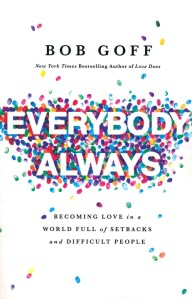 Everybody Always: Becoming Love in a World Full of Setbacks and Difficult People by Bob Goff, 3/5
After loving Love Does, I was very excited to read Goff’s next book, which I hoped would provide further illumination on the challenge of how to love people extravagantly without getting used up in the process. Unfortunately, I didn’t sense the same spirit in this book: the stories felt a little forced, the resulting morals were sometimes a stretch and the whole thing came off a bit preachy and canned. It’s actually a little funny because when I read Love Does, I literally thought to myself that it was the kind of inspired book you would live your whole life to write and never write another.
Why I read it: I wished Love Does was a longer book.
Herding Cats
 Herding Cats: A “Sarah’s Scribbles” Collection by Sarah Andersen, 5/5
Just as funny and disturbingly relatable as Andersen’s webcomic and other books.
Why I read it: I saw it advertised on the Sarah’s Scribbles website.
 OmniRambles