American Shaolin

american shaolin polly gotham books 2007American Shaolin: Flying Kicks, Buddhist Monks, and the Legend of Iron Crotch: An Odyssey in the New China by Matthew Polly, 3/5

This memoir of an American college dropout who transforms from bullied to badass by studying kung fu with Shaolin monks in China is a fun read, if a little bit less interesting, less believable and dirtier than the author’s later book Tapped Out.

[Why I read it: I enjoyed the author’s other book a lot.]

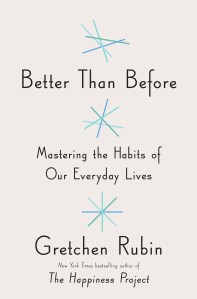
Better Than Before

better than before rubin crown publishing 2015Better Than Before: Mastering the Habits of Our Everyday Lives by Gretchen Rubin, 3/5

They say that opposites attract, in which case I suspect that I may be very similar to the author, who I found to be thoroughly grating.  Perhaps it’s her approach to the topic, which is somehow both overly analytical and overly anecdotal, or perhaps it’s because studying how to make habits seems pointless to me (surely the hard part is deciding what habits to have, not how to keep them up?).  I knew I was in trouble when Rubin’s first attempt (of many) to organize her readers into overly-tidy categories failed to resonate with me–am I an Upholder, Questioner, Obliger, or Rebel?  Does it even matter?  At any rate, I felt so little interest in this book that I had a difficult time finishing it and remember practically nothing about it now.  It has joined the growing ranks of faceless self-help books that have made the New York Times Best Seller list but not an impression on me.

[Why I read it: my friend Joy recommended it to me.]

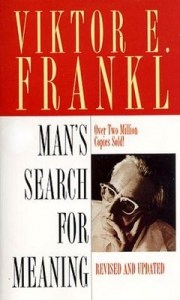
Man’s Search for Meaning

mans search for meaning frankl pocket books 1985Man’s Search for Meaning by Viktor E. Frankl, 5/5

When a psychiatrist who endured the German concentration camps of WWII has something to say about happiness and the meaning of life, you can bet it’s something worth paying attention to.  Frankl’s thoughts on the bigger questions in life are woven into the first part of this short book–an account of the author’s experiences and observations in Auschwitz and other concentration camps.  An introduction to the foundations of logotherapy (the author’s approach to psychotherapy) comprise the second part of the book, in which Frankl’s ideas really come into focus.

Frankl’s refreshing premise is that “man’s search for meaning is the primary motivation in his life” (121) and that “A man’s concern, even his despair, over the worthwhileness of life is an existential distress but by no means a mental disease” (125).  The author’s theory of the meaning of life encompasses the complexities of human existence with startling simplicity:

As each situation in life represents a challenge to man and presents a problem for him to solve, the question of the meaning of life may actually be reversed.  Ultimately, man should not ask what the meaning of his life is, but rather he must recognize that it is he who is asked.  In a word, each man is questioned by life; and he can only answer to life by answering for his own life; to life he can only respond by being responsible (131).

I have seldom been moved as this book moved me, right from the preface, which contains this bit of wisdom that alone would make the book worth reading:

Don’t aim at success–the more you aim at it and make it a target, the more you are going to miss it.  For success, like happiness, cannot be pursued; it must ensue, and it only does so as the unintended side-effect of one’s personal dedication to a cause greater than oneself or as the by-product of one’s surrender to a person other than oneself.  Happiness must happen, and the same holds for success: you have to let it happen by not caring about it.  I want you to listen to what your conscience commands you to do and go on to carry it out to the best of your knowledge.  Then you will live to see that in the long run–in the long run, I say!–success will follow you precisely because you had forgotten to think of it (17).

[Why I read it: it was mentioned in Your Money or Your Life and the title sounded interesting.]

Tapped Out

tapped out polly gotham books 2011Tapped Out: Rear Naked Chokes, the Octagon, and the Last Emperor: An Odyssey in Mixed Martial Arts by Matthew Polly, 5/5

This entertaining account of a middle-aged writer’s transformation from overweight fixer-upper with a distant background in kung fu to competent mixed martial artist is impossible to put down–I started it at 2am last night, meaning to read just a little before falling asleep, and the next thing I knew it was 2.5 hours later and I was on the last page.  Polly is a good writer with a great sense of humour and seems to know how to embellish a story without exaggerating it all out of proportion.  Famous figures in MMA appear throughout and I’ll admit to a few fan-girl squeals along the way.  Probably the fact that I’ve been doing a lot of kickboxing, grappling and Brazilian jiu-jitsu this year made the book even more enjoyable–a lot of Polly’s experiences as a beginner were hilariously relatable.  I enjoyed the book so much that I’ve already ordered Polly’s American Shaolin from the library.

[Why I read it: I came across it while looking for BJJ books in the library database.]

Niccolò Rising

niccolo rising dunnett vintage books 1999Niccolò Rising by Dorothy Dunnett, 2/5

This dense historical fiction starts with a barrage of names and characters reminiscent of the panic-inducing first chapter of Tolstoy’s War and Peace.  Unfortunately, the barrage doesn’t seem to let up and I spent most of the book feeling both unable and unwilling to follow all the subtle intrigues and sift through previous pages for hints about who that one guy is and what on earth his cryptic comments mean.  At first, I blamed myself for reading too quickly or not being smart enough to understand the intricacies of the story.  Then, I started to suspect that the author was responsible for the frustrating obscurity with which the book tangled along and purposefully used inscrutable characters to half-hint at important aspects of the plot through scenes and conversations that would only make sense in retrospect (if then).

In addition, I didn’t feel that the author did a very good job of integrating the story with its historical setting in 15th-century Bruges.  The characters didn’t feel real, the dialogues all felt very modern and there were those dreaded episodes where “history” happens, G. A. Henty style–the story is paused so that a dry list of historical events can take place, consisting of stuff like Duke So and So having a battle with ex-King What’s His Name over some historical province that I can’t be bothered to take out an atlas to locate.  For a story that hinges on character development (this is only the first of eight books in the series about Niccolò, a bastard dyer’s apprentice who makes his way to the top of the food chain), there wasn’t much development.  Yes, some of the characters were complicated, but mostly because they acted unpredictably and inconsistently.  Dunnett seems to think that it’s deep to make a character act out of character, but if the action is not a result of believable motives and growth, then the effect is off-putting, not illuminating.  I didn’t really like or understand many of the characters in the book and certainly can’t face reading the second book in the series.

Now, I am no fan of historical fiction in general, so I can understand that Dunnett has many loyal admirers and I can even imagine a reader who might adore this book: someone with a long attention span, lots of free time and an unhealthy interest in the prosaic details of historical economics and politics (or at least, a willingness to be bribed into tolerance of these details by the promise of a sex scene or two).

[Why I read it: it was passed on to me in defeat by Tom from choir (whose reference in conversation to Tom Jones happily inspired me to read that classic), who in turn received it from fellow choir member Paula.]

Back Home

back home mauldin bantam 1948Back Home by Bill Mauldin, 2/5

Tedious political ramblings accompany this collection of aged cartoons by celebrated WWII cartoonist Bill Mauldin, who obviously had a rough transition back to a civilian career after the war.  I’ve always been put off by political cartoons in general because they tend to over-simplify complicated issues, mindlessly ridicule opposing viewpoints and, crucially, are usually not even funny.  The cartoons in this book are no exception and, I think, would appeal to few readers besides fans of Mauldin and those who are interested in an inside view of one person’s perspective of the political climate in post-WWII United States.

[Why I read it: I recognized Mauldin’s name and liked what I had previously seen of his army cartoons.]

The Runagates Club

runagates club buchan house of stratus 2001The Runagates Club by John Buchan, 3/5

The twelve short stories in this collection rely a little too much on the supernatural for my taste, but are still good fun and feature such familiar friends as Sir Richard Hannay, John Palliser-Yeates, Lord Lamancha and Sir Edward Leithen.

[Why I read it: I love Buchan and added this book to the pile by my bed after I saw a family member reading it.]

The Wombles

wombles beresford ernest benn 1975The Wombles by Elisabeth Beresford, 4/5

I may be twenty years older than the target audience, but I still enjoyed reading this charming British children’s classic.

[Why I read it: I recognized the title while browsing in the thrift store.]

Crap Towns

crap towns jordison kieran boxtree 2003Crap Towns: The 50 Worst Places to Live in the UK, edited by Sam Jordison and Dan Kieran, 3/5

Towns filled with soulless concrete architecture and jobless, shell suit-wearing inhabitants are prominent features in this entertaining collection of complaints and critiques (many of them written and submitted by each town’s own inhabitants).  Almost more entertaining than the variety of inventive insults and tongue-in-cheek taunts are the rebuttals by MPs and county council members, which are hilarious in corresponding degree to their seriousness.

[Why I read it: the title caught my eye as I was browsing in the thrift store.]

The Organized Mind

organized mind levitin dutton 2014The Organized Mind: Thinking Straight in the Age of Information Overload by Daniel J. Levitin, 4/5

I didn’t enjoy reading this book very much; it does not seem well focused, does not flow very well and flip-flops annoyingly between information that is too technical to be useful and organizational ideas that are too simplistic.  In one paragraph, the author explains that the enzyme catechol-O-methyltransferase regulates dompamine and noradrenaline in the prefrontal cortex, in another he suggests the not-exactly-earth-shattering idea of writing things down instead of trying to remember everything.

That said, there were still a lot of very interesting concepts in this book and several of the things I learned merited being read aloud to the family or being brought up in conversation over the last few days.  For example, it should be common knowledge by now that multitasking is not a thing, but did you know that watching TV while studying can actually cause the information you learn to be stored in the wrong part of your brain?  That’s powerful stuff.  Or that humans naturally tend toward a bimodal sleeping pattern that includes two four or five hour chunks, separated by an hour or two of wakefulness in the middle of the night and supplemented by an afternoon nap?

In my opinion, this book can’t hold a candle to Thinking Fast and Slow by Daniel Kahneman (who, along with his partner Amos Tversky, is referenced quite often in The Organized Mind), but Levitin compensates for a sub-ideal reading experience by the fascinating and varied topics he explores.

[Why I read it: My friend, Joy, recommended it to me.]