
Category: Reviews
Ready Player One
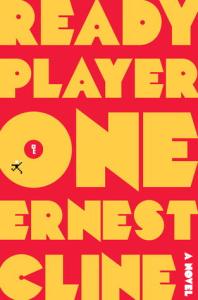 Ready Player One: A Novel by Ernest Cline, 3/5
A dystopian setting in Planet Earth’s near future provides an interesting contrast to the steady stream of 1980s trivia in this homage to geek culture. It is, perhaps, unreasonable to complain about the preponderance of cliches and stereotypes in this novel, since Cline uses them effectively to create an exciting, page-turner story. However, the complete lack of character development, increasingly contrived plot, clumsy foreshadowing, excruciatingly poorly-written “love” angle, and lightweight ending complete with deus ex machina ultimately kind of killed it for me.
[Why I read it: I waited so long for this book to come in at the library that I’ve completely forgotten how I heard about it. Perhaps a friend told me about it?]
The Histories
 The Histories by Herodotus, translated by Aubrey de Sélincourt, 3/5
At its best, this fifth-century B.C. account of cultures and conflicts in the areas surrounding the Mediterranean tells epically ferocious tales of questionable veracity. At its worst, it reads like the dryer, more tedious parts of 20,000 Leagues Under the Sea (just substitute Greeks and Persians for fish and seaweed).
[Why I read it: Found it in the thrift store and it seemed like a good tool with which to combat my [gradually lessening] ignorance of Classical literature.]
The Constitution of the United States of America
 The Constitution of the United States of America, 5/5
It is tax season, so perhaps I can be forgiven for expecting “the supreme law of the land” to be as ludicrously bloated and unreadable as the Internal Revenue Code. Fortunately, it is not so–the fifty-five delegates to the 1787 Philadelphia Convention crafted a document of startling elegance, simplicity and practicality (probably marking the first and last time such adjectives could be used to describe a piece of legislation).
[Why I read it: I planned to send this copy to my brother after reading it myself, but it sat in the pile of books by my bed until it became assigned reading in my business law class.]
As You Wish
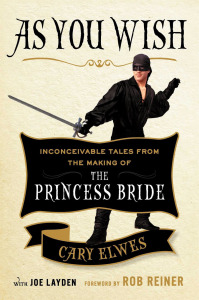 As You Wish: Inconceivable Tales from the Making of The Princess Bride by Cary Elwes with Joe Layden, 2/5
This underwhelming book, written by “Wesley” from the movie The Princess Bride, does contain some entertaining stories but consists mostly of uninteresting prose meant more to beef up the word count than to communicate anything insightful. Along with intensely boring descriptions of how many chairs were at the first table read and exactly what kind of sandwiches were provided, is a tiresome quantity of trite tributes to the general awesomeness of everyone involved with the film. And Elwes is not the only one spouting sweet nothings about the rest of the cast: there are also numerous interviews with relevant people who mostly seem to have nothing very meaningful to say and say it in a very generic way. Even worse, these interviews are set apart from the main text in grey boxes that fragment the reading experience, making it disjointed and annoying. All in all, I’d say the few really interesting anecdotes it contains make the book worth reading for fans of the movie, but they shouldn’t expect too much.
[Why I read it: I saw the title while ordering The Princess Bride novel at the library.]
Small is Beautiful
 Small is Beautiful: Economics as if People Mattered by E.F. Schumacher, 4/5
Schumacher eloquently weaves together the topics of economics, environmentalism, philosophy and spirituality in a very thought-provoking way. He makes the case for a smaller-scale, more personal, moral, holistic and sustainable approach to the business of business, in contrast to the soul-crushing materialism of a modern society that worships wealth, serves mega-corporations and demands growth at any cost. He envisions a world where men are not unhappy cogs in giant money-making machines, but are engaged in work that is fulfilling, promotes their physical and spiritual well-being, and benefits their communities.
I fear that, in stripping Schumacher’s ideas of context and rationale, my summary makes them sound a bit like trite hippie-talk. They are not so. Schumacher makes an intelligent, efficient case for most of his beliefs and almost every page is quotable. It is because of the vast quantity of insightful ideas and observations that I have refrained from quoting any at all and have instead bought a copy of the book for future reference.
My favourite parts of the book are the more philosophical sections in which Schumacher looks at what it means to be human. (I especially enjoyed Part II, Chapter 1, which focuses on metaphysics.) His visions of a human existence that transcends the rat race is inspiring and encouraging. In general, the author places significant value on both Judeo-Christian and Buddhist morals and makes the kind of powerful case for spirituality that seems to come naturally to intelligent former-atheists like himself. This is refreshing, since society nowadays seems largely unwilling to acknowledge the numerous positive effects of religion, focusing instead on, say, the Crusades or sex scandals involving pastors.
My least favourite parts of the book involved Schumacher’s proposals for actually putting his ideas into action. It is one thing to attempt to influence someone’s personal beliefs and quite another thing to merely inflict your own on them. I believe that the kind of morality and radical changes that the author wishes to see enacted on a massive, economic scale can only come from personal conviction at a grassroots level. Anything else infringes on that necessary human freedom to make your own decisions, even if they are bad ones (addressed by Dostoyevsky in Notes from the Underground). Also, at times, the author seems to wish for a happy, hobbit-like society, where everyone is a subsistence farmer except for Fred, who makes shoes, and Sally, who weaves cloth. He doesn’t seem to leave much room for human nature or for people who think differently than him, such as innovators, scientists, entrepreneurs and visionaries.
[Why I read it: I think I saw the title in an article about The Times Literary Supplement‘s list of 100 most influential books published since WWII.]
Jumped, Fell, or Pushed?
 Jumped, Fell, or Pushed?: How Forensics Solved 50 “Perfect” Murders by Steven A. Koehler, MPH, Ph.D., with Pete Moore, Ph.D., and David Owen, 3/5
The informational portions of this book are simplistic and likely won’t add much to any knowledge of forensics you might have already picked up from watching entirely too much TV in the police procedural genre. However, the case studies are fascinating and represent an interesting variety of locations and eras (not just modern, American crimes like you might expect). The book’s layout is good and manages to achieve a varied, magazine-style page format without requiring the reader to jump around from one disjointed text box to another.
[Why I read it: came across it while browsing in the library.]
Adventures in the Screen Trade
 Adventures in the Screen Trade: A Personal View of Hollywood and Screenwriting by William Goldman, 5/5
This book is everything you would expect from the screenwriter responsible for Butch Cassidy and the Sundance Kid, All the President’s Men and The Princess Bride: funny, irreverent, surprising, insightful and, above all, well-written. It might not be a step-by-step, how-to manual for aspiring screenwriters, but it is an education. Even the book’s layout is a great illustration of one of Goldman’s main points: “SCREENPLAYS ARE STRUCTURE” [capitals his] (195). The author brilliantly organizes what could be a very rambling, amorphous topic into three main sections: 1) aspects of the film industry, 2) his experiences with specific movies, and 3) an example of a short story converted to screenplay, along with commentary from industry experts. Each of the three sections contains a limited number of logical subsections, with subpoints under those. From the table of contents, this all seems very organized and textbook-perfect and, you would think, creativity-quashing. But here is the interesting bit: on the subpoint level, Goldman is anything but conventional. He cuts loose, telling anecdotes, making jokes, communicating via bits of custom-written scripts, and utilizing unconventional text layouts (the one page devoted to the topic of directors consists of one sentence and a large P.S. written in all caps). This is all extremely entertaining but it is also effective; even at his craziest, Goldman makes sure you always know where you are and what the point is. And because there is a point, you don’t feel that your time is being wasted, no matter what seeming tangent the author might go off on.
Now, it’s difficult to know how far to trust claims made in a book that was written over thirty years ago and contains the words “personal view” in the subtitle, but Goldman’s experience in the industry and the examples he provides support some claims that I found surprising. Most notably:
1) Major stars will generally not play characters that seem “weak” or “blemished,” no matter how fantastic the writing or compelling the story. They will either demand that the script be altered to make their characters more sympathetic, or will leave the roles to character actors, has-beens and up-and-comers (37).
2) “NOBODY KNOWS ANYTHING” [capitals his] (39). By this, Goldman means that no one in the movie industry can reliably predict what film is going to be a hit and what is going to flop. He mentions dozens of promising, big-name pictures from the 80s that were inexplicable failures, while other films became hits for equally inexplicable reasons. It felt surreal to see so many unfamiliar movie titles and recognize the time, effort and money that went into making films that no one wanted to see then and no one remembers now.
3) I knew that film-making wasn’t a tidy process, but had no idea of the sheer insanity that can occur in the early stages of a movie’s development, from writers being hired and fired, willy nilly, to stars being first in, then out, then in again.
Another thing I was shocked to find out was how much specialized training and experience Goldman had before being approached to write his first screenplay. The answer? Zero. He was a published novelist, yes, but had not the first clue how to write a screenplay. According to his account, he hadn’t even read a screenplay before being asked to write one (166). It seems that his expertise has been gained not through expensive schooling or mentoring, but through experience, the courage to accept a challenge first and save the panicking for later, and having the tough skin required to see his hard work critiqued, altered or destroyed by a variety of people and unforeseeable circumstances.
Goldman doesn’t spend a lot of time complaining or making dire predictions about the future of the film industry, but he does point out a trend toward producing more and more “comic-book movies” (he uses the term figuratively, but it is hilariously literal now)–movies that are shallow, predictable, lack resonance, and deal with an idealized, sanitized version of life (153). Now, I don’t know much about the 1980s films he was talking about, but I’d be willing to bet a lot of money that the trend is worse now than ever before. Likewise, I would agree completely with his thirty-year-old statement that most commercial films fit into the third of these categories:
1) movies that aspire to quality and succeed
2) movies that aspire to quality and don’t succeed
3) movies that never meant to be any good at all (127).
Near the end of Part One, Goldman predicts that “…for the present [1983], I think we may as well prepare ourselves for seven more Star Wars sequels and half a dozen quests involving Indiana Jones” (158). Though the most recent Indiana Jones movie directly led to the creation of the term “nuking the fridge” to describe the decline of a franchise, there’s no denying that the number of post-1983 Star Wars sequels listed in the franchise’s Wikipedia article is…seven. Spooky.
[Why I read it: saw the title in Goldman’s The Princess Bride and thought it looked interesting. Surprisingly, my library didn’t have a copy, but I was able to get it through interlibrary loan. I’ve also requested the 2000 sequel, so fingers crossed that some library in the network will have it…]
Personal Injuries
 Personal Injuries: A Novel by Scott Turow, 2/5
This book has all the right components–characters with strong personalities and motivations, an exciting, page-turner plot about an undercover FBI agent working with a corrupt-lawyer-turned-informant to bring down a bevy of crooked judges, and expertise on the part of the author, who is himself a practicing attorney. However, the whole thing just didn’t work for me. The characters felt cliched and unreal, the plot melodramatically contrived and a bit gimmicky, and the writing style strained. The technical parts were a little dry, but infinitely preferable to the sexed up sub plot. I feel that the book should have been enjoyable, but I’m left just wishing I could get back the time I spent reading it.
[Why I read it: An acquaintance who is an attorney mentioned a different book, Burden of Proof, by this author, but the library didn’t have it.]
The Hitchhiker’s Guide to the Galaxy Audiobooks
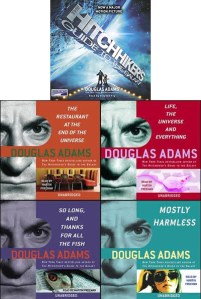 The Hitchhiker’s Guide to the Galaxy by Douglas Adams, narrated by Stephen Fry
The Restaurant at the End of the Universe by Douglas Adams, narrated by Martin Freeman
Life, the Universe and Everything by Douglas Adams, narrated by Martin Freeman
So Long, and Thanks for All the Fish by Douglas Adams, narrated by Martin Freeman
Mostly Harmless by Douglas Adams, narrated by Martin Freeman
Overall rating: 5/5
Very rarely do I stop what I’m doing and think Do you know what would be great right now? A soundtrack of someone reading out loud much too slowly for hours and hours, completely oblivious to whether I’ve become distracted or have just woken up from an impromptu nap with no idea how much story I’ve missed. You see, audiobooks are a form of entertainment that require a strangely specific level of participation on the part of the listener. You must be doing something while you listen, not just staring at a blank wall, but it mustn’t be anything too interesting or you will get distracted and lose track of the story. There simply aren’t many activities in my life that fit this criteria. If I want to experience a certain book, I’ll read it quickly and efficiently in my spare time; if I’m doing an activity that leaves a little brain space free, I’ll listen to music. Even if I were a truck driver, window washer or commuter who relied on audiobooks to stay sane, I’d still consider listening to a book to be an inferior experience to reading a book.
At least, that was my opinion until I heard about five minutes of The Restaurant at the End of the Universe while driving to school with my sister. The first thing that struck me was not Douglas Adams’ bone-achingly funny writing, but Martin Freeman’s extraordinary narration skills. He doesn’t just read, he acts. And, with his plaintive, everyman, English accent, he is perfectly cast. The second thing that struck me was how much funnier and more enjoyable Adams’ humour-packed writing is when delivered at normal speaking speed instead of my usual voracious reading tempo, which barely leaves time to absorb one joke before the next is past. In fact, I felt the series was strangely well-suited to the audiobook format, not realising until much later that The Hitchhiker’s Guide to the Galaxy in fact started as a BBC radio comedy series! So in a sense, the audiobooks are more in tune with the original concept than the books, which could almost be considered spin-offs.
With regard to the quality of Douglas Adams’ writing, I have few complaints besides the dreariness with which the series ends. Sure, there are ups and downs, parts that are brilliant and parts that lag, inventive jokes and cliched ones, but the overall effect is one of astounding genius and imagination.
[Why I listened to it: My sister’s friend listened to the series repeatedly while working as a window washer, so she decided to give it a try and I heard excerpts when we happened to drive to school together. I actually bought the entire book series (in one volume) last year, but had not gotten around to reading it before encountering the audiobooks.]
The Last Chronicle of Barset
 The Last Chronicle of Barset by Anthony Trollope, 5/5
This sixth book in the Barchester Chronicles provides a satisfying, yet bittersweet, ending to the series. The main plot focuses on the unfortunate Reverend Josiah Crawley, an impoverished man of unbending integrity and crippling pride who is, to everyone’s shock, accused of stealing a cheque. Familiar faces abound in the subplots, which include the courtship of disgraced Grace Crawley by Archdeacon Grantly’s widowed son, the romantic tribulations of Johnny Eames and Lily Dale (main characters from the previous book, The Small House at Allington), hen-pecked Bishop Proudie and his dreadful wife’s involvement in the Crawley affair, and the latter years of dear old Septimus Harding, protagonist of the first book in the series, The Warden. Overall, the tone of the book is more serious and less witty than the reader might expect and the stories are somewhat less engaging than could be hoped, but any author that can bring tears to my eyes twice in one book must be doing something right.
A note for readers new to the series: Those with the time and inclination to read the whole series and the patience to endure its lower-quality third and fourth books will be well rewarded. However, for less perfectionist readers, I feel that it is entirely reasonable to skip the third and fourth books altogether. And for readers even less ambitious, the first two books would suffice (the second book, Barchester Towers, is actually my favourite of the entire series). Readers new to Trollope and hesitant to invest time and energy will be glad to learn that the first book, The Warden, is not only the shortest in the series, but gives a very good indication of what they are in for if they continue.
[Why I read it: it concludes the Barchester Chronicles series, which I started six months ago.]
 OmniRambles