
Tagged: Nonfiction
The Weight of Glory and Other Addresses
 The Weight of Glory and Other Addresses by C.S. Lewis, 5/5
I half-expected C.S. Lewis’ intellectual style to be unsuited to the short-speech format, but was only slightly surprised to find that he is as brilliant a writer of sermons as a writer of books. Of the nine essays in this collection, I found “The Weight of Glory” to be the most challenging and “Is Theology Poetry?” the most encouraging, both addressing, to some extent, struggles I am currently experiencing.
My deepening distaste for humanity in general and aversion to interaction with humanity in particular made some parts of “The Weight of Glory” difficult to read and almost impossible to believe (though I have fewer reasons to doubt Lewis’ assertions than to trust them).
It may be possible for each to think too much of his own potential glory hereafter; it is hardly possible for him to think too often or too deeply about that of his neighbour. The load, or weight, or burden of my neighbour’s glory should be laid on my back, a load so heavy that only humility can carry it, and the backs of the proud will be broken. It is a serious thing to live in a society of possible gods and goddesses, to remember that the dullest and most uninteresting person you can talk to may one day be a creature which, if you say [saw?] it now, you would be strongly tempted to worship, or else a horror and a corruption such as you now meet, if at all, only in a nightmare. All day long we are, in some degree, helping each other to one or other of these destinations. It is in the light of these overwhelming possibilities, it is with the awe and the circumspection proper to them, that we should conduct all our dealings with one another, all friendships, all loves, all play, all politics. There are no ordinary people. You have never talked to a mere mortal. Nations, cultures, arts, civilisations – these are mortal, and their life is to ours as the life of a gnat. But it is immortals whom we joke with, work with, marry, snub, and exploit – immortal horrors or everlasting splendours (18).”
Luckily, Lewis can comfort as well as he convicts and I found the following excerpt (greatly weakened by the lack of supporting context) to be a welcome antidote to the noxious mélange of malaise and meaninglessness to which I have been lately putting up an admittedly feeble resistance:
If, on the other hand, I swallow the scientific cosmology as a whole, then not only can I not fit in Christianity, but I cannot even fit in science. If minds are wholly dependent on brains, and brains on biochemistry, and biochemistry (in the long run) on the meaningless flux of the atoms, I cannot understand how the thought of those minds should have any more significance than the sound of the wind in the trees. And this is to me the final test. This is how I distinguish dreaming and waking. When I am awake I can, in some degree, account for and study my dream. The dragon that pursued me last night can be fitted into my waking world. I know that there are such things as dreams; I know that I had eaten an indigestible dinner; I know that a man of my reading might be expected to dream of dragons. But while in the nightmare I could not have fitted in my waking experience. The waking world is judged more real because it can thus contain the dreaming world; the dreaming world is judged less real because it cannot contain the waking one. For the same reason I am certain that in passing from the scientific points of view to the theological, I have passed from dream to waking. Christian theology can fit in science, art, morality, and the sub-Christian religions. The scientific point of view cannot fit in any of these things, not even science itself. I believe in Christianity as I believe that the Sun has risen, not only because I see it, but because by it I see everything else (91).”
[Why I read it: it was given me as a birthday present and I am always eager to read anything nonfiction by C.S. Lewis.]
The Man Who Never Was
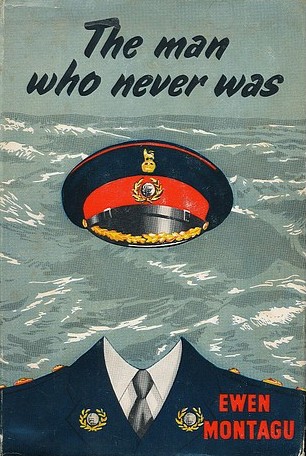 The Man Who Never Was by Ewen Montagu, 4/5
This is the definitive and first-hand account of a real-life wartime deception that bears more similarity to a fictional spy/thriller story than to reality. During WWII, the author was in charge of a scheme to float a corpse bearing falsified military papers off the coast of Spain, in an attempt to trick the Germans into diverting resources from the impending Allied invasion of Sicily. The narrative is simply-told and well-illustrated with numerous photos.
[Why I read it: the retro design on the spine caught my eye at the thrift store and I was somewhat familiar with the historical event the book describes so I bought it for my brother’s library.]
Steal This Computer Book 2
 Steal This Computer Book 2: What They Won’t Tell You About the Internet by Wallace Wang, 1/5
This 2001 version is hopelessly outdated and consists mostly of very generic info and URLs. The little of interest it has to offer is purely archival – references to and screenshots of old-school websites and software. Wang seems to lack the qualifications necessary to write a truly informative book or to live up to his self-styling as a sort of tourist guide to the hacking subculture. His muddled philosophising on politics/ethics does not camouflage what is a blatant attempt to capitalise on the pop-culture appeal of hacking.
My favourite quote from the book is this gem: “…assume that any strange music coming from your computer is from a virus” (227).
[Why I read it: the title caught my eye in the thrift store.]
Mafia!
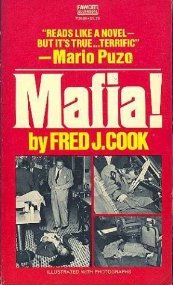 Mafia! by Fred J. Cook, 3/5
For once, the commendatory cover quote on a cheap paperback is accurate! While the book is entertaining and does indeed read like a novel, it is unfortunate that, lacking sources, citations and notes of any kind, it also tends toward the credibility of a novel.
The thing I was most shocked to learn was the fact that upper-class society doesn’t care about morals as long as a person is personally attractive, charming and has plenty of money and power. Perhaps this seems obvious to others, but I could hardly believe the amount of hobnobbing with evil, murdering gangsters that was (and still is, I’m sure) done by celebrities, politicians, and respected businessmen.
[Why I read it: it was a random thrift store find and I admit I partly bought it because of all the fedoras being worn in the vintage photo illustrations inside.]
Understanding X-Rays
 Understanding X-Rays: A Plain English Approach by Mikel A. Rothenberg, M.D., 3/5
Apparently, “plain English” is not-so-plain-English for the most baffling presentation of puns and random clip art I have ever seen published. At the bottom of this post are three of the more traumatising pages in the book.
Despite the format, there is still some valuable info and I enjoyed the more sensible sections, especially the case studies at the end. Even with my lack of medical knowledge, however, the scope of the book felt very narrow and simplistic. I could see it being well-used as a supplement for a class, but it definitely left me wanting more information.
[Why I read it: I became interested in the topic through my frustration at not being able to make much of my friend’s Lisfranc dislocation x-rays. I saw that this book had good reviews on Amazon and likely wouldn’t be too far over my head, so I ordered it through interlibrary loan.]

Unbroken
Unbroken: A World War II Story of Survival, Resilience, and Redemption by Laura Hillenbrand, 5/5
Several people recommended this book to me, so naturally, I expected it to suck (following the observable and direct correlation between popularity and shitness… *ahem* 50 Shades of Grey, Twilight *ahem*). Given this [realistic, not pessimistic] expectation, I was first surprised to find myself not hating the beginning chapter, then shocked to find the rest of the book to be an extremely enjoyable page-turner. Not only does the story have enough drama and action for four movies, but it is based on a true account and is written sensibly. Hillenbrand doesn’t waste the reader’s time or make loads of obnoxious speculations about characters’ subjective feelings. The book is well-formatted, with pictures placed strategically throughout instead of in annoying inserts. The last time I was this surprised to love a book was War and Peace.
Lose It!
Lose It! by Charles Teague and Anahad O’Connor, 1/5
I love the Lose It! website (it’s helped me lose 30+ pounds) but this book has little to recommend itself. The info it provides is shallow and repetitive. The whole eat-a-normal-hamburger-every-day-instead-of-a-supersized-cheesy-one-and-you’ll-save-enough-calories-in-a-year-to-lose-5-pounds method of weight loss is not very convincing or motivating to me. The only reason to buy this book would be to support the free app and website. Everything you need to know can be found on the website, in the forums.
Words Like Loaded Pistols
Words Like Loaded Pistols: Rhetoric from Aristotle to Obama by Sam Leith, 4/5
Leith achieves a great balance with this book – he’s entertaining without being insulting, academic without being dry and analytical without being annoying. Where other writers might exhaustively dissect a piece of rhetoric at the cost of common sense and the reader’s patience (see How to Read Literature Like a Professor), Leith keeps his analyses to-the-point and useful. Less importantly, I enjoyed the English pop culture references – it was fun to see mentions of TV shows and celebrities that I love, but don’t get to share with anyone here.
Mind Reader
Mind Reader: Unlocking the Power of Your Mind to Get What You Want by Lior Suchard, 2/5
This book is pointless B.S. that somehow manages to be very entertaining.
F My Life World Tour
F My Life World Tour: Life’s Crappiest Moments from Around the Globe by Maxime Valette, Guillaume Passaglia and Didier Geudj, 3/5
Basically just like the website, but with more adult content (I thought). I think that the community-contributed nature of the content suits the website more than the book format.
 OmniRambles