
Tagged: Nonfiction
A History of Wales
 A History of Wales by John Davies, 3/5
There is a good reason why this massive book of almost 700 pages is not a very enjoyable read–it was originally written in Welsh for Welsh people and this English translation is merely a concession to popular demand. Davies is very thorough and efficient, providing one or two solid facts in every single sentence, but he doesn’t really make the topic interesting. I felt completely lost just a few hundred years in and failed to get a good overall grasp of Wales’ basic history. And, since I am not knowledgeable about Britain’s political parties, the last couple chapters were almost completely incomprehensible to me. Overall, the book is impressive in scope and makes a good reference, but contains too many details to foster a basic understanding of the topic and does not make the history come alive.
Davies’ portrayal of Welsh history is rather grim–full of poverty, oppression, strikes, and unemployment. While he is not critical of Socialism (which has historically been very popular in Wales), its application did not paint an appealing picture. Perhaps it is just the American in me, but I think I would rather be oppressed by a wealthy coterie of selfish capitalists than earn a government-mandated wage, working in a government-run industry and living in government housing.
Near the end of the book, I became curious about the relative size of Wales, both in area and population. I guessed it would have about as many people as California and cover as much land as Washington State. Shockingly, it turns out that Wales is about 1/9 the size of Washington and has less than 1/12 the population of California (that’s less than half the population of Washington)!
[Why I read it: it was a birthday gift in anticipation of a trip to Wales.]
Frank Skinner
 Frank Skinner by Frank Skinner, 4/5
This autobiography is very funny and very dirty but not often, to my taste, both at the same time. Despite the “knob jokes,” I quite enjoyed the casually-disorganised, friendly tone of the book and the inside view of a man who, contrary to his on-stage persona, seems more artist than arsehole. Skinner’s self-deprecating but jubilant views on success and fame were entertaining without being alienating and his self-conscious defensiveness about his Roman Catholic faith was refreshing.
[Why I read it: I have always enjoyed Skinner’s panel show appearances on the likes of Have I Got News for You, QI, and Would I Lie to You,but didn’t know he’d written a book until Scottish comedian Kevin Bridges cited it as his inspiration to become a stand up comedian. I found a free sample online of the first few pages and lost it at this part:
When I still lived in Birmingham, I dated a stunningly attractive woman. I had been seeing her for about three weeks when I finally asked her where she lived. It turns out she dwelt in what was, at the time, a very rough block of flats called Bath Court. I said, in what I felt was a slightly Wildean tone, ‘The trouble with Bath Court is that the residents spend a good deal more time in the latter than they do in the former.’
‘Where’s “The Latter”?’ she asked. I knew then that our love could never flourish. (6)
My library wouldn’t buy it for me (some bollocks about it not being available in the U.S.), but there was a copy in the first Waterstones book store I wandered in to in London.]
Quiet
 Quiet: The Power of Introverts in a World That Can’t Stop Talking by Susan Cain, 5/5
As a somewhat stereotypical introvert, it’s hard to view this book objectively: how can I resist the charm of a well-written description of the introverted personality’s inherent strengths, along with an expose of the myriad ways introverts are under-appreciated and disadvantaged in modern culture? To be fair, the complexity of the topic requires a twin book, championing an opposing viewpoint, but as far as provoking thought, discussion, providing encouragement to the less-than-bold and making some very interesting points, this book is well rewarding.
Though it sometimes feels that Cain unfairly pits the strengths of introversion against the weaknesses of extroversion, the author generally achieves a well-researched approach to the topic, appropriate to her background and expertise. I appreciate that she restrains herself to a more observational, journalistic point of view, instead of succumbing to the allure of pop science pomposity.
There were several times during the book when I felt a sense of “What? Other people feel like that and do those things too? And that’s considered introversion, not some psychological problem?” It is encouraging to hear that there are other people in the world who reserve their small talk for deep relationships, find shallow social conversations to be unbearably boring, don’t feel connected to the crowd hype at events, would rather hear a teacher’s lecture than fellow students’ ignorant opinions (aired under the guise of “class participation”), would rather be independent than either leader or follower, feel two-faced for acting extroverted in some scenarios, sometimes don’t feel like socializing even with close friends, or feel that people who talk a lot often don’t have much to say.
One of the most helpful ideas I got out of this book was that it’s ok for the same person to have introverted or extroverted reactions to different scenarios: just because I feel reserved and unsocial in one scenario doesn’t mean that I am a faker or insincere for acting outgoing and high-energy in another. According to Cain, finding something you feel strongly enough about (such as a job, idea, or relationship) to make it bearable to sometimes act extroverted, is a positive thing and often a sign of a “core personal project” (209). “Free Trait Theory” gives people the freedom to sometimes act out of character when it is useful to do so, without feeling guilty about the inconsistency (209).
[Why I read it: saw it in a selection of recommended books at the library]
House, M.D. vs. Reality
 House, M.D. vs. Reality: Solving the Puzzles of TV’s Smartest Doctor by Andrew Holtz, 2/5
There is not a single original idea in this tedious book, which is written without wit or authority and manages to suck all the life out of an interesting topic. Holtz, a health journalist with no medical credentials, is good at performing interviews and Googling for relevant documents, but lacks the expertise to add anything of value to the topic or even present his “research” in a unique or remotely engaging way. The main content of the book is paragraphs of direct quotes (often several paragraphs on one page), mindless paraphrasing and TV episode synopses. I almost didn’t even make it through.
[Why I read it: came across it while browsing in the library.]
Project Planning, Scheduling, and Control
 Project Planning, Scheduling, and Control: A Hands-On Guide to Bringing Projects in On Time and On Budget (Third Edition) by James P. Lewis, 4/5
This straight-forward book provides a lot of common sense advice and widely-applicable guidelines for project management. It is easy to understand, even for someone with no experience in the subject (such as myself). Since I was reading more for recreational purposes than practical, I would have enjoyed more anecdotes; the author obviously has a lot of experience and probably some wild stories to tell, but generally refrains from giving too-specific scenarios that would encourage his readers to focus on details and miss out on the larger concepts.
Probably the most interesting thing I got from this book is Lewis’ definition of the concept of “Control”:
Control is exercised by comparing where you are to where you are supposed to be so that corrective action can be taken when there is a deviation from target (526).
If there is no plan, there can, by definition, be no control. This is a concept that I sort of came to on my own, through teaching my brother writing (you don’t know anything about control until you try to get a kid to write a paper), but I hadn’t really put it into words.
Another interesting concept is the difference between closed-ended and open-ended problems. According to Lewis, closed-ended problems have only one possible solution, are past-oriented and benefit from an analytical, left-brained approach. Open-ended problems, on the other hand, have more than one possible solution, are future-oriented, and respond best to a right-brained, synthetic approach (123). This might seem very obvious to some people, but it just wasn’t on my radar. Reading about the two types of problem made me realise that I tend to treat everything in my life like a closed-ended problem.
I would recommend this book to anyone considering project management as a career; Lewis speaks frankly about the responsibilities and challenges inherent to the work, as well as the type of person who might find success in it. I am not that type of person, apparently, since Lewis advises not to get into the career if you tend to think “Projects would be okay if you could just get people to be logical!” (35), a cry that is basically the theme song of all my social interactions…
My only complaint about the book is the large amount of space it wastes with huge, pointless illustrations of the odious “clip art + direct quote from the text” variety. Also, I would be interested to read a more recent, updated version.
[Why I read it: Dad borrowed it from a bookshelf at his work and brought it home for me to read.]
The Voyage of the Beagle
 The Voyage of the Beagle by Charles Darwin, 5/5
This account of Darwin’s 5-year journey around the world is armchair traveling at its finest–every page offering the reader a shameless escape to foreign landscapes and civilisations. The author’s scientific observations are communicated in prose that is both sensible and sensitive. The occasional dry sections are more than compensated for by the few places where Darwin allows himself a poetical description or insightful commentary beyond what is strictly necessary or scientifically relevant.
In much the same way that reading the Seven Pillars of Wisdom completely shattered my unfavourable preconceptions of T.E. Lawrence, this book changed my opinion of Charles Darwin. As a Christian with deeply skeptical tendencies (especially inflamed by scientists’ general attitude of infallibility), I’ve always had an ominous, hazy view of Darwin as some sort of Antichrist of Science. The Darwin of this book was not so. Not only was he a total badass, braving extreme weather, forbidding terrain and a multitude of terrifying insects that I would not feel comfortable viewing in a zoo, much less in my sleeping bag; he was also open to the spiritual aspects of human existence and respectful (even approving) of Christianity. He shows a childlike eagerness to “fill up the wide gaps of knowledge” so obvious to his questioning mind, and a thoughtful humility when identifying any “inaccurate and superficial hypotheses” he might have created in travel-induced haste and enthusiasm. While the book’s focus is mostly on geology, zoology and botany, Darwin does provide information about the human component of his trip, displaying compassion toward the less-fortunate and a marvelling thankfulness toward the helpful. All of which leads me to feel great respect for him, both as a man and a scientist.
A note on the book edition (Bantam Classic, 1958): it is sparsely illustrated and altogether missing a map of any kind. I found myself in the unusual position of needing a map and not finding one, instead of the more usual scenario: seeing an unnecessary map at the beginning of the book and then feeling guilty through the rest for not referring back to it even once. Given the geographical nature of the content and Darwin’s penchant for referring to unfamiliar animals by their Latin names only, I would suggest reading a heavily annotated version of this book, accompanied by as many illustrations and maps as possible.
[Why I read it: saw it in the thrift store for 99¢ and decided it might be a relatively painless way to challenge my preconceptions about Darwin. I hoped it would focus more on travel observations (which it did) than on complicated scientific theories that might put me in the unenviable situation of doubting, but not being knowledgeable enough to refute.]
The Dip
 The Dip: A Little Book That Teaches You When to Quit (And When to Stick) by Seth Godin, 4/5
There’s no “I” in “Quitter,” my family has often joked…but according to Godin, there is and often should be. In this delightfully short book (which, at <80 pages, is the size most popular self-help books would be if they cut the B.S.), Godin makes a compelling case for the use of strategic quitting in the pursuit of the ambitious goal to be the “best in the world” at something. Godin advocates setting high goals, specialising rather than diversifying, persevering through the difficulties that weed out the competition (the Dip), and quitting dead-end/mediocre pursuits in order to avoid living the “sunk cost fallacy,” while freeing up resources for more successful endeavors. All this advice is little more than common sense applied with guts and the book does not pretend to provide some grand, fool-proof philosophy to get rich quick. Instead, it gives a little motivation and encouragement, while stimulating a thoughtful, courageous approach to business and career decisions.
[Why I read it: I think I came across it online or something…I can’t really remember. Anyway, the title caught my eye because I’ve always wondered if my aversion to quitting (and even aversion to starting things that I might be forced to quit at some point) limits my potential or is in fact a healthy approach to challenges. Godin has this to say on the subject: “Simple: If you can’t make it through the Dip, don’t start” (32), but I suspect that at that point, he’s writing more to serial quitters than to potentially over-cautious people. So the book was not completely conclusive on the subject, though it still definitely has something to offer both types of people.]
The Weight of Glory and Other Addresses
 The Weight of Glory and Other Addresses by C.S. Lewis, 5/5
I half-expected C.S. Lewis’ intellectual style to be unsuited to the short-speech format, but was only slightly surprised to find that he is as brilliant a writer of sermons as a writer of books. Of the nine essays in this collection, I found “The Weight of Glory” to be the most challenging and “Is Theology Poetry?” the most encouraging, both addressing, to some extent, struggles I am currently experiencing.
My deepening distaste for humanity in general and aversion to interaction with humanity in particular made some parts of “The Weight of Glory” difficult to read and almost impossible to believe (though I have fewer reasons to doubt Lewis’ assertions than to trust them).
It may be possible for each to think too much of his own potential glory hereafter; it is hardly possible for him to think too often or too deeply about that of his neighbour. The load, or weight, or burden of my neighbour’s glory should be laid on my back, a load so heavy that only humility can carry it, and the backs of the proud will be broken. It is a serious thing to live in a society of possible gods and goddesses, to remember that the dullest and most uninteresting person you can talk to may one day be a creature which, if you say [saw?] it now, you would be strongly tempted to worship, or else a horror and a corruption such as you now meet, if at all, only in a nightmare. All day long we are, in some degree, helping each other to one or other of these destinations. It is in the light of these overwhelming possibilities, it is with the awe and the circumspection proper to them, that we should conduct all our dealings with one another, all friendships, all loves, all play, all politics. There are no ordinary people. You have never talked to a mere mortal. Nations, cultures, arts, civilisations – these are mortal, and their life is to ours as the life of a gnat. But it is immortals whom we joke with, work with, marry, snub, and exploit – immortal horrors or everlasting splendours (18).”
Luckily, Lewis can comfort as well as he convicts and I found the following excerpt (greatly weakened by the lack of supporting context) to be a welcome antidote to the noxious mélange of malaise and meaninglessness to which I have been lately putting up an admittedly feeble resistance:
If, on the other hand, I swallow the scientific cosmology as a whole, then not only can I not fit in Christianity, but I cannot even fit in science. If minds are wholly dependent on brains, and brains on biochemistry, and biochemistry (in the long run) on the meaningless flux of the atoms, I cannot understand how the thought of those minds should have any more significance than the sound of the wind in the trees. And this is to me the final test. This is how I distinguish dreaming and waking. When I am awake I can, in some degree, account for and study my dream. The dragon that pursued me last night can be fitted into my waking world. I know that there are such things as dreams; I know that I had eaten an indigestible dinner; I know that a man of my reading might be expected to dream of dragons. But while in the nightmare I could not have fitted in my waking experience. The waking world is judged more real because it can thus contain the dreaming world; the dreaming world is judged less real because it cannot contain the waking one. For the same reason I am certain that in passing from the scientific points of view to the theological, I have passed from dream to waking. Christian theology can fit in science, art, morality, and the sub-Christian religions. The scientific point of view cannot fit in any of these things, not even science itself. I believe in Christianity as I believe that the Sun has risen, not only because I see it, but because by it I see everything else (91).”
[Why I read it: it was given me as a birthday present and I am always eager to read anything nonfiction by C.S. Lewis.]
The Man Who Never Was
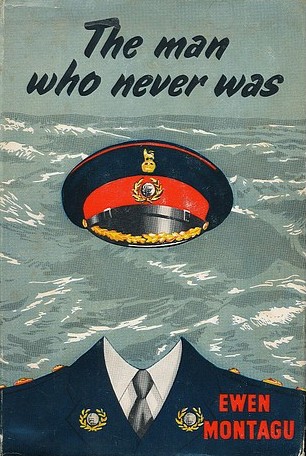 The Man Who Never Was by Ewen Montagu, 4/5
This is the definitive and first-hand account of a real-life wartime deception that bears more similarity to a fictional spy/thriller story than to reality. During WWII, the author was in charge of a scheme to float a corpse bearing falsified military papers off the coast of Spain, in an attempt to trick the Germans into diverting resources from the impending Allied invasion of Sicily. The narrative is simply-told and well-illustrated with numerous photos.
[Why I read it: the retro design on the spine caught my eye at the thrift store and I was somewhat familiar with the historical event the book describes so I bought it for my brother’s library.]
Steal This Computer Book 2
 Steal This Computer Book 2: What They Won’t Tell You About the Internet by Wallace Wang, 1/5
This 2001 version is hopelessly outdated and consists mostly of very generic info and URLs. The little of interest it has to offer is purely archival – references to and screenshots of old-school websites and software. Wang seems to lack the qualifications necessary to write a truly informative book or to live up to his self-styling as a sort of tourist guide to the hacking subculture. His muddled philosophising on politics/ethics does not camouflage what is a blatant attempt to capitalise on the pop-culture appeal of hacking.
My favourite quote from the book is this gem: “…assume that any strange music coming from your computer is from a virus” (227).
[Why I read it: the title caught my eye in the thrift store.]

