
Tagged: Nonfiction
The Man Who Mistook His Wife for a Hat
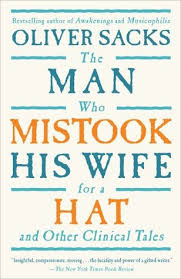 The Man Who Mistook His Wife for a Hat and Other Clinical Tales by Oliver Sacks, 5/5
This book provides a fascinating, if somewhat unscientific and possibly semi-exploitative, exploration of the myriad ways the human brain can go wrong. From the woman who suddenly lost track of her body’s whereabouts, to the one who lost all concept of “left” and the ex-sailor who was inexplicably stuck 30 years in the past—many of the illnesses described in this book are beyond imagination.
[Why I read it: an intriguing title and one of those famous books that has been on my radar for a while.]
Give and Take
 Give and Take: A Revolutionary Approach to Success by Adam Grant, 4/5
This book explores the characteristics, strengths and weaknesses of “givers” (both “otherish” and “selfless”) compared to “takers” and “matchers,” analyzing why givers are more likely to experience extremes of failure or success. Grant illustrates his points with numerous interviews and psychological studies/experiments performed by himself and others, which he works skillfully into the text. This isn’t one of those unsatisfying, modern self-help books that have little original thought and substance to contribute–Grant has something to offer and he doesn’t waste your time.
[Why I read it: So annoying: I can’t remember what put this book on my radar!]
Mossad
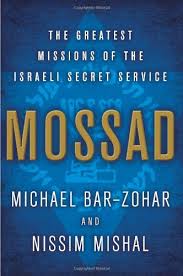 Mossad: The Greatest Missions of the Israeli Secret Service by Michael Bar-Zohar and Nissim Mishal, 4/5
This book contains purportedly true stories that I would have thought only existed in the minds of spy-movie screenwriters. The writing style isn’t very polished and there are lots of dates and foreign names floating around, but I appreciated the long list of sources in the back and the fact that the authors conducted numerous interviews with people who had first-hand experience with the events described in the book.
It’s one thing to enjoy a cool story involving spies, assassination, and intrigue, but when it involves real people and events, ethical issues arise. I’m all for killing the baddies before they kill you, but car-bombing foreign scientists and their wives seems questionable. As does hunting down and murdering war criminals without trial. A couple times, the authors fell back on the Talmudic proverb: “If someone comes to kill you–rise up and kill him first,” but this seems weak justification, given Mossad’s tendency toward the preemptive. In saying this, I am questioning, not criticizing, the ethicality of many of the missions described in this book. I am in no position to understand Israel’s situation, surrounded by countries who actively desire to obliterate them. The U.S.’s neighbors are more kind; perhaps I would be out assassinating Canadian scientists with no compunction if their country were developing nuclear weapons and intended to destroy us.
Ethical concerns about specific missions aside, it is clear from this book that Israel is a kickass nation and their saga of survival is almost beyond belief.
P.S. I just came across this relevant bit of humour in the film The Constant Gardener:
Tessa: “I thought you spies knew everything, Tim.”
Tim: “Only God knows everything. He works for Mossad.”
[Why I read it: the title caught my eye while I was browsing in the library.]
Six Easy Pieces
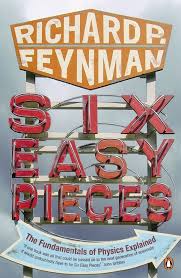 Six Easy Pieces: The Fundamentals of Physics Explained by Richard P. Feynman, 5/5
This book contains six accessible, non-technical lectures from Feynman’s famous Caltech physics course:
1. Atoms in Motion
2. Basic Physics
3. The Relation of Physics to Other Sciences
4. Conservation of Energy
5. The Theory of Gravitation
6. Quantum Behavior
Feynman’s genius, contagious enthusiasm, conversational tone, ability to simplify concepts without dumbing them down, and knack for creating memorable explanations, combine to form a book that allows non-geniuses like myself an intoxicating glimpse into the dazzling world of physics.
[Why I read it: I admit I’m a bit addicted to having my mind blown by theoretical and quantum physics. Also, I had previously developed a minor crush on Feynman during a lecture by my college physics teacher, who had an even bigger crush on him. So when I came across this book in Hay-on-Wye, it was a no-brainer to buy it.]
Escape Artist
 Escape Artist: True Stories of People Who Turned Their Obsessions into Professions by Joshua Piven, 4/5
This refreshing book tells the stories of ten people who rejected the financial security of traditional careers in favour of less-profitable occupations that made them feel happy and fulfilled instead. I enjoyed reading about the chance circumstances, accepted and rejected opportunities, and unpredictable chains of events that ushered these people into occupations they probably couldn’t have planned for and might not even have imagined. I appreciate that Piven doesn’t romanticize these stories, attempt to create some sort of cheesy blueprint for success from them, or devalue the majority of people who are willing to spend half their lives working a normal, 9-5 job.
[Why I read it: I came across it while browsing the library and the topic is relevant to me.]
Think on Your Feet
 Think on Your Feet: Presenting Your Ideas with Clarity, Brevity and Impact by Keith Spicer, 3/5
This slim workbook focuses on ten mnemonics to aid organization and presentation of ideas in public speaking and Q&A situations. I think the method is more a systematized deconstruction of common-sense processes than anything too groundbreaking. While it is fun to identify uses of the different categorizations (in terms of time, place, aspects, images, cause-effect, changing perspectives, extremes, advantages, opposites/contrasts and storytelling), I think most people who possess rudimentary organization skills would find them to be extraneous, as a logical system of organization would more likely emerge from their topic organically. However, people who are unfamiliar with basic essay writing techniques such as the idea of having a concise thesis and supporting points connected by transitions, or people who have to contrive a speech at short notice on an unfamiliar topic, might find this book to be very helpful.
[Why I read it: my dad attended a work seminar on the topic and brought the book home.]
101 Things I Learned in Law School
 101 Things I Learned in Law School by Vibeke Norgaard Martin with Matthew Frederick, 4/5
There is a great variety of “things” in this book, including definitions of legal terms, descriptions of famous court cases, discussion of concepts (both practical and theoretical), relevant quotes, differences in law practice between U.S. states and general advice for lawyers. By the end, I was wishing it covered 1001 things, not just 101.
The tone of the book is simple and straightforward without appearing dumbed-down. I’m not sure if any actual lawyers or law students would find it very enlightening, but it is perfect for someone who has a casual interest in the topic and/or enjoys watching legal dramas on TV. The illustrations are fun and keep the book light.
[Why I read it: came across it while browsing in the library. Law is an interesting topic to me, though I don’t think I could ever pursue it seriously because of Thing #2: “Lawyers must be honest, but they don’t have to be truthful.” The whole setup–two sides fighting to win–seems so wrong compared to the ideal: one side fighting to discover the truth.]
The Art of War
 The Art of War by Antoine Henri Jomini, translated by Capt. G. H. Mendell and Lieut. W. P. Craighill, 4/5
I’m sure people who know things could have a spirited discussion about the merits of Jomini’s theories, especially vs. those of his contemporary, Clausewitz. Sadly, I am not one of those people, having but a feeble grasp of the workings of war and having read Clausewitz’s On War too long ago to remember much. But judging merely from the viewpoint of style, I found Jomini much preferable. His writing is concise, cogent, and reasonably readable. He seems more confident than Clausewitz, less defensive and more interested in proving theories right or wrong instead of proving himself right and others wrong. (Though he isn’t above the occasional bitchy remark, such as referring to “General Clausewitz, whose logic is frequently defective…”).
Without a map of Europe on hand, and lacking a detailed knowledge of Napoleon’s campaigns, I probably absorbed about 10% of this book’s intended effect. Because I got lost in the historical parts, my favourite sections were the practical ones, with nitty-gritty details, specific scenarios and diagrams (such as the entertaining chapter on “Different Orders of Battle”). Jomini’s ideas are easily boiled down into compact sentences and I believe this one summarizes the basic logic behind the entire work: “Every maxim relating to war will be good if it indicates the employment of the greatest portion of the means of action at the decisive moment and place” (295).
[Why I read it: I found it in a box of my brother’s books and set it aside to read later. Many years later. No doubt, he has given it up for lost and will be surprised to be reunited with it soon.]
The Day the World Came to Town
 The Day the World Came to Town: 9/11 in Gander, Newfoundland by Jim Defede, 3/5
This story of a small town that stepped up to take care of over 6000 passengers and crew of flights diverted due to the terrorist attacks of 9/11 is competently written, but I did not find it particularly engaging or affecting. If approached at all cynically, it could even have a slightly mercenary feel, as if a small-time news reporter was trying to make it big by telling someone else’s story.
[Why I read it: I came across the book’s Amazon page through work and saw that it had ridiculously positive reviews.]
No Man Is an Island
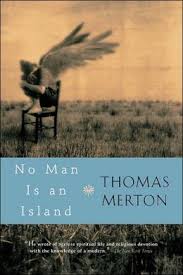 No Man Is an Island by Thomas Merton, 3/5
At first, I thought this collection of thoughts on 16 different spiritual topics was reasonably profound and insightful. It wasn’t until Merton started saying, with blithe confidence, things I doubted or disagreed with that I missed the intellectual underpinnings characterising the likes of C.S. Lewis and G.K. Chesterton. Merton’s unintellectual approach to spiritual matters is made palatable by his eloquent writing skills, perhaps dangerously so. Those who approach this book wishing to be told what to think could quite possibly be led into error, but those who have already given thought to such topics will likely recognise much truth in what he says.
[Why I read it: the title is appealing and seemed relevant to my life at the moment. I originally thought the phrase “no man is an island” came from this book, but it actually originated in a poem by the 17th-century poet John Donne. Interestingly, from the same short poem comes the phrase “for whom the bell tolls.”]
 OmniRambles