
Tagged: Nonfiction
Born to Run
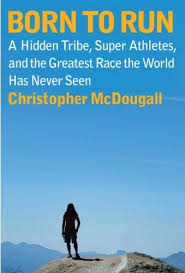 Born to Run: A Hidden Tribe, Superathletes, and the Greatest Race the World Has Never Seen by Christopher McDougall, 4/5
It’s no wonder this entertaining tale is a bestseller that helped fuel the natural running craze–it has all the right ingredients: a mysterious Mexican tribe renowned for long-distance running ability, a legendary and equally mysterious American runner who gained their trust, superhuman athletes running ultramarathons in unbelievably punishing conditions, scientific evidence that natural running is…well…natural, and all told from an intoxicating “everyman” perspective that makes you feel that you too could learn to run forever.
As an inspiring story, I give it full points. But. As an ethnography or scientific case for natural running, not so much.
Yes, I am an unattractively skeptical person, but I’ve been burned before (see The Long Walk and The Third Eye) and something definitely smells fishy about this book. It is an issue of trust and McDougall doesn’t exactly make it easy for the suspicious reader. Thanks to the paucity of corroborating material online and the book’s lack of citations, endnotes, and pictures, one must simply trust that McDougall is telling a true story and not succumbing unduly to the temptation to sensationalize, romanticize and otherwise manipulate the truth. The author’s background in journalism is not enough to assuage my suspicion that much was sacrificed in the interest of The Story.
McDougall’s case for natural running features interviews with various experts in the field and interesting statistics/studies, but his approach is one-sided, oversimplifying a complicated topic that is still much debated and far from resolved. Also, if “a little learning is a dangerous thing” then readers beware–there is very little technical, practical information to arm the newly-inspired disciple of natural running. However, the author undoubtedly achieves what seems to be his main goals–general entertainment and inspiration.
[Why I read it: My dad was sorting through some of his books and thought I might be interested.]
Your Money or Your Life
 Your Money or Your Life: 9 Steps to Transforming Your Relationship with Money and Achieving Financial Independence by Vicki Robin and Joe Dominguez with Monique Tilford, 3/5
Comparing this book to Robert Kiyosaki’s Rich Dad series, it soon becomes clear that the concept of financial independence means different things to different people. To some, such as Kiyosaki, it seems to mean being able to live a luxurious lifestyle, supported by more money than they could possibly spend. Unfortunately, this seems to coincide with dedicating your life to the all-engrossing pursuit of ever-increasing income, which at the end doesn’t really look like independence to me. To those who see financial independence more as freedom from obsessive worry over money, Your Money or Your Life asks a question that Kiyosaki would find completely nonsensical: How much money is enough? It turns out that, thanks to some inexplicable vagary of the human condition, more and more money does not necessarily equal more and more happiness. The authors argue convincingly that peak fulfillment occurs when we have enough money for the things we need and a little bit more. By this metric, financial independence is achieved when one’s passive income covers these basic expenses and little luxuries.
Given the mindless consumerism endemic to the average American, it is no surprise that the authors would choose to focus on the low-hanging fruit of lowering expenses rather than the more complicated issue of creating passive income. Similar to keeping a food diary in order to lose weight, the mere act of tracking expenses, realizing the expended life-energy they represent and assessing the resulting feelings of fulfillment or lack thereof could be a relatively painless way to increase savings, lower debt and create a healthier relationship with money. However, my personal saving rate is already so high and my expenses so low (my three main hobbies–reading, exercising and surfing the internet–cost less than most people’s coffee habit) that I don’t think any life-changing revelations would come out of applying the book’s method for tracking finances.
I am much more interested in developing sources of passive income, which is a topic that is not addressed very well in this book. This was very disappointing and surprising, since passive income plays such a huge part in the book’s own description of financial independence. The authors’ main (basically, only) advice is simply to buy U.S. treasury bonds. As far as I can understand, you’d have to tie up about $350k in 30-year treasury bonds in order to make just $10k a year at the current 2.87% yield. I don’t see how this could be a viable path to financial independence for most people, but I guess I need to do more research.
[Why I read it: It was mentioned in a book review of Rich Dad, Poor Dad by Trent Hamm on The Simple Dollar blog.]
Present Concerns
 Present Concerns: A Compelling Collection of Timely, Journalistic Essays by C.S. Lewis, 4/5
The necessarily limited length of these articles means that Lewis doesn’t have time to fully develop and defend his opinions, but they are still a joy to read and cover a stimulating variety of topics (in addition to the ever-present subject of Christianity) such as history, philosophy, education, and morality. Some of the essays have not aged well and some would be of little interest to the average reader, but overall they are a nice supplement to Lewis’ more in-depth works.
[Why I read it: It seems that just when I think I’ve read everything C.S. Lewis ever wrote, something else turns up. I think I picked this unfamiliar title up at some used bookstore or other.]
Be Ready When the Sh*t Goes Down
Be Ready When the Sh*t Goes Down: A Survival Guide to the Apocalypse by Forrest Griffin and Erich Krauss, 3/5

 This book is extremely crude and full of hilariously bad advice, but is also somehow endearingly funny. Definitely not a book you’d want to read in public or, for that matter, send your mom and little sister to pick up for you at the library (true story)…
[Why I read it: I enjoyed Griffin’s other book Got Fight.]
How to Talk American
 How to Talk American: A Guide to Our Native Tongues by Jim “the Mad Monk” Crotty, 3/5
This haphazard collection of vernacularisms is fun, though not at all up to the standards of a proper dictionary. I especially enjoyed the words spelled to reflect regional pronunciation, such as “PSDS” (pierced ears), “sssta” (sister), “dreckly” (soon. “We’ll be at the store dreckly.”), and “tamar” (the day after today).
[Why I read it: came across it in the thrift store and thought it looked interesting.]
Democracy–The God That Failed
 Democracy–The God That Failed: The Economics and Politics of Monarchy, Democracy, and Natural Order by Hans-Hermann Hoppe, 2/5
This series of essays starts out strong, with the author daring to question the hallowed concept of democracy and finding it severely lacking in several easily demonstrable ways. However, common sense and strong opinions can only take you so far when it comes to formulating complicated theories of politics and economics. As Hoppe’s ideas became more and more bizarre, I became increasingly angered by his failure to provide convincing supporting arguments or hard data of any kind. I couldn’t figure out why an obviously intelligent academic would present his opinions so insultingly, through shallow reasoning, cheap rhetoric and gross oversimplification. After quite a lot of teeth gnashing, I finally realised the problem was identified right in the first sentence of the book’s introduction: the essays were originally speeches written for Libertarian conferences. The whole point was to fire up sympathetic audiences, not necessarily to convince anyone of anything. I wish I’d known this ahead of time, because maybe then I’d have been spared the prospect of Hoppe’s horrifying “solution” to the problem of democracy: an “anarchic” private law society, overseen by military-grade private insurance corporations.
[Why I read it: it came up in conversation with my brother.]
Rich Dad’s Guide to Investing
 Rich Dad’s Guide to Investing: What the Rich Invest In, That the Poor and Middle Class Do Not! by Robert T. Kiyosaki, 2/5
Given this book’s large size, I hoped to find a lot of helpful, practical information in it that would help me learn the basic concepts and vocabulary of investing and perhaps give some direction on how to best invest any “excess” cash I might accumulate. Disappointingly, Kiyosaki’s anecdotal style, focus on generalities, and avoidance of technical terminology rendered the book almost completely unhelpful. There are a couple interesting concepts, such as creating valuable businesses yourself instead of simply investing in other people’s businesses and using your business to purchase assets so that you can stay poor on paper and avoid paying tax. Unfortunately, much of the information seemed pretty sketchy and the author provides very few examples of his ideas in action. Overall, this book felt like a waste of time and casts a rather charlatan shade over Kiyosaki’s whole financial self-help enterprise.
[Why I read it: I’ve read several of Kiyosaki’s books and this one looked interesting.]
Got Fight?
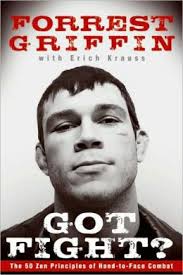 Got Fight? The 50 Zen Principles of Hand-to-Face Combat by Forrest Griffin, with Erich Krauss, 4/5
This in-your-face manliness manifesto was much, much funnier than the front cover lead me to expect, what with its bashed-up author and stupid title (to which Griffin vociferously objected, to his credit). What it is: an R-rated, surprisingly witty, expletive-filled, laugh-inducing series of ramblings that are mostly centered on martial arts and dubious advice about being a Man. What it is not: a martial arts how-to guide or factual account of Griffin’s MMA experience.
[Why I read it: I love MMA and pounced on this after my dad picked it up at the thriftstore.]
Deeper Thoughts
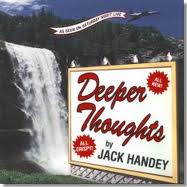 Deeper Thoughts by Jack Handey, 5/5
This is a hilarious collection of random, unreasonably funny quotes, such as:
“Probably the earliest fly swatters were nothing more than some sort of striking surface attached to the end of a long stick.”
“I wish my name was Todd, because then I could say, ‘Yes, my name’s Todd. Todd Blankenship.’ Oh, also I wish my last name was Blankenship.”
“Sometimes I think I’d be better off dead. No, wait. Not me, you.”
[Why I read it: I came across the book in the thrift store and recognized the author from reading his stuff online. I bought the book for my brother, Samuel, but had to read it before sending it to him.]
Alex & Me
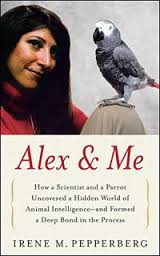 Alex & Me: How a Scientist and a Parrot Uncovered a Hidden World of Animal Intelligence–and Formed a Deep Bond in the Process by Irene M. Pepperberg, 2/5
Readers looking for more than a heartwarming animal story will be disappointed by this relentlessly unscientific book. Pepperberg spends more time complaining about being unappreciated by the scientific community, blatantly anthropomorphizing her parrot and giving unsubstantiated anecdotes of Alex’s human-like behaviour than providing anything of academic interest. I was annoyed right from the beginning of the punishingly emotive first chapter, which is all about the emotional trauma that Alex’s death caused the author. Pepperberg appreciatively quotes a letter from a lady who said the parrot’s demise caused her as much grief as the death of her only child, even though this long-distance sympathiser had never even met Pepperberg or Alex! Now that’s just crazy talk, but the author treats it as a matter of course. While some interesting comments are made about the model/rival method of teaching (where the learner observes two trainers interacting), no satisfying explanation is given of the time between Alex being taught, with difficulty, his first word and Alex spontaneously spouting grammatically correct, complete sentences in response to complex social scenarios. Given Pepperberg’s credentials, I can only assume that she is a legitimate scientist, but this book is not at all convincing.
[Why I read it: frustratingly, this book has been sitting by my bed for so long that I can’t even remember why I ordered it from the library in the first place. I think it might have been mentioned in some other book I read.]
 OmniRambles