
Tagged: military
Discipline Equals Freedom

Discipline Equals Freedom: Field Manual MK1-MOD1 (expanded edition) by Jocko Willink, 2/5
Reading this book is certainly more convenient than buying 200 motivational posters and sitting in a dark room while someone shouts their slogans in your ear and smacks you with the cardboard tubes they were shipped in.
Why I read it: my husband bought it.
The Code. The Evaluation. The Protocols.

The Code. The Evaluation. The Protocols. Striving to Become an Eminently Qualified Human by Jocko Willink, with Dave Berke and Sarah Armstrong, 1/5
I have a ton of respect for Jocko Willink…BUT…this book is so absolutely ridiculous that I’m not even sure if his advice to “Set physical goals like running a 5K or deadlifting 8000 pounds” (2.4) is a typo or not. Overlooking the trademark typewriter font (which is borderline unbearable), awkward formatting, and repetitive language, I still cannot imagine many scenarios in which a rigorous, score-based method of evaluating one’s progress towards godhood would be necessary or useful. The “Protocols” are a one-size-fits-all series of steps for addressing each of life’s little problems (such as death, trauma, and addiction) in a style that can only be described as bizarrely confident and obliviously motivational.
Why I read it: my husband bought several of Jocko’s books.
Leadership Strategy and Tactics

Leadership Strategy and Tactics: Field Manual by Jocko Willink, 3/5
I appreciate the specific leadership (and followership) scenarios that Willink addresses in this book, but it feels somewhat contrived and disjointed. I suspect it would make a better reference resource than a cover-to-cover read.
Why I read it: working my way through Jocko Willinks’ books, if slightly out of order.
Extreme Ownership
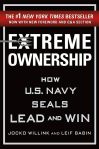
Extreme Ownership: How U.S. Navy Seals Lead and Win by Jocko Willink and Leif Babin, 4/5
This book’s layout is flawless: each chapter starts with an engaging war story, extracts a leadership principle for further analysis, and concludes with a real-life application to business. My only complaint is that the authors often stop short in each example of exploring the actual results of their approach, sometimes failing to address the outcome altogether and other times glossing over it with vague descriptions of generic success. The question left, for me, is not whether the authors are effective hammers, but what scenarios realistically constitute appropriate nails.
Why I read it: It’s been on my radar for quite a while.
Red Platoon

Red Platoon: A True Story of American Valor by Clinton Romesha, 5/5
This harrowing story gave me a renewed sense of respect and empathy for all U.S. service members who have seen combat. I have several family members in the military, including a couple who have been deployed to the Middle East, but I’ve never asked for any war stories and they’ve never told me any. It’s not that I’m uninterested, it just feels rude (or worse, tacky) to pry. After all, I wouldn’t ask a police officer how many people they’ve shot or a newly single person why they got divorced. Because of this, it felt like a rare privilege to read such a raw account of danger, bravery and sacrifice. I’m thankful the author was willing to relive such a personally traumatic experience and honor the dead’s memory with a permanent, written record.
Why I read it: my brother, Ian, recommended it to me.
 OmniRambles