
Tagged: history
Castles
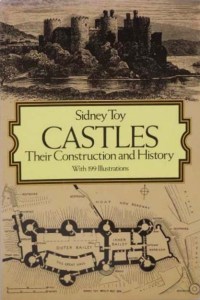 Castles: Their Construction and History by Sidney Toy, 2/5
Never has a book more sadly lacked a glossary! In retrospect, I should have created one of my own as I encountered endless, undefined technical terms like “barbican,” “corbel,” and “machicolation.” Because the author is very good at describing castles in painstaking detail and creating architectural drawings, this book has historical value as a record of the condition of various castles at the time of the author’s visits (pre-1939). Unfortunately, however, Sidney Toy is more focused on presenting data than interpreting it, so there is very little narrative flow or sense of the bigger picture as far as castles’ construction and history in general is concerned.
Why I read it: With several castles on the itinerary for a recent trip to Ireland, I was hoping to gain some knowledge on the subject, but this book was disappointingly unhelpful.
In the Garden of Beasts
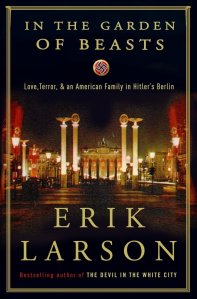 In the Garden of Beasts: Love, Terror, and an American Family in Hitler’s Berlin by Erik Larson, 5/5
It’s been a long time since I picked up a book that I couldn’t put down again (especially a nonfiction one), but I read this for 3 hours straight one morning and finished it almost in one sitting. This true story takes place in an odd slice of history–the years directly preceding the outbreak of WWII, as Hitler consolidated his power in Germany and gradually revealed the extent of his aspirations to the tentative but growing concern of the rest of the world. The characters on whom the story focuses are even more odd: an elderly academic, appointed in desperation to the role of American Ambassador to Germany when more qualified men turned it down, and his free-spirited daughter who lets few opportunities to party and sleep with the enemy slip through her fingers, despite the delicacy of her family’s situation in Nazi Germany. Even more interesting than the political twists and turns of this turbulent time are the many appearances of famous and infamous entities, portrayed from a more personal, intimate perspective than the hard, cold light that history usually shines on them. Author Erik Larson somehow achieves a well-researched tone without diminishing the natural drama of events.
There were, as might be expected, many horrifying things in this book. What was unexpected to me, however, was the source of this horror. I was most shocked, not by Hitler and his Nazis’ iconic atrocities, but by the greedy, irresponsible, antisemitic attitudes documented in the behavior of many U.S. politicians and other high-profile citizens. Many influential policy-makers were more than willing to identify a so-called “Jewish Problem” in the U.S. and seemed more interested in Germany’s ability to repay high-interest war loans than any human rights concerns. Wealth and social prestige, unbelievably, seemed to be acceptable qualifications for positions of world-event-affecting influence and politicians trusted by the U.S. public to guide their country in perilous times floundered without coordinated priorities or plans. Hindsight, as they say, is 20/20, but knowing in retrospect the millions of lives that were at stake makes the outcome of events documented in this book seem even more tragic.
Why I read it: My friend, Peggy, passed it on to me.
Tapisserie de Bayeux
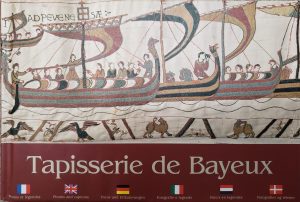 Tapisserie de Bayeux: Photos and Captions of Bayeux Tapestry, published by Éditions Artaud Frères, 5/5
This high-quality souvenir book contains photos of the complete 11th-century Bayeux Tapestry and terse captions in six languages, outlining events leading up to the Norman conquest of England and culminating in spoilers King Harold’s death at the Battle of Hastings in 1066. The needlework is charmingly quirky, from the multi-colored horses to the occasional nude figures in the border, proudly displaying their embroidered nethers to my extreme amusement.
Why I read it: this book has been in my to-read pile for so long that I can’t remember where or when I bought it. Glad I did, though!
Sophie’s World
 Sophie’s World: A Novel About the History of Philosophy by Jostein Gaarder, translated by Paulette Møller, 2/5
The most thought-provoking aspect of this reading experience was simply trying to understand how a book featuring such peculiarly bad writing could be published at all, much less become an “international bestseller.” Half of it consists of dialogue between two-dimensional characters, so stilted and unnatural it has to be read to be believed. The other half reads like increasingly vague course descriptions for philosophy classes taught by someone who considers Wikipedia articles to be the pinnacle of literary accomplishment through the ages. In my experience, fiction writing this bad generally relies on themes like sex, mystery or fantasy to attract readers, so I guess in a twisted way this book’s very existence is a testament to the powerful appeal of philosophical ideas and the ubiquity of existential angst.
Why I read it: recommended to me by a gym friend.
Treasure Hunting Northwest
 Treasure Hunting Northwest by Ruby El Hult, 3/5
This follow-up book to Lost Mines and Treasures of the Pacific Northwest is shorter, more elegantly written and can stand alone.
Why I read it: the title caught my eye in a used bookstore.
Lost Mines and Treasures of the Pacific Northwest
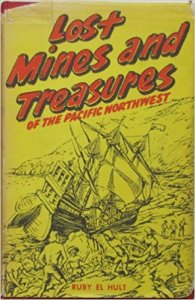 Lost Mines and Treasures of the Pacific Northwest by Ruby El Hult, 3/5
This book, written in 1957 about events that largely took place in the late 1800s, occupies a strange middle ground both methodologically and temporally. Not only was the author’s research ability limited to the pre-Information Age resources of her time, but there was the further complication of the existence of personal accounts from living people who were within a generation or two of original events (close enough to be convincing, but not close enough to be reliable). Thus, the book is an awkward mix of fanciful hearsay and dry research that takes a few chapters to get into the spirit of. Whether entirely true or not, these stories provide interesting insight into the early history of the Pacific Northwest and the world of pioneers, pirates and prospectors.
Why I read it: The sequel, Treasure Hunting Northwest caught my eye in a used bookstore so I thought I’d better buy the original too.
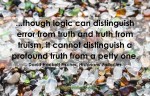
Picture Quote — David Hackett Fischer

Background photo is from Glass Beach in Fort Bragg, California. © 2016 omnirambles.com
Historians’ Fallacies
 Historians’ Fallacies: Toward a Logic of Historical Thought by David Hackett Fischer, 5/5
Fallacies everywhere! Browsing through eleven categories of faulty reasoning, all illustrated by examples from published works of historical scholarship, made me feel like a kid in a candy shop. My initial reservation–that it isn’t very respectable to do nothing but pick apart the works of one’s colleagues–was satisfactorily addressed in Fischer’s deliciously cogent introduction to the book. Here, the author acknowledges the dual impossibility and necessity of defining a logical approach to the study of history and justifies his negative method with the respectable goal “to extract from these mistakes [in other historians’ reasoning] a few rough rules of procedure” (xviii).
Though some may find his approach off-puttingly critical, the author is no intellectual slouch–many of the fallacies he addresses are so subtle that I am impressed he could identify them at all, much less find relevant examples in the wild. Though the topic is very specific, the application is broad–historians aren’t the only ones who are susceptible to fallacies of question-framing, factual verification, factual significance, generalization, narration, causation, motivation, composition, analogy, semantical distortion and substantive distraction.
Why I read it: The title caught my eye as I was browsing through Easton’s Books. The owner was so surprised that someone was actually interested in the book (he’d almost thrown it out, thinking no one would ever buy it) that he gave me a discount and said I’d made his day.
A picture quote I made:
The Constitution of the United States of America
 The Constitution of the United States of America, 5/5
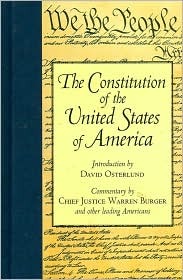
It is tax season, so perhaps I can be forgiven for expecting “the supreme law of the land” to be as ludicrously bloated and unreadable as the Internal Revenue Code. Fortunately, it is not so–the fifty-five delegates to the 1787 Philadelphia Convention crafted a document of startling elegance, simplicity and practicality (probably marking the first and last time such adjectives could be used to describe a piece of legislation).
[Why I read it: I planned to send this copy to my brother after reading it myself, but it sat in the pile of books by my bed until it became assigned reading in my business law class.]
The First and the Last
 The First and the Last: The Rise and Fall of the German Fighter Forces, 1938-1945 by Adolf Galland, translated by Mervyn Savill, 3/5
This memoir by Adolf Galland, a German fighter pilot and Luftwaffe General of Fighters during WWII, is undoubtedly an invaluable resource for the student of history, but I did not find it to be written in a particularly engaging manner. The parts I found most interesting were those describing Galland’s personal encounters and conflicts with Hermann Göring and Hitler, with whom Galland had major disagreements over policies that focused on bombers to the detriment of the fighter wing, handicapped fighters by forcing them to operate defensively instead of offensively, and spread the air force’s assets too thinly. Of course, Galland comes off rather well in the memoir, so it is difficult to tell what is accurate and what is embellished in retrospect (whether purposefully or not).
Like many others, I presume, my exposure to WWII was mostly of the sanitized, black and white version found in history textbooks. It was thought-provoking to see the war from a different, more morally-ambiguous point of view. Galland did not seem to experience any moral conflicts regarding Hitler’s actions; he may have doubted his führer’s method of conducting the war, but he didn’t raise any concerns about Hitler’s ideology. Except in the case of his under-trained fighters being sent out on what amounted to suicide missions, his mindset was very much that of a faithful cog in the war machine, as was the case, I suspect, with the vast majority of people who fought and died for the Axis.
When I think of civilian casualties during WWII, the first thing that comes to mind is the London Blitz. That chapter of England’s history is not unduly disturbing to me because 1) I [incorrectly] picture everyone hiding in bomb shelters while empty buildings take the brunt of the violence and 2) the Germans were the baddies and thus could be expected to target the civilian population. This naive point of view was shattered when I read Galland’s account of the Allied bombing of German cities, in which hundreds of thousands of German civilians were killed (including thousands of children). I always pictured collateral damage occurring only in the course of bombings of war factories and industries vital to sustaining the war effort. I never pictured the “Good Guys” taking off to purposefully destroy cities and centers of culture, filled with normal people. It’s always been my unthinking opinion that if a country is at war, it’s civilians are at war too, but this first-hand account was hard to stomach.
[Why I read it: my sister enjoyed it first.]
 OmniRambles