
Tagged: health
Fast Like a Girl

Fast Like a Girl: A Woman’s Guide to Using the Healing Power of Fasting to Burn Fat, Boost Energy, and Balance Hormones by Dr. Mindy Pelz, 3/5
It is refreshing to read a diet book written specifically for women. This is the clearest layout of the female hormone cycle I’ve ever encountered, accompanied by easily understandable nutritional guidelines for each stage–a welcome break from the one-size-fits-all approach of most programs. The author makes an impassioned and compelling argument for the “miraculous” healing power of fasting but, unfortunately, relies heavily on anecdotal evidence from her own practice. Like many questionable health gurus, Pelz has a doctorate in chiropractics and her main source of credibility seems to be a few celebrity clients and the following she has built by posting hundreds of YouTube videos on topics for which she has zero formal education. Much of what she states without reservation seems to reside in that twilight zone of science where it may be correct, but has yet to be satisfactorily proven.
Now, I am not a blind believer in mainstream medicine–I feel there is an air of undeserved infallibility about it, closed-mindedness, and conflicts of interest that slow progress unnecessarily. However, even a little research into Dr. Mindy and her fasting regimen rings warning bells. She has built an entire program and community around her ideas, yet there is not a single Doctor of Medicine on her 24-person team. Dietician Abby Langer has written an excellent review of Fast Like a Girl that points out the cult-like aspects of Pelz’s program and is able to put her finger on some of the over-confident language in this book that made me uncomfortable without quite knowing why. Curious, I did just a little further research on the much-vaunted concept of fast-induced autophagy, finding that Pelz not only fails to mention the potential negative effects of autophagy, but also bases her 17-72 hour fast guidelines on a study of baby mice that cannot be extrapolated to human subjects and neither supports her recommendation, nor even the actual statement in the book to which the endnote is appended (32).
Another issue I have with Pelz is her attempt to discredit calorie-restriction diets by employing the straw man fallacy (5). As someone who has personally achieved substantial, long-term, transformative weight loss through calorie counting, I found her depiction of calorie-restriction diets to be either ignorant or downright deceptive (depending on how generous you want to be about her motives). She cites a study from the 1960s called the “Minnesota Starvation Experiment” in an attempt to discount an approach to weight loss that is completely reasonable, commonsense, accessible, and has worked for many, many people. I achieved metabolic health, according to her own definition, through calorie counting and exercise. Sure, there are many times I have slept in and had a very late breakfast…does the fact that I went 15 hours between dinner and breakfast mean that I fasted? According to Pelz, yes, and I can expect health miracles if I continue do this a lot. According to commonsense, no!
The author’s attempt to demonize calorie-restriction diets becomes even more ridiculous when you get past the fasting section of the book and reach her actual “30-Day Fasting Reset,” which involves two diet plans (ketobiotic and hormone feasting), along with a bunch of complicated and gross-sounding recipes. It feels like a total bait-and-switch to be told that, in addition to fasting, one should also adhere to a diet that is much like any other diet that people routinely fail to stick with. We’re told to avoid bad oils, refined flours and sugar, toxic chemical ingredients, and alcohol, while adding in specific healthy foods (all organic, non-GMO, hormone-free, obviously). Duh! How is this different from other diets? How is someone who fails at traditional diets going to have success trying to eliminate processed foods, sweetener in your coffee, breads, pastas, crackers, and desserts? How is this better than counting calories and experiencing for yourself the value of choosing nutrient dense foods over empty calories? I honestly cannot comprehend how anyone who is struggling with weight loss would be able to stick with this diet plan over others. So, what we are left with is some very cliched diet recommendations, six different fasts (all under-researched), and some information about what types of foods might support female hormones at different times of the month (no citations given).
One might be justified for wondering why I would give a book that I perceive to have so many issues a decent, 3/5 rating. The reason is this: I respect the author’s exploration at the cutting edge of nutrition and medicine, and appreciate her focus on the female experience. Just because the scientific research on fasting doesn’t yet justify specific guidelines doesn’t mean it’s not a concept of value, worth experimenting with (especially for people who have tried literally everything else).
Why I read it: my dad sent me a podcast featuring Dr. Mindy, but I would rather read a book than listen to a podcast any day.
What to Expect the First Year
What to Expect the First Year by Heidi Murkoff, 3/5
My husband and I were fortunate enough to have the world’s most chill baby, so I didn’t bother reading most of this book until we were halfway through year two of parenthood. Though raising our little guy has definitely become more challenging as he matures, the first twelve months were relatively straightforward; most issues that came up were easily addressed by a quick internet search, knowledgeable friends and family, or at medical check-ups. I didn’t feel the anxious anticipation, curiosity, and solitariness of first-time pregnancy that made What to Expect When You’re Expecting so comforting and helpful. For me, this book occupies a weirdly unhelpful middle ground, at times too hyper-focused to be practical or too general to be a reliable source for researching complex issues (especially controversial ones like vaccinations or discipline).
Why I read it: a friend and parent of two young children recommended it very highly.
Training for the Uphill Athlete
Training for the Uphill Athlete: A Manual for Mountain Runners and Ski Mountaineers by Steve House, Scott Johnston and Kílian Jornet, 5/5
This bible for uphill endurance athletes accomplishes what most other sports and fitness books promise and fail to do: give readers a solid understanding of the physiological effects that specific training has on their bodies and the ability to use that knowledge flexibly in the pursuit of their own athletic goals. The fact that a book could never fully substitute for a good coach does not seem to discourage the authors from trying, and their approach to the topic is extremely well-conceived. They avoid the common shortcomings of only providing information that is too general (here are some good exercises!) or too specific (here is a complete training plan for a 125lb female athlete with 3 years of experience, coming off an ankle injury!). Additionally, the photographs in this book are abundant and exceptional. If there were such a thing as an armchair athlete, this book would be very satisfying for them.
Every sport deserves to have a training guide like this one but, selfishly, I’m kind of bummed out that it exists for such a niche and not for any of the martial arts or even “normal” running. Mountain running seems so…extra…and I’d never even heard of ski mountaineering (skimo) before. Still, as the authors point out, “Increasing aerobic capacity has major benefits to all athletes regardless of the duration of the event they are training for” (54). Perhaps the most broadly-applicable chapter is the one titled “The Physiology of Endurance,” which debunks the VO2 max as the holy grail of fitness and explains how and why plentiful training at low- to moderate-level intensity, interspersed strategically with short, high intensity workouts, can raise one’s aerobic threshold to within 10% of one’s lactate (anaerobic) threshold. Think about it. Who wouldn’t want the ability to perform at a higher level for longer? I’m not an endurance nerd, but the more of the science I read, the more I coveted the “big aerobic motor” this book describes.
Why I read it: a recommendation from my sister.
What to Expect When You’re Expecting

What to Expect When You’re Expecting by Heidi Murkoff and Sharon Mazel, 5/5
This ubiquitous book is well-deserving of its reputation as the bible of pregnancy. It contains a ton of helpful information but what makes it truly outstanding, in my opinion, is the comforting and positive tone with which the info is conveyed. Reading it feels more like having a conversation with your mom than referencing a textbook or encyclopedia. Pregnancy can be a scary experience and it’s such a relief to read that whatever bizarre symptom you are dealing with is perfectly normal. I do wish that the book ended on a happier note instead of a chapter on complications and pregnancy loss, though.
I also really like the What to Expect website’s week-to-week feature and forums.
Why I read it: I am pregnant and remember seeing this book on my parents’ shelf as a kid. I was lucky that a friend passed along this copy to me.
Roar
Roar: How to Match Your Food and Fitness to Your Female Physiology for Optimum Performance, Great Health, and a Strong, Lean Body for Life by Stacy T. Sims, PhD, 3/5
It is so refreshing to read a book written specifically for female athletes that pragmatically and constructively addresses the comparative strengths and weaknesses of our sex. I am often the only woman on our martial arts fight team and it is tempting to think of myself simply as a smaller, weaker man, cursed with monthly inconsistency in performance. Sims makes it clear that things are not that simple and offers helpful ideas for navigating the ups and downs of the menstrual cycle, menopause, and pregnancy, in addition to the basics of general strength and conditioning, nutrition, hydration and recovery for women. I found the section on different types of birth control and their effects on athletic performance to be particularly interesting. I was also fascinated to find out that I should be eating protein as a recovery snack instead of carbs.
While I definitely plan to refer to this book in future, I do wish it contained specific footnotes for many of its claims instead of general endnotes. Sims’ recommendations for PMS supplements were particularly unsupported by any obvious science or reasoning, which did not inspire confidence. I also wish the advice was more easily scalable; while Sims gives many examples of specific guidelines for specific clients, there is obviously considerable guesswork that would be involved in applying her principles to one’s own situation. This is a definite obstacle to the practical application of her ideas, especially for a perfectionist like myself. Of course, no book can be a substitute for one-on-one coaching, so perhaps I am asking too much. But while I’m at it, I would love to ask for a book like this to be written specifically for female MMA athletes!
Why I read it: a recommendation from my sister.
Expectant Motherhood
 Expectant Motherhood by Nicholson J. Eastman, M.D., 3/5
In the last eight months, since I first found out that I was expecting a baby of my own, I have learned a lot about pregnancy and childbirth from a variety of sources. This vintage book from 1957 is the oldest of all, but I was delighted to discover that a surprisingly large amount of the information and advice it gives still survives, little changed, in our modern age. To me, this is encouraging proof that the process of growing and delivering a baby to the world is natural and something most women are innately empowered to accomplish.
Of course, much has changed in the field of medicine in the 60-plus years since the third edition of this book was published, leading to some fascinating insights into the past. For example, I had never thought to wonder how pregnancy tests worked before the modern “pee stick” was invented in the 1970s. I learned that the easiest and cheapest method was simply to wait until an expected menstrual cycle was at least ten days late, at which point chances were good that you were pregnant. The downside of this approach is obviously that you do not receive positive proof of pregnancy, just an ever-increasing likelihood of it. For those requiring more certainty, a much more expensive option was to wait two weeks past the missed menstrual cycle, inject a mouse or rabbit with the woman’s urine and, forty-eight to seventy-two hours later, dissect the unfortunate creature to check its ovaries for changes! The “frog test” also involved the injection of urine, but pregnancy was confirmed by the development of frog eggs in only eight to eighteen hours and the frog would happily survive. Needless to say, peeing on a stick seems much less gross and inconvenient after learning about these alternate methods of the past!
Why I read it: a gift from my sister.
Natural Childbirth the Bradley Way
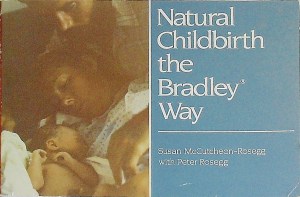 Natural Childbirth the Bradley Way by Susan McCutcheon-Rosegg, with Peter Rosegg, 4/5
I read this book for a laugh, expecting that almost 40 years of advancements in the field of medicine would have rendered it largely useless by now. To my surprise, I found myself being won over by the commonsense advice it presents, emphasizing mindful relaxation, supportive coaching, patience and faith in the natural process. After all, the act of childbirth is as old as time and if, as so many experts assert, we still experience primitive influences on a biological level, why should we rush to intervene with little excuse?
Younger Next Year
 Younger Next Year: Live Strong, Fit, and Sexy–Until You’re 80 and Beyond by Chris Crowley & Henry S. Lodge, M.D., 3/5
Clearly, the target audience for this book is aging guys who will appreciate the old-fashioned generalizations and cringey humor that make Younger Next Year pretty unrelatable to anyone else. Fortunately though, you don’t have to be an old man to be encouraged by the premise that consistent exercise, smart eating (but not “dieting”), and healthy relationships can make old age a less terrifying prospect. This book also confirms something I’ve suspected for a long time–that we often associate increasing age with loneliness, misery and a sedentary lifestyle because those are the most available and memorable role models (thanks, negativity bias). All the healthy, adventurous, active, passionate old people are too busy out doing things to stop and convince us that a post-prime life can be amazing.
On a sad side note, I learned that the younger co-author, Dr. Lodge, died at the age of only 58 from prostate cancer. I’m tempted to conclude that one shouldn’t sacrifice happiness for health, since the latter is never guaranteed.
Why I read it: my dad gave me a copy because he enjoyed it.
Sugar and Salt–Foods or Poison?
 Sugar and Salt–Foods or Poison? by Axel Emil Gibson, 3/5
As a sugar addict in a state of near-constant relapse, I have first-hand experience with the bizarre, drug-like power of sugar and the rarely-acknowledged withdrawal symptoms that accompany any serious attempt to resist it. Over-dramatic as this may sound, it’s positively restrained compared to Dr. Axel Emil Gibson’s opinion on the topic:
The dominating ingredient in most of our dishes, sugar perverts our taste, blinds our instincts, bewilders our gastric consciousness, and leaves us guidelessly and aimlessly adrift in the rapids and breakers of morbid and despotic cravings, not infrequently decoying the individual into body-and-mind-destroying excesses (13).
Though a proponent of naturally-occurring sugars in fruits and vegetables, Dr. Gibson fervently denounces “free sweets” (extracted or concentrated sugar) and has no qualm about addressing the metaphysical and moral implications of one’s nutritional choices. Written in 1913, this eyebrow-raising rhetoric, accompanied by old-fashioned science, makes it tempting to dismiss the book as outdated and of historic rather than practical value. After all, if current, more-enlightened times see numerous fad diets fueling a multi-billion dollar weight loss industry, what crazier, more ignorant, unscientific advice might this doctor from over 100 years ago recommend? The answer is extremely embarrassing. Gibson’s dietary recommendations are simple, commonsense, and inarguable: he preaches moderation and “[nature’s] own faultless cuisine, where the sun does the cooking and the earth the seasoning” (26). And yet, it is just in recent years that science and popular culture have started to catch up with this hundred-year-old wisdom, after spending decades hardheadedly demonizing fat. To me, this supports the “sugar conspiracy,” which is a rabbit hole well-worth traveling down since the “evidence” against it actually seems to argue for it instead. Just read a summary of Science magazine’s article claiming to prove there is no “sugar conspiracy,” or this Verge article on the topic. Both focus on salvaging the scientific community’s credibility and denying the conspiracy, while at the same time verifying and attempting to excuse the sugar industry’s underhanded dealings.
Why I read it: The title caught my eye in an antique store and for $5, I couldn’t resist discovering 100-year-old opinions on a still-controversial topic.
Wired to Eat
 Wired to Eat: Turn Off Cravings, Rewire Your Appetite for Weight Loss, and Determine the Foods that Work for You by Robb Wolf, 3/5
If lack of information is the reason you struggle with weight loss, then you may find this book to be life-changing–it certainly contains a lot of information. If lack of motivation is what’s holding you back, then you may find this book to be helpful–its tone is very motivational. However, if you are already familiar with the ultimate weight loss triumvirate Sleep More, Move More, Eat Less Processed Food, but you simply lack the self control to put it into practice, then you will likely find this to be just another useless diet book.
Many of Wolf’s observations are in line with my personal experience, especially that junk food makes you feel hungrier beyond reason and hyper-palatable, highly-processed foods are pure evil. However, I think of these facts as incidental to weight loss; in other words, learning them was simply the by-product of successful weight loss and maintenance in my case, not the cause. If knowledge gained through personal experience is insufficiently motivating, how much less is knowledge gained from merely reading a book? Such pessimistic practicalities aside, Wolf does his best to get his readers fired up and seems genuinely motivated to help people. His use of pop science/psychology is purposeful at least, though somewhat nauseating, and I respect his unusual advice that each person find the foods that work for them (within limits, obviously) instead of slavishly following some one-size-fits-all diet/religion. However, I feel that Wolf does not make nearly as convincing, scientific or detailed a case for the paleo diet as Good Food, Great Medicine makes for the Mediterranean diet (with the added benefit of much less hype and pop science).
Why I read it: My boyfriend thought it sounded interesting but I thought it sounded sketchy, so I read it first to save him time in case it sucked.
 OmniRambles