
Tagged: fantasy
Winterset Hollow

Winterset Hollow: A Novel by Jonathan Edward Durham, 1/5
I respect the hard work and courage required of first-time novelists, but…this was so bad. At the heart of this fantasy story is an imaginary work of poetry, supposedly written in the early 1900s and of enduring popularity and influence. Unfortunately, the poetry excerpts throughout the book are not convincing at all: for no apparent reason, the introductory verses and a handful of other snippets are in a different rhyme scheme than all the rest, and the overall effect is not consistent with the work’s era of origin. As a lover of poetry, it was hard to maintain suspension of disbelief in the face of verses like the following (21-22):
You know I love it here, said Runny, you know I am a happy bunny
But still I wish to spread my wings and fly beyond the trees
I promise you that I’ll be back, I promise I’m not lying, Flack
I promise I just need to go see what I need to see
And with those words, his shoulders dropped, and Runny hopped a might hop
And turned to face the hedgerow that he’d known for all this time
And jump, he did, as rabbits do, for this was sad for Runny too
It was no treat to go and leave his bestest frog behind
Poetry aside, the descriptive passages are self-indulgently tedious, like someone telling you every detail of a dream they had the other night. The author’s word choices are often contrived in their novelty, trampling across the line between “inventive” and “incorrect.” Words used in unexpected ways are usually a sign of excellent writing, but not when they fail to enhance the effect of the text and merely serve as a distraction. I was particularly baffled by the appearance of the word “ingrace” in three different contexts, none of which were consistent with the solitary dictionary definition (from 1913) that exists online. Adding to my annoyance were petty complaints like an increasingly repetitive use of “well” as an intensifier towards the end of the book (I guess you could say I was well annoyed by it), multiple instances of comparing things to lanterns, and more than one reference to “serendipity.” Scenes of gruesome violence and a somewhat banal plot twist work feverish overtime to cover for characters lacking in depth and development. The cover blurb by Diana Gabaldon (author of the Outlander series) describing Winterset Hollow as “astonishingly powerful and multilayered” is so ridiculous in light of the book’s crucial shortcomings that I have to assume she was treating the review as a creative writing exercise.
Why I read it: The author is absolutely hilarious on Instagram.
Gulliver’s Travels and Baron Munchausen

Gulliver’s Travels by Jonathan Swift and Baron Munchausen by Rudolf Erich Raspe, 2/5
When I finally get around to reading an enduring classic, it is usually fairly obvious what timeless merits ensured its survival. In the case of Gulliver’s Travels, however, I was surprised to find it exceedingly dull and tediously obsessed with the author’s now-obscure political feuds. Perhaps the most entertaining aspect of this 1888 edition is the unfiltered disapproval evident in the editor’s preface and biography of Jonathan Swift, who apparently played rather fast and loose with the ladies (at least by the standards of the time) and did not shy away from the occasional crass flight of literary fancy. The editor baldly states that he “has not disguised his want of affection for the character of this hero” (10) and is “unable to make the biography a eulogy” (10). He continues further to claim that “The greatest difficulty in the analysis of Swift’s literary character is to discover by what depravity of intellect he acquired a taste for loathsome and filthy ideas, from which every other mind shrinks with disgust” (50). Adding further insult to injury are the numerous footnotes pettily highlighting instances of incorrect grammar in Swift’s at-that-time 162-year-old work. The whole effect was so judgy, self-righteous, uptight, and just stereotypically Victorian that, in retrospect, where I expected to find a commentary on 18th-century morals and issues, I instead encountered an unintentional commentary on 19th-century ones.
The second part of this book consists of the bafflingly ridiculous tall tales of Baron Munchausen, in two volumes. I did not enjoy this unillustrated edition as much as the other that I previously reviewed.
Why I read it: Gulliver’s Travels has been on my to-read list for ages, but I didn’t realize I owned a copy until I was searching for a boring book to combat pregnancy-induced insomnia.
Yorkshire Legends
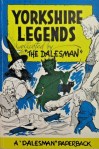
Yorkshire Legends collected by “The Dalesman,” 3/5
I love to see folklore preserved and even better when it is accompanied, as in this case, by a variety of appealing illustrations.
Why I read it: a fun find in a Yorkshire charity shop.
Descent Into Hell

Descent Into Hell by Charles Williams, 2/5
I’m not going to lie: I had absolutely no idea what the heck was going on for large portions of this novel and ran immediately to Google after finishing it to see what overarching themes I was too oblivious to comprehend. I guess it says something that the most helpful-looking analyses were hidden behind academic paywalls…
Undoubtedly, Williams had a more coherent vision than what he communicates through the overlapping stories of a saintly poet, an orphan haunted by her doppelgänger, the ghost of a past suicide, and a historian who creates a succubus from pure ego, among others. In retrospect, it is surprising that a novel with so many interesting characters could have so little plot and so many tedious passages of incomprehensible spiritual imagery. There are several places in which Williams purposefully disintegrates the English language in what I can only guess is an approximation of what having a stroke would feel like.
All in all, not my favorite reading experience, though with themes like art, sacrificial love, death, and the sin of self-absorption, I can understand how it might resonate better with other people or at another time.
Why I read it: the last of Williams’ seven “novels of the supernatural” I had left, since starting with All Hallows’ Eve.
The Greater Trumps
The Greater Trumps by Charles Williams, 3/5
This story of a young couple’s quest to unlock the power of the original tarot deck features beautifully crafted dialogue, fantastical imagery, interesting characters and, unfortunately, some Romani stereotypes that have not aged well.
Why I read it: it’s the fourth book in Charles Williams’ set of supernatural thrillers.
Many Dimensions
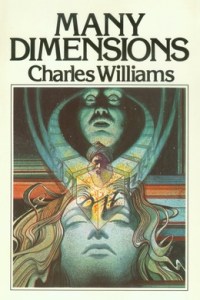
Many Dimensions by Charles Williams, 4/5
This spellbinding book must not be judged by this later edition’s psychedelic cover art or by a mere summary of its bizarre plot, in which an infinitely divisible holy relic empowers its keepers to travel through time and space. The story is, in fact, much more sophisticated than you might expect–peopled with interesting characters and exploring (often humorously) the political, social, and ethical ramifications of such an object’s existence. I felt the plot was a little weak towards the end, or it would have been a 5/5 for me.
Why I read it: I am working my way through Charles Williams’ seven supernatural novels.
War in Heaven

War in Heaven by Charles Williams, 3/5
I’m not going to pretend that I understood the more esoteric implications of this bizarre spiritual thriller, but I certainly did enjoy its zany plot, humor, and original take on the ever-popular search for the Holy Grail. It’s not a particularly well-crafted novel, but it’s hard to fault a story that opens thusly:
The telephone bell was ringing wildly, but without result, since there was no-one in the room but the corpse.
Why I read it: After my introduction to Charles Williams via All Hallows’ Eve, I wanted to read some of his other “novels of the supernatural,” of which War in Heaven is the first.
Letters from the Earth

Letters from the Earth: Uncensored Writings by Mark Twain, edited by Bernard DeVoto, 2/5
From a scholarly perspective, this collection of previously unpublished writings by Mark Twain is no doubt a valuable resource. However, from a casual reader’s perspective, it was a bit of a tedious mishmash. The main attraction, to me, was an unfinished story, dubbed by the editor “The Great Dark,” which made it onto the list of “10 Forgotten Fantastical Novels You Should Read Immediately.” The concept was memorable–a man and his family are trapped on a dream ship exploring a microscopic drop of water–but the tone was very uneven and the story too unpolished and indeed, unfinished, to be a satisfying read. Much of the rest of this collection consisted of snarky essays in which the author mocked Christianity in an ignorant and closed-minded way that, in my opinion, reflected more poorly on himself than on the religion.
Why I read it: this was the last book I had left to read from the list of “10 Forgotten Fantastical Novels You Should Read Immediately.”
All Hallows’ Eve
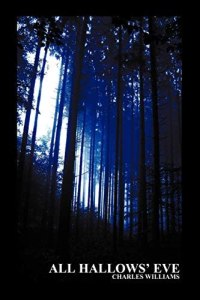
All Hallows’ Eve by Charles Williams, 5/5
I had very little idea what to expect from this slim book and that, perhaps, is partly why I found it to be so absolutely astonishing (though pure novelty cannot account for that fully). I don’t want to give away too much, but think Gothic thriller meets supernatural romance in the interest of exploring highly-developed and unconventional theological beliefs. I was not at all surprised to later learn that Williams was a regular member of the Inklings, enjoying the friendship and literary criticism of C.S. Lewis and J.R.R. Tolkien.
This book demands to be re-read, but I would avoid this edition (Oxford Reprints) at all costs. The binding has that ubiquitously cheap, self-published feel and the text contains a baffling number of typos. Most egregious of all is the use of hyphens in place of em dashes. I know how pedantic that complaint sounds, but Williams used em dashes often and in very long sentences. The relentless and incorrect use of hyphens disrupted visual flow in addition to hindering comprehension.
Why I read it: another entry on the list of 10 Forgotten Fantastical Novels You Should Read Immediately.
The Boats of the “Glen Carrig” and Other Nautical Adventures

The Boats of the “Glen Carrig and Other Nautical Adventures by William Hope Hodgson, 3/5
Taken singly, these stories are fun in a kitschy way, but overall, the effect is repetitive and hackneyed. Maybe the editor’s introduction about Hodgson’s writing career tainted my perspective, but I got the feeling throughout that the author was writing more for a financial inlet than a creative outlet. There were a few brief moments when I thought “Oh, he is capable of higher quality writing and insightful observations when he cares to be,” but they were lost in the endless “weeds” that the ships in his stories all-too-inevitably encountered.
Why I read it: one of the few remaining entries on the list of 10 Forgotten Fantastical Novels You Should Read Immediately that I have left to read.
 OmniRambles