
Tagged: book review
Traffic
Traffic: Why We Drive the Way We Do (and What It Says About Us) by Tom Vanderbilt, 2/5
To put it bluntly, this book has no point. The topic is interesting enough to sustain the first half tolerably well, but overall, it reads like a research paper whose author had a great brainstorm in the shower but subsequently forgot to form a thesis. This means that, while many individual issues are addressed, no meaningful connections are made between them, leading to lots of cognitive dissonance (such as when one chapter’s claims clash with the evidence provided by the next chapter). Mutant statistics are a concern, as Vanderbilt has no problem with drawing his own conclusions from complicated studies and statistics, though he is in no way qualified to do so.
Though the excessive end notes take up 1/4 of the book, unsourced claims still slip through. Some are absolutely ridiculous, such as “We do not let children walk to school even though driving in a car presents a greater hazard” (275).
One last issue that I feel deserves mention: Vanderbilt states that, since traffic accidents kill more people than 9-11 did, Americans are inconsistent for submitting to increased anti-terrorism measures while resisting increased traffic safety measures. I found this to be an incredibly (almost unbelievably) tasteless, offensive and illogical statement. Surely Vanderbilt is aware that traffic laws affect more people’s lives more directly and often than anti-terrorism procedures do. Surely it is obvious that there are a multitude of logical reasons why people would be willing to accept, for example, increased airport security, but traffic changes he suggests, such as lowering the speed limit (Vanderbilt later praises Bermuda for its 22mph, island-wide speed limit) and installing more red-light cameras (whose expense and efficiency are controversial) might be unsuited for nation-wide institution and require more discussion.
Rotting in the Bangkok Hilton
Rotting in the Bangkok Hilton: The Gruesome True Story of a Man Who Survived Thailand’s Deadliest Prison by T.M. Hoy, 4/5
This was much better written and less sensationalistic than the title (and especially, subtitle) led me to expect. It was unusual in that it was not at all biographical or agenda-driven, but consisted of a short selection of powerful and insightful essays focusing on specific happenings, individual people the author encountered and aspects of prison life.
What the Hell are You Doing?
What the Hell are You Doing? The Essential David Shrigley by David Shrigley, 5/5
Shrigley’s cartoons are like nothing else I’ve ever seen. There is an otherworldliness to their intrinsic funniness; they somehow had me laughing out loud almost before I could process the content on the page. In many of them, it is the things suggested or left completely unsaid that are the funniest. However, Shrigley’s surreal morbidness is not for everyone and I would love to meet some people who didn’t “get” it and just stare at them for a while.
Tracking the Chupacabra
Tracking the Chupacabra by Benjamin Radford, 3/5
Basically, Chupacabras don’t exist, but I wish they did so they could drain the blood of all the incredibly stupid people who believe that they do.
Party Confidential
Party Confidential: new etiquette for fabulous entertaining by Lara Shriftman and Elizabeth Harrison, 3/5
Most of this was common-sense stuff along the lines of “don’t get drunk” and “compliment the food, especially if it’s homemade.” However, it did provide a couple interesting tidbits of info (such as that “fashionably” late is 15 minutes) and an interesting peep into the A-list party style. Regardless, I still say that parties suck.
The Pacific
The Pacific by Hugh Ambrose, 1/5
Some stories demand to be told, while others merely tolerate the telling. Unfortunately, most of this book seems to belong to the latter category. Ambrose’s attempt to follow his historian father’s success (who was involved with Band of Brothers and Saving Private Ryan, among other projects) comes off as extremely dry, forced and disjointed. Instead of weaving together the individual stories of WWII marines in a meaningful way, he jumps jarringly from one short scene to another, preventing the reader from developing any cohesive overall impressions. One small, but exceedingly annoying, example of Ambrose’s unpolished writing style is his inordinate fondness of the phrase “dribs and drabs,” which appears distractingly several times throughout the book. He is also exceptionally bad at incorporating quotes into his writing, an unfortunate failing for a research writer to have. The most interesting content, regarding Medal of Honor recipient “Manilla” John Basilone, is hardly original, as this celebrated soldier was already famous and his exploits well-documented. Combine all this with descriptions of military tactics that read like cooking instructions to the world’s most boring recipe and you have proof that historical and writing skills are not hereditary.
Hark! A Vagrant
Hark! A Vagrant by Kate Beaton, 2/5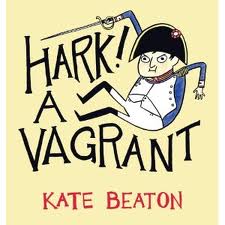
A couple of these comics were funny, but most were not.
The Story of Britain’s Best Buildings
The Story of Britain’s Best Buildings by Dan Cruickshank, 3/5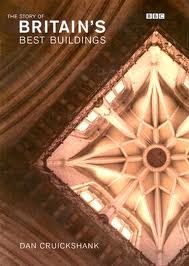
The commentary was generally tolerable and I appreciated the fact that all the photos were taken especially for this book (though it needed more photos). However, the first chapter was filled with some of the most unmitigated bullshit I have ever read. In the absence of reliable historical records about ancient Durham Cathedral, Cruickshank resorts to absolutely ridiculous architectural guesswork, making all sorts of strangely specific assertions about different aspects of the building. For example, he describes a certain point in the cathedral as “the physical centre of the building and, in the analogy of the cathedral as Christ’s body, it marks the heart, the omphalos or navel that draws sustenance and sacred power from above.” So what is it, the heart or the navel? Could it perhaps be just the center of the building, which is an inevitable and not always wildly symbolic part of every single building ever made in the history of ever? Here is another paragraph whose utter bullshittiness has to be read to be believed. Keep in mind, this commentary is on a plain pillar with a simple chevron pattern carved into it.
“A simple analysis of the columns offers another answer. The pattern is formed by 12 bands on each column, and each band has eight points, four pointing up and four pointing down. The key or prime number here is four because eight and 12 evolve from four, and four is the number of the square. In fact, the chevrons on this pattern can easily be explained in relation to the square. Take a square and then place a second square on top of it but rotated 45 degrees and you have an octagram or eight-pointed star. Turn alternate points up and down and you have one of the chevron bands on the column. This pattern seems, then, also to be proclaiming the importance of the square in the design of Durham – this time in the form of an eight-pointed star. The column, based on the circle, and the chevron, based on the square, are in combination perhaps another exercise in squaring the circle.”
Now if only Cruickshank would do an exercise in taking his head out of his own ass.
Three Months in the Southern States
Three Months in the Southern States: April-June, 1863 by Lt. Col. Arthur James Lyon Fremantle, 3/5
Fremantle undoubtedly deserves the title “Most Hardcore Tourist” of 1863. An Englishman living in Gibraltar, he read about the war and thought it sounded like a jolly good time to go explore the South. During his adventures, on which he met such historical figures as Jeff Davis and Generals Lee and Longstreet, he kept a daily diary. The result is an interesting, if not convincingly unbiased, glimpse into the world of the Confederacy. It is remarkable that Fremantle started his journey with a pro-Union attitude, but was quickly won over by the gentlemanly behaviour of the Confederates he met and the apparent contentedness of most of the slaves. While the account is fascinating, it is no masterpiece of literature; Fremantle’s genius is more social than literary. Though the writing is somewhat prosaic and the vocabulary limited, it still a valuable work that startlingly humanizes some of our most historic figures and events.
A Respectable Army
A Respectable Army: The Military Origins of the Republic, 1763-1789 by James Kirby Martin and Mark Edward Lender, 4/5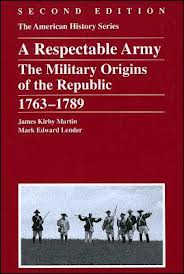
This book presents an engaging and not overly esoteric overview of George Washington’s army during the American Revolution. It challenges the popular myth that all of the colonists participated equally, eagerly and selflessly to achieve independence, pointing out that the people who bore the brunt of the conflict were the poor and displaced in society. I was surprised to learn that the colonists were rabidly anti standing-army, depending on the militia and the idea of the citizen-soldier (a romantic notion that produced lots of short-lived emotion but little dependable action). Because of this, the Continental Army was looked down upon and abused by both politicians and populace. War strategy and specific battles were worked tastefully into the text, providing interest without obscuring the bigger picture. Without presenting any ground-breaking claims or research, this book manages to be very informative, interesting and well-written.
 OmniRambles