
Tagged: 1991
All That the Rain Promises and More…
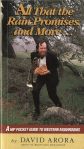
All That the Rain Promises and More: A Hip Pocket Guide to Western Mushrooms by David Arora, 5/5
Don’t be fooled by the frankly insane cover photo and title–this helpful book is packed with color photographs and well-organized descriptions of the most common mushrooms found in the western United States, interspersed with additional info, poetry, recipes, and anecdotes collected from the mycophile community. Yes, it’s a little silly at times, but the author is deeply knowledgeable about the topic and I appreciate the sense of humor and passion that are reflected in this conveniently-sized book. I found the closing essay to be particularly compelling on the topic of over-regulation of hunting/gathering activities:
“In other words, the largely urban-suburban vision of nature as a beautiful, peaceful refuge from the stresses and conflicts of civilization, is in fundamental conflict with the rural or less “civilized” perception of nature as a provider of sustenance and wealth. Therein lies a great irony: it is the cities that suck food, energy, and resources from the landscape, yet there is a long and tragic history of industrial and agricultural peoples persecuting “savage” outsiders (in the most literal sense of the word) who hunt and gather (253).”
…
“No doubt the admonition to “take only photographs, leave only footprints,” is desirable in certain sensitive or pristine areas. But it is inappropriate in most situations because it is a fundamental denial of who we are: creatures of the earth whose most ancient heritage (or birthright, if you will) is foraging for food in the forest.
This enforced separation of human being from the natural world can only undermine support for the public acquisition and protection of habitat. The more we view the forests and fields as a resource […] the more likely we are to cherish that resource (254).”Why I read it: I find mushrooms fascinating and love to spot them around the yard.
Sophie’s World
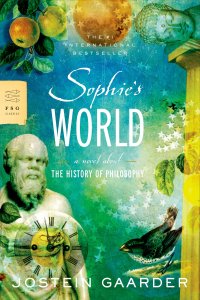 Sophie’s World: A Novel About the History of Philosophy by Jostein Gaarder, translated by Paulette Møller, 2/5
The most thought-provoking aspect of this reading experience was simply trying to understand how a book featuring such peculiarly bad writing could be published at all, much less become an “international bestseller.” Half of it consists of dialogue between two-dimensional characters, so stilted and unnatural it has to be read to be believed. The other half reads like increasingly vague course descriptions for philosophy classes taught by someone who considers Wikipedia articles to be the pinnacle of literary accomplishment through the ages. In my experience, fiction writing this bad generally relies on themes like sex, mystery or fantasy to attract readers, so I guess in a twisted way this book’s very existence is a testament to the powerful appeal of philosophical ideas and the ubiquity of existential angst.
Why I read it: recommended to me by a gym friend.
Film Directing
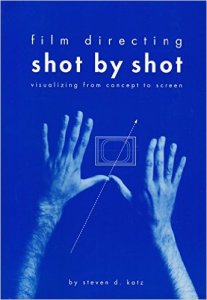 Film Directing Shot by Shot: Visualizing from Concept to Screen by Steven D. Katz, 4/5
This book offers a fascinating glimpse behind the scenes of the film director’s craft, laying out the many tools, visualisation strategies, camera angles, movements and stagings that are available to the person intent on transferring a story from script to film. The book format is obviously not ideal for the topic and it is up to the reader to imagine how a shot might flow between the still images that are provided, but the author is a clear communicator and most of the concepts are not difficult to understand.
Why I read it: I came across it while browsing through books at the thrift store and thought it looked interesting.
The Best of Medical Humor
 The Best of Medical Humor: A Collection of Articles, Essays, Poetry, and Letters Published in the Medical Literature, compiled and edited by Howard J. Bennett, M.D., 1/5
This relentlessly unfunny book was a chore to read and there were a couple of times I almost gave up (in retrospect, I wish I had). Doubtless, having a medical background would have made it more enjoyable, but that does not completely explain the lack of laughs; after all, I’ve largely found that quality humor transcends topic and is recognizable even when it is not entirely understandable (why else would Scottish sitcoms be so enjoyable?). In this case, though, most of the pieces reminded me of mediocre speech-openers, whose appeal lies mainly in stating the obvious and evoking half-hearted laughs of recognition from an audience who has steeled itself for the extremely boring lecture that is to follow. The rest of the book mostly contains stuffy parodies of medical writing, which I imagine would seem most funny if you came across them unexpectedly in a serious medical journal.
In addition, it seems cheap that no single author is more represented in the collection than the compiler himself. The fact that so much of his own work made it through the rigorous sorting process he describes in the introduction (he read over 800 articles, only choosing ones that could “make him laugh” and were “the best”) is very off-putting. Things that are more entertaining than someone who fancies himself a comedian include getting a popcorn kernel stuck in your teeth, driving around a corner while holding a very full cup of coffee in one hand and stepping into the shower with a new sunburn.
[Why I read it: found while browsing in the thrift store.]
 OmniRambles