
Tagged: 1947
History of American Painting

History of American Painting, Volume One: First Flowers of Our Wilderness (The Colonial Period) by James Thomas Flexner, 2/5
In my experience, it’s unusual to encounter a book that has become outdated due, not to the information it contains, but to the technology used in its production. Unfortunately, that is the case with this book due to its high-contrast, black and white illustrations that bear very little resemblance to the historic paintings they represent. Additionally, individual illustrations are not specifically referenced in the text, nor are they always adjacent to relevant passages, so one is constantly flipping around in annoyance.
Having realized the pictures would be of little use, I tried to focus on the text, but was put off by the author’s highly opinionated tone (particularly combined with his lack of formal expertise on the topic). Flexner writes with a chip on his shoulder, simultaneously making it seem like he is the first to shed light on the early history of American painting, while also finding more bones to pick with other academics than you would expect if that were the case. While I didn’t appreciate his pettiness and have no idea how his mid-twentieth-century scholarship has held up, it was interesting to read about the evolution of painting from trade to Art, and develop an appreciation for details that might otherwise go unobserved.
Why I read it: I bought it from a library sale many years ago and it’s been sitting on my shelf ever since.
Miracles
 Miracles: A Preliminary Study by C.S. Lewis, 5/5
It’s like no one told C.S. Lewis that you can’t prove the existence of God, so he just does. And that is merely to lay the foundation for his main topic, which I actually found much less interesting and convincing than the preliminary discussions–the man does not shirk an intellectual challenge. Though I have occasionally sensed some antagonism from him towards science, in this book he cheerfully tackles both the known and unknown with the grace, focus and rigorous logic that make me sometimes fear that I tend to put more faith in him than in God. Of course, no matter how hard one tries to be open-minded and logical, it cannot be too difficult a task to convince someone of something they already believe. With that in mind, I would love to know how this book is perceived by people with different backgrounds and beliefs than me.
Why I read it: C.S. Lewis is one of my favourite authors and thankfully, every time I think I’ve read all his books I come across a new one.
Back Home
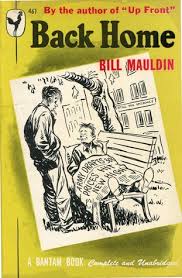 Back Home by Bill Mauldin, 2/5
Tedious political ramblings accompany this collection of aged cartoons by celebrated WWII cartoonist Bill Mauldin, who obviously had a rough transition back to a civilian career after the war. I’ve always been put off by political cartoons in general because they tend to over-simplify complicated issues, mindlessly ridicule opposing viewpoints and, crucially, are usually not even funny. The cartoons in this book are no exception and, I think, would appeal to few readers besides fans of Mauldin and those who are interested in an inside view of one person’s perspective of the political climate in post-WWII United States.
[Why I read it: I recognized Mauldin’s name and liked what I had previously seen of his army cartoons.]
 OmniRambles