
Category: Book Reviews
Laughing Gas
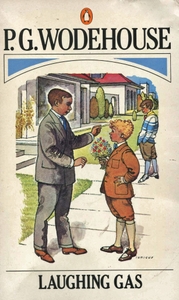 Laughing Gas by P.G. Wodehouse, 5/5
Definitely the most bizarre Wodehouse story I’ve encountered, this tale of an English Earl who inadvertently swaps bodies with a Hollywood child star during a routine tooth extraction is told with a rate of quips and quibbles quaint per paragraph that your average author would be thrilled to achieve per chapter.
[Why I read it: Wodehouse is one of my favourite authors, so I was pleased to find a title I didn’t recognize in the rather impressive selection of Wodehouse books at Michael’s Books in Bellingham, WA.]
The Midwife’s Revolt
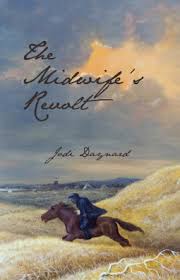 The Midwife’s Revolt by Jodi Daynard, 3/5
This fun and competently-written story about the adventures of Abigail Adam’s midwife during the American Revolution was a bit too much of a page-turner to fit my customary pre-bedtime reading schedule, leaving me somewhat sleep-deprived over the last couple days. The book is impressively long and Daynard doesn’t succumb to the first-time novelist’s temptation to rush the ending. I thought she also did a good job of incorporating period-specific vocabulary in a natural way. Ultimately, though, the plot felt lacking to me, the characters puppetish and I found the ending unsatisfying in its predictability and mushy romanticism. Suspension of disbelief was difficult for me to attain and I often found myself wondering just how accurate the author’s perception of the era really was.
Since my friend Alison, who is an enthusiastic connoisseur of historical fiction, assures me that the book is well-written and convincing, the foregoing complaints no doubt stem from my deep mistrust of the historical fiction genre in general (which is surely not Jodi Daynard’s fault). I know that all history is subjective (filtered as it is through human perception) but some sources are more subjective than others, with historical fiction being the most untrustworthy and potentially misleading of all, in my opinion. I don’t mind so much when iconic time periods are used as settings or major historic events are incorporated into plots, but it grates on me no end when famous people from the past, people who were once as fully alive, independent and individual as you and I, are co-opted for major roles in other people’s made-up stories. What right does an author have to put words into these once-alive mouths? To invent experiences and reactions, emotions and opinions, for people who can no longer defend or explain themselves? Most historical fiction seems written by people who are either expert writers OR expert historians, but how rarely is a synthesis of these two qualities achieved.
[Why I read it: it was my friend’s end-of-summer book recommendation. Our library didn’t have a copy, but I put in a request and they bought it! This is the second time in as many months. I’m definitely feeling spoiled.]
Kon-Tiki and I
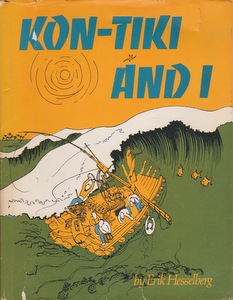 Kon-Tiki and I by Erik Hesselberg, 5/5
This humorous account of the Kon-Tiki expedition is written and illustrated by multi-talented Erik Hesselberg, artist, writer, composer, sculptor, and the only professional sailor aboard the balsa raft during its 4,300 mile journey from Peru to the Polynesian Islands. I only meant to read a few pages of this book before bed, but ended up reading the whole thing in one go, laughing out loud at Hesselberg’s witty observations and admiring his art, which ranges from the sparse, spontaneous lines of caricature to more detailed, scientific drawings of various sea creatures the crew encountered. The book is very accessible and appeals to readers of every age, from children to those older people looking for a fun companion to Heyerdahl’s more in-depth account of the Kon-Tiki expedition.
[Why I read it: my brother recommended it to me.]
Smoke on the Mountain
 Smoke on the Mountain: An Interpretation of the Ten Commandments by Joy Davidman, 2/5
I couldn’t find much to like in this preachy, dated commentary on the Ten Commandments, which joins hundreds of thousands of useless, forgettable sermons on the topic that have been written over the centuries. Davidman does little more than poke at low-hanging fruit, criticizing society’s moral failings in a manner calculated to appeal more to the smugly self-satisfied or the masochistically guilt-ridden than the individual (Christian or non-Christian) who is searching for Truth. Also, the tone of authority with which the author treats issues of theology, anthropology and history does not seem well-supported by any expertise or original thought. The most remarkable aspect of the book is C.S. Lewis’s incredibly graceful foreword, which I think evinces approbation more benevolent than spontaneously appreciative.
[Why I read it: I was curious to learn more about the woman who some consider C.S. Lewis’s intellectual equal and whose death inspired A Grief Observed. Unsurprisingly, my library didn’t have a copy of this book. Surprisingly, they bought a copy when I requested it. Pretty cool.]
Blood Rites
 Blood Rites by Jim Butcher, 3/5
An abundance of one-line groaners and an entertaining plot make this a fun read (albeit not one I’m proud to be seen with in public).
[Why I read it: this series is a guilty pleasure and gives my brain a welcome break from more serious literature.]
Barchester Towers
 Barchester Towers by Anthony Trollope, 5/5
Simply put, this is one of the funniest and most entertaining books I have ever read; the characters, scenarios and author’s commentary (Trollope breaks the fourth wall frequently) had me laughing out loud throughout and I was sorry to reach the last page. Trollope’s delightfully fresh writing style and lack of idealized, stereotypical characters, combined with an unrelenting derision of organised religion’s faults make this novel stand out from others in its genre. The continuing trials of meek Mr. Harding, the romantic perils encountered by his widowed daughter, the clerical ambitions of hateful Mr. Slope, and a cast of other new and fascinating characters form a literary enterprise that is even more enjoyable than the first book in the series, The Warden.
[Why I read it: I enjoyed the first book in the series immensely.]
QED
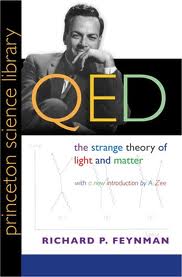 QED: The Strange Theory of Light and Matter by Richard Feynman, 5/5
Most of this book hinges on the bizarre idea of adding amplitude arrows to calculate the probability of certain events happening. Probability equals the square of the length of an arrow, while the arrow’s direction is determined by the ending position of an imaginary stopwatch’s rotating hand, which turns during the event. Surprisingly, this unintuitive concept explains a number of phenomena, from iridescence to why light appears to travel in straight lines to the focusing effect lenses have on light.
Of this book’s four chapters, I found the first two to be challenging but reasonably accessible, while the following two became increasingly confusing as the concepts became more complex and Feynman’s patience for explanations seemed to wear thin (if straightforward explanations are even possible, which I almost doubt). I wish to reread the entire book at a later date and hopefully increase my understanding of the strange concepts it portrays.
[Why I read it: I love reading about quantum physics and have lately been on a Feynman binge.]
Death Masks
 Death Masks by Jim Butcher, 2/5
Many fans promise that Butcher only starts to hit his stride as the series continues, but I felt that this fifth book was generally less appealing than its predecessors. The plot was thin, the characters lacklustre and overall I felt it was missing that “so bad it’s good” quality that made the earlier books enjoyable. Also, there were a couple pages where the “adult tone” mentioned in the commendatory cover quote was a little too adult for me.
[Why I read it: sometimes I need a break from the 19th century literature and books on quantum physics.]
The Warden
 The Warden by Anthony Trollope, 5/5
This sweet little novel is about a mild churchman named Septimus Harding, whose quiet life and untested convictions are disrupted by scandal instigated by church reformer, would-be suitor to his daughter, and family friend, John Bold. The story is as simple as its characters, but this is no reproach: there is a sweetness and authenticity to Trollope’s style that charms and warms, while avoiding the over-sentimentality and contrivance that plagues much 19th-century literature.
[Why I read it: I seemed to encounter more Trollope novels on the shelves of bookstores in Hay-on-Wye than any other author (including Dickens), which made me curious.]
Alfred and Guinevere
 Alfred and Guinevere by James Schuyler, 3/5
This short novel is told exclusively through the conversations and diary entries of eponymous siblings. I am always suspicious of the words adults put into children’s mouths (they never seem quite authentic to me) and found this effort dull overall, despite a few amusing interactions. Also, the consistent lack of dialogue tags made it difficult to keep track of who was speaking. I could imagine this book appealing to some people, especially connoisseurs of literature featuring children, but it just didn’t interest me at all.
[Why I read it: While perusing actor Bill Nighy’s filmography, I came across the movie The Young Visiters (also starring the fantastic Hugh Laurie), which is rather unique in that it is based on a story written by a nine-year-old. I loved the movie and, while researching the story, read a review that also happened to mention Alfred and Guinevere very positively, making me want to read it.]
 OmniRambles