
Category: Book Reviews
The Small House at Allington
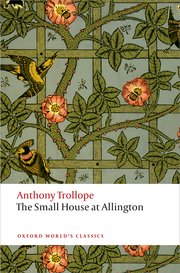 The Small House at Allington by Anthony Trollope, 4/5
With good humour, skill, and psychological insight, Trollope tells a twisted tale of love and loss that centers around passionate Lily Dale and her more sensible sister, Bell; social climber Adolphus Crosbie; John Eames, the quintessential boy-man; and a collection of other characters who inspire love, disgust and pity by turns. Though the preceding two books in the series were disappointing, I feel that in this fifth novel Trollope captures once again the unique voice and perspective that made me fall in love with the Barchester Chronicles. Fingers crossed that the sixth and final book in the series will be similarly inspired.
[Why I read it: I am reading my way through the Chronicles of Barsetshire, having started with The Warden a few months ago. Strangely, my library contained all the books in the series except for this one, which they kindly purchased at my request. They are the best!]
Odes
 Odes by Horace, translated with commentary by David R. Slavitt, 2/5
Slavitt sets himself a Herculean task–translating the Latin Odes of eminent Roman poet Horace with a view to recreating for modern readers a similar reading experience to the one that the poems might have offered ancient audiences, who enjoyed a different language, different range of knowledge, and different sensibilities.
The commentary Slavitt provides for each ode, clarifying difficult parts of the text and explaining what he added in or left out, is both helpful and horrifying: helpful in that it provides insight into the intricate art of translation, horrifying in its revelation of some of the liberties he takes with the text. It set my teeth on edge when Slavitt inserted the anachronistic “cougar” (an older woman who chases younger men) into one of the odes, explaining that “Had such a convenient concinnity of terms been available to Horace, I am sure he’d have used it” (134). Or when he describes a “murder” of crows, using the word because it’s “one I have always liked” (130). Or when he invents unwarranted poetic additions simply to increase the “linguistic density” of the poem (113).
I admire Slavitt’s stated goal very much, but felt that many of the liberties he took with the text were unscholarly, unjustified and disrespectful to the original works. After all, it boils down to this: Horace was one of Rome’s leading poets. Who is David R. Slavitt? I would have had absolutely no problem with this book if Slavitt had just fully indulged himself and created a work titled Odes by David R. Slavitt, inspired by Horace.
In addition to my dislike of Slavitt’s approach to translation, I also did not much enjoy the resulting poems themselves. This is not a reflection of their quality or value, just the fact that I failed to experience a connection with them. Poetry has always seemed to me a very personal thing–you never know what is going to resonate, when, and with whom. Overall, however, I did not find the odes to be very beautiful or thought-provoking, they generally did not demonstrate pleasing word choices and metres, and they did not make me look at things in new or different ways (all aspects common to poetry I enjoy).
[Why I read it: I think I just stumbled across it while browsing in the library and thought it looked interesting.]
Of Mice and Men
 Of Mice and Men by John Steinbeck, 3/5
It is embarrassing to admit, but I really don’t understand why this novella is so famous and respected. Is it merely because of the shocking ending? The fact that it was censored by many schools? Besides the linguistic value of the dialogue, which can be presumed to accurately represent the spoken English of a certain time and social class, I found little else to recommend this simple story. Yes, it is competently written, has some nice imagery and a few touching scenes, but by the end the main sensation it inspired was the question “Why?” As in, “Why was this even written? Why would anyone want to read it?” Now there are many works of literature for which I could not answer those same questions, but the big difference is that those works of literature don’t really inspire me to ask those questions in the first place.
I thought this edition’s substantial introduction would perhaps give some insight into the book’s point, but it was full of “troubled interplay,” “concentration on the circumscribed space,” “allegorical potential,” “symbiotic dependency”…all the silly things that scholars love to write about writing and readers hate to read. The most helpful bit was an actual quote from Steinbeck to his disappointed agents: “I probably did not make my subjects and my symbols clear. The microcosm is rather difficult to handle and apparently I did not get it over–the earth longings of a Lennie who was not to represent insanity at all but the inarticulate and powerful yearning of all men.” I would have to agree with the author that this point was not at all communicated by the story, at least to me.
As a side note, I cannot believe that high schoolers are forced to read books like this, The Old Man and the Sea, The Catcher in the Rye, The Great Gatsby, Lord of the Flies and the works of Shakespeare. Whatever their literary value might be according to scholars and those with mature taste, I only know that, if this were the only sort of literature I was exposed to at a young age, I would likely not read at all.
[Why I read it: It is famous, but wasn’t really on my radar until I saw several references to it in the film Man on Fire (1987).]
The Princess Bride
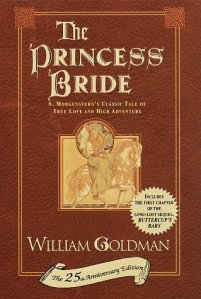 The Princess Bride: S. Morgenstern’s Classic Tale of True Love and High Adventure by William Goldman, 5/5
Reading this book was a strange experience because I could not separate it in my mind from the 1987 film, which I had seen many times before I realised it was based on a real book and many, many more times before actually reading the novel for the first time (years ago). I was delighted to experience all the “extras” that didn’t make it into the movie but contribute to a novel that is hilarious and fantastical. Goldman’s editorial asides, biographical anecdotes and surprisingly plausible insistence that he is merely the translator, not the creator, of this tale, create a mind-bending false reality that seems to blur the line between fact and fiction (when actually, it’s all fiction). The book is also a valuable read for those interested in screenwriting and filmmaking. When compared to the movie, it is an education to realise what was left out, what was added in, and what was changed by an author who is also an accomplished screenwriter.
[Why I read it: I was too young to completely understand the book the first time; it might never have ended up back on my reading list if one of my sisters-in-law hadn’t mentioned it and given me a craving.]
Belles on Their Toes
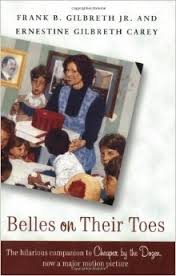 Belles on Their Toes by Frank B. Gilbreth Jr. and Ernestine Gilbreth Carey, 5/5
I thought this lesser-known companion to the popular Cheaper by the Dozen would suffer from Sequel Syndrome but it doesn’t–the stories it contains are funny, touching, and calculated to make even a cynical reader like myself wish the book were ten times longer. While the first book is dominated by the charismatic person of their father, this sequel is a tribute to the mother who somehow managed to keep the family together after her husband’s death, put all the children through college, keep up the family business and pioneer the male-dominated world of industrial engineering.
[Why I read it: I enjoyed Cheaper by the Dozen.]
Le Morte d’Arthur
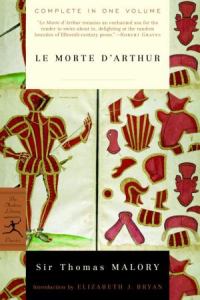 Le Morte d’Arthur translated from the French and compiled by Sir Thomas Malory, edited by William Caxton, introduction by Elizabeth J. Bryan, 5/5
Whether this book represents a few weeks of delightful escapism or 938 pages of unrelenting torture will depend a lot on the reader’s background. As my well-worn old copy of King Arthur stories for children can attest, my love affair with knightly tales started at a young age, though I gradually acquired a taste for more and more archaic retellings of the familiar adventures. The tolerance I developed over the years for medieval-style prose, my affection for the characters and stories of Arthurian legend, a hint of nostalgia, and the many fine qualities of Malory’s work all combined to make the experience of reading Le Morte d’Arthur pure delight.
Perhaps the quality that strikes me most when contemplating this literary work is that of contrast. Inhabitants of Arthur’s world are at times inaccessibly mythological, at other times deeply human. Romantic excesses and impossible passions exist in a world that can otherwise be as bleak and heartless as that inhabited by the Norse gods. The wildly fantastical is accompanied by mundane details whose invention seems as unlikely as unnecessary. Stories of bravery and nobility are interspersed with soap opera plots whose participants seem to belong more on the Jeremy Kyle show than in a serious literary work.
Notions such as love, loyalty, hate, respect, and honor are connected in ways foreign to modern man and the outworking of these values and emotions does not fit neatly into currently accepted ideas of morality. The sordid immorality portrayed without judgement in the first couple chapters was the reason that my attempt to read this book as an adolescent was aborted. Thankfully, the whole book does not continue in the vein of lust and murder with which it begins.
A note about this edition: it is not very scholarly and I had a hard time finding information about the editing methods to which it was subjected (no editor is even mentioned). As stated in its introduction, this version is based off of William Caxton’s 1485 printing of Thomas Malory’s text. With the discovery of the earlier Winchester Manuscript, it seems that Caxton’s is no longer necessarily the most reliable source for Malory’s original work; however, Caxton’s edits have value in themselves and, I feel, do not make this version less legitimate. Caxton’s changes included reorganizing the original work into 21 shorter books (originally eight) and further subdividing into chapters. He also added short summaries of the events of each chapter, which are helpful despite the spoilers they provide (this Random House Modern Library edition also uses the right header space to include a short description of each page’s contents, which is extremely helpful). More worryingly, Caxton reworded and shortened Book 5 which tells the tale of King Arthur’s conquest of Rome. This version is listed on the Le Morte d’Arthur Wikipedia page as containing “modernised spelling” and this, along with modernised punctuation, seem to be the only changes made to Caxton’s printing. I even compared the opening lines with a reprinting of Caxton’s original manuscript and found the words and basic sentence structure to be identical. The end effect is very readable prose which retains that vital medieval flavour.
[Why I read it: The memory of my first attempt to read this has always rankled, but I can’t remember what motivated me to finally get around to a second attempt.]
Entropy Academy
 Entropy Academy: How to Succeed at Homeschooling Even if You Don’t Homeschool by Alison Bernhoft, ♥♥♥♥♥/5
My friend wrote a book! It is, unsurprisingly, just like her: intelligent, passionate, inspiring and humorous. Despite possessing an impressive formal education that includes degrees from England’s Royal College of Music, Oxford, and UCLA, Alison wasn’t afraid to embrace unconventionality when it came to successfully homeschooling her large family. Her decision to work with life’s chaos instead of fighting it resulted in a homeschooling style that is joyful and realistic, integrating learning naturally into every aspect of life. Hilarious anecdotes and creative educational ideas are woven into a family narrative that provides an antidote to the sort of dry, rigidly-structured homeschooling ideologies that crush children’s natural love of learning and burden their parents with unrealistic demands on time and patience. This is the sort of book that is written out of love, and, I have no doubt, in response to demand from people who have seen the fruits of Alison’s labour in her loving family and successful children, now grown up.
You can find more information on her website or buy a copy on Amazon, Barnes & Noble, IndieBound, and Books-A-Million.
[Why I read it: No one who has read Alison’s hugely-entertaining Christmas letters, met her talented family or talked to her in person could resist the opportunity of reading an entire book written by her! Also, I was honored to edit the book, design the cover, convert it to e-book formats, put it up for sale on Amazon, Barnes & Noble and Google Play, create the website and Facebook page, as well as whatever other things needed doing. It was a challenging project that took over a year to complete, but provided great fun and satisfaction, as well as invaluable learning experience.]
Update: Since writing this review, Entropy Academy has been further refreshed and published by Propriometrics Press.
John Macnab
 John Macnab by John Buchan, 5/5
In this charming tale, four eminent English gentlemen combat crippling ennui with a roguish poaching wager that shocks the countryside. Buchan’s writing style is delightful and, though the story flags a bit in the fourth quarter, it ends strong.
[Why I read it: Already a fan of Buchan’s Hannay stories, I jumped at the chance to read an unfamiliar book by him when I saw it at the thrift store.]
Homemade Busy Book
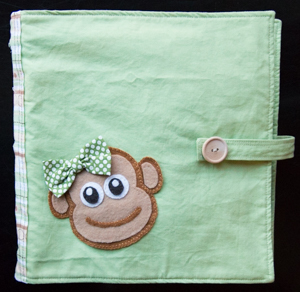 Recently, my mom sewed a busy book for my brother’s baby (her first grandchild) and I think it turned out amazing! Since she used a lot of online resources (Pinterest, Google Images) throughout the project, we thought it would be only fair to give back by sharing photos of the finished book in case they can help anyone else with a similar project.


Cracking Cases
 Cracking Cases: The Science of Solving Crimes by Dr. Henry C. Lee, with Thomas W. O’Neil, 3/5
Impeccably-credentialed forensic scientist Henry Lee uses five sensational cases to illustrate basics of forensic science and police procedure. Each case is the subject of a detailed description that covers requisite back-stories, overview of the investigation, forensic analysis, descriptions of the trial and result. At the conclusion of each case, Lee focuses in more detail on a specific aspect of forensic science relevant to the case, such as bloodstain pattern analysis, DNA analysis, time of death, and gun shot residue.
Two of this book’s strongest aspects are the author’s obvious expertise and ability to write about sensational material in an un-sensational manner. This book did not feel mercenary in intent and did not leave me with the dirty feeling that much true-crime literature engenders. Given that English is not his first language, writing idiosyncrasies are forgivable; but less forgivable is the dryness of the more technical sections, distracting asides, and the unsatisfactory number of photos and diagrams. I think this FBI-affiliated review of the book provides a very good assessment of its strengths and weaknesses.
[Why I read it: This is a topic that interest me, partly because it puts in a new light the police-procedural TV shows I like to watch. Browsing through the library, this book had me at “Woodchipper Murder Case.”]
 OmniRambles