
Tagged: world war ii
Shadow Divers

Shadow Divers: The True Adventure of Two Americans Who Risked Everything to Solve One of the Last Mysteries of World War II by Robert Kurson, 5/5
When a group of shipwreck divers discover a German WWII U-boat sunken just 60 miles off the coast of New Jersey, it sparks a 6-year saga of danger, drama, research, speculation and discovery. Kurson’s prose is beautifully written and guides the reader effortlessly through the biographical backstories, technical diving information, and historical events that combine to form the context for a real-life adventure story so intriguing that I stayed up until 2am to finish it in one day. Though less mythical in topic than the author’s other diving book, Pirate Hunters, this one is equally interesting, has a more satisfying conclusion, and contains more photos.
Why I read it: I enjoyed Pirate Hunters and wanted to check out more by this author.
Schindler’s List

Schindler’s List by Thomas Keneally, 4/5
Many books have been written about the inhumanity of Nazi Germany during WWII, but fewer portray the bureaucracy. Behind the scenes, the business of war gave Oskar Schindler an opportunity to leverage the “ordinary” vices of extraordinarily evil men in order to save Jewish lives. Almost all of the seven deadly sins make an appearance as Schindler schmoozes, name-drops, threatens, cajoles, bribes, wines and dines his way through the war. A man who, at the beginning of the story, could barely be described as “decent” transforms into a fanatic who risks everything to sabotage the German war effort and protect his Jewish workers. It is a fascinating tale, both from a historical and a psychological perspective, though the author’s writing style is a bit dry and idiosyncratic.
Why I read it: I’ve never been motivated to watch the film (way too depressing for movie night) so I was excited to come across the book instead.
Night
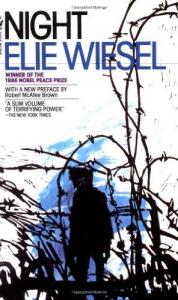 Night by Elie Wiesel, 5/5
This firsthand account of a Jewish teenager’s experience in four German concentration camps during World War II is short, stark and brutal. While most other historical accounts from this era that I have read contain some sliver of hope, faith, humanity, and closure, there is none to be found in Wiesel’s testimony. Presumably these elements are explored in the following, fictional, books of the trilogy, Dawn and Day. There are many disturbing and moving scenes in this book, but strangely, the thing that hit me most was the author’s brief mention of electrical fences around the camp. Some irrational part of me pictures the Holocaust as happening in the dark and distant past, before modern civilization. Realizing that something as thoroughly modern as an electric fence was used to contain innocent men, women and children, 11 million of whom were doomed to die, brings the horror of the Holocaust back to the very near past, where it belongs.
Why I read it: My boyfriend and I found the battered little paperback in a box of his high school relics. If it’s still not required reading, it should be.
 OmniRambles