
Tagged: fiction
Shogun
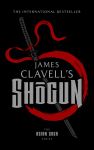
Shogun by James Clavell, 3/5
This 1300-page monster of a hardback novel weighs almost 4lbs, and anyone who thinks it’s weird to dwell on a book’s physical dimensions in a book review has clearly not been been physically traumatized, as I have, by attempting to read it in bed every night! I am only partially joking; the book’s unwieldiness gives a palpable presence to the author’s leisurely writing style, which often makes it seem as if scenes were occurring in real time and not in the pages of a novel. As far as plot, well it’s got a lot. A lot of politics, religion, drama, and unacknowledged historical inspiration. There were a few chapters that dragged, but overall, I felt surprisingly engaged by the story, despite its obscene length and last-minute reliance on a deus ex machina of sorts. The detailed portrayal of 17th-century Japanese culture, written by a European making no claims to historical accuracy, seems problematic to me (I doubt something like this could be written nowadays without causing controversy), but surprisingly, there seem to be no complaints. While I am impressed by the author’s confidence and stamina, I found the length of the book to be a bit self-indulgent and would prefer to read a true account of the historical events portrayed in this novel.
Why I read it: When the first season of the 2024 TV show based on this book ended, I was left wanting more.
The Big Door Prize

The Big Door Prize: A Novel by M. O. Walsh, 2/5
When the TV show based on this novel committed the crime of a season-ending cliffhanger, followed by permanent cancellation, I hoped to find the closure and answers I wanted so desperately by reading the book. Unfortunately, there is so little similarity between the two that it actually raised more questions than it answered, such as why on earth would the show writers keep the same weirdly unrelated title when they were planning to change almost everything else about the story? I am not exaggerating–saying the show is based on this book is the equivalent of creating a sci-fi series about a time-traveling jeweler and saying it’s based on Lord of the Rings.
Now, this cannot be a fair review of the novel because I admittedly spent the first half of it struggling to re-picture all the characters, and the rest trying to reconcile the vast differences between the charming TV series I had enjoyed and the bleak, depressing, comparatively unimaginative plot of the novel.
SPOILERS AHEAD
So how does the story actually end? Well, I read a lot of Reddit threads on the topic and was surprised that practically no one provided a detailed answer to this question, possibly because the answer is not revealed until the last few pages of a book that is almost unbearably dull in comparison to the show. In the novel, it is revealed that the obnoxious town photographer, Bruce “Deuce” Newman (the character on whom the show’s “Giorgio” is loosely based), created the DNAMIX (Morpho) machine as part of an art project to capture images of all the townspeople and use them to create a giant mosaic of Cherilyn (Cass), with which he hoped to win her love by displaying it at the town’s bicentennial celebration. At first, he entertained himself by writing specific “potentials” for people, but eventually he just set it to random. The book ends with him moving on from his obsession with Cherilyn, who renews her relationship with her husband, Douglas Hubbard (Dusty). In a less-uplifting subplot, Trina fails in her attempt to frame Jacob as a school shooter in punishment for sexual abuse resulting from his now-dead twin brother’s abandonment of her at a drunken high school party.
Why I read it: to get closure for the cancelled TV show based on the novel.
The Last Devil to Die
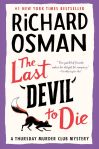
The Last Devil to Die: A Thursday Murder Club Mystery by Richard Osman, 3/5
This story contained some touching character development and I enjoyed how the author incorporated characters and references from previous books. I felt that the criminal-with-a-heart-of-gold archetype is getting a bit worn at this point in the series, but perhaps that is my fault for reading three Thursday Murder Club books in less than a week.
Why I read it: the fourth book in the series.
The Bullet that Missed

The Bullet that Missed: A Thursday Murder Club Mystery by Richard Osman, 4/5
This third installment in the series brings back some of the charm and wit that was missing from the second book, in my opinion.
Why I read it: the third book in the series.
The Man Who Died Twice

The Man Who Died Twice: A Thursday Murder Club Mystery by Richard Osman, 3/5
Enjoyable, though a bit less witty and charming than the first book in the series and featuring a more conventional, spy thriller plot.
Why I read it: the second in a series that started out very strong.
The Thursday Murder Club
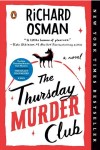
The Thursday Murder Club: a novel by Richard Osman, 5/5
The only mystery left unsolved at the end of this charming, witty, and absolutely delightful novel is how something so polished and sparkling could be the author’s first. I read it in one day and didn’t handle distractions too gracefully, I’m afraid. It made me laugh, it made me cry, and I especially appreciated how the author took his time at the end instead of wrapping up too hastily.
Why I read it: Frustratingly, I can’t remember how I heard of this series.
All the Light We Cannot See

All the Light We Cannot See: A Novel by Anthony Doerr, 4/5
I could complain that this story lost me a bit near the end, but that could very well be a symptom of the pure exhaustion I was feeling at 1am, after reading the entire book in one day. While I can’t claim to be as emotionally traumatized (in a good way) as other reviewers seem to be, I did find this to be a well-crafted and beautifully-written work of historical fiction. I especially appreciated how the author was able to keep my interest equally in both the main character’s story arcs, despite switching between them for the bulk of the book in a way that would be annoying if not so thoughtfully done. A prominent MacGuffin and too little time spent weaving the two character’s stories together after they finally met, is all that keeps this from being a classic, in my opinion.
Why I read it: an oft-mentioned entry in the comments on an Instagram post about favorite (or most meaningful–I can’t remember which) books.
The Midnight Library
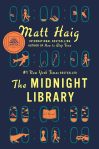
The Midnight Library: A Novel by Matt Haig, 4/5
It feels petty to complain that this deeply meaningful novel about existential crisis and regret boils down to a few cliches and wraps up a little too tidily–the fact remains that I read it greedily in one sitting, shedding a few tears in the process. I couldn’t shake an intense feeling that it was written just for me, which I’m sure is exactly how many other readers feel and is a testament to the author’s writing skill and insight into the mental struggles of modern existence.
Why I read it: an oft-mentioned entry in the comments on an Instagram post about favorite (or most meaningful–I can’t remember which) books.
Anthology of Japanese Literature
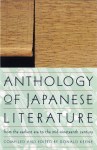
Anthology of Japanese Literature from the Earliest Era to the Mid-Nineteenth Century, compiled and edited by Donald Keene, 5/5
This collection is pleasingly varied and conveniently oriented towards a lay audience; the annotations are minimal and linguistic subtleties are simply acknowledged without being dissected. Most of the short poems are presented in side-by-side rōmaji (romanized Japanese) and English, allowing the reader to absorb a little more of the syllabic patterns, alliteration, and overall flavor of the original writings. Though the imagery, values, and cultural references felt refreshingly unfamiliar, there was an undeniable undercurrent of universal human appeal in the timeless themes of love, loss, death, and spiritual life.
Why I read it: an interesting-looking thrift store find.
Winnie-the-Pooh
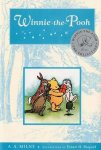
Winnie-the-Pooh by A.A. Milne with decorations by Ernest H. Shepard, 5/5
These stories are delightful and surprisingly witty (Milne was, after all, also a writer for the popular humor and satire magazine, Punch), so it is easy to see why Winnie-the-Pooh continues to be such a popular character, even almost 100 years after he was first introduced. This edition is particularly lovely, with thick paper, imaginative typesetting, and tastefully-colored illustrations.
Why I read it: included in a box of hand-me-down books from a friend.
 OmniRambles