
Tagged: 1981
How to Win Friends & Influence People
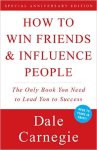
How to Win Friends & Influence People: The Only Book You Need to Lead You to Success by Dale Carnegie, 3/5
In today’s saturated self-help market, it takes a little imagination to understand just how novel and influential this first-of-its-kind work must have been, back in 1936. Carnegie’s “principles” are practical and based on a commonsense understanding of psychology that, though now well-worn, have stood the test of time. Charming anecdotes illustrate the following principles:
Three Fundamental Techniques in Handling People
Principle 1: Don’t criticize, condemn or complain.
Principle 2: Give honest and sincere appreciation.
Principle 3: Arouse in the other person an eager want.
Six Ways to Make People Like You
Principle 1: Become genuinely interested in other people.
Principle 2: Smile
Principle 3: Remember that a person’s name is to that person the sweetest and most important sound in any language.
Principle 4: Be a good listener. Encourage others to talk about themselves.
Principle 5: Talk in terms of the other person’s interests.
Principle 6: Make the other person feel important–and do it sincerely.
Win People to Your Way of Thinking
Principle 1: The only way to get the best of an argument is to avoid it.
Principle 2: Show respect for the other person’s opinions. Never say, “You’re wrong.”
Principle 3: If you are wrong, admit it quickly and emphatically.
Principle 4: Begin in a friendly way.
Principle 5: Get the other person saying “yes, yes” immediately.
Principle 6: Let the other person do a great deal of the talking.
Principle 7: Let the other person feel that the idea is his or hers.
Principle 8: Try honestly to see things from the other person’s point of view.
Principle 9: Be sympathetic with the other person’s ideas and desires.
Principle 10: Appeal to the nobler motives.
Principle 11: Dramatize your ideas.
Principle 12: Throw down a challenge.
Be a Leader
Principle 1: Begin with praise and honest appreciation.
Principle 2: Call attention to people’s mistakes indirectly.
Principle 3: Talk about your own mistakes before criticizing the other person.
Principle 4: Ask questions instead of giving direct orders.
Principle 5: Let the other person save face.
Principle 6: Praise the slightest improvement and praise every improvement. Be “hearty in your approbation and lavish in your praise.”
Principle 7: Give the other person a fine reputation to live up to.
Principle 8: Use encouragement. Make the fault seem easy to correct.
Principle 9: Make the other person happy about doing the thing you suggest.
Why I read it: a recommendation from my sister.
A Penny Saved is Impossible

A Penny Saved is Impossible by Ogden Nash, 3/5
This collection of poems on the topics of work and finances is still surprisingly relevant and features the linguistic inventiveness and charm that fans of Ogden Nash will expect.
Why I read it: a thrift store find to add to my collection.
Mörder Guss Reims
 Mörder Guss Reims: The Gustav Leberwurst Manuscript, translated and annotated by John Hulme, 5/5
Inspired by Mots d’Heures: Gousses, Rames, these German verses sound, when read aloud, like Mother Goose rhymes being spoken in accented English.
You can give it a try if you’re in private (or not easily embarrassed):
Little Bo-peep has lost her sheep,
And doesn’t know where to find them;
Leave them alone, and they will come home,
Bringing their tails behind them.
Liesel Bopp hieb es Schloss der schieb
An Dutzend Noor, wer zu Feind dem,
Lief dem Aal ohn’ an Tee willkomm Ohm;
Brenken der Teil Spee ein dem.
Compared to the French version of this concept, I found the rhymes much easier to recognize in German. I also liked that this edition had all the English verses in the back, so I didn’t have to resort to Google for translations nearly as often.
Why I read it: while researching Mots d’Heures, I learned about this book and bought a copy immediately. I sing in German a lot (in fact, this weekend I’m performing in Bach’s St. John Passion), so this is great practice and fun.
 OmniRambles