In Patagonia

in patagonia bruce chatwinIn Patagonia by Bruce Chatwin, 4/5

Short, vignette-like chapters relating Chatwin’s Patagonian travel experiences are loosely, but satisfyingly, tied together by his interest in the extinct mylodon (Giant Ground Sloth), the fate of Butch Cassidy’s Wild Bunch gang, and the life of his sailor uncle, Charley Milward.  Chatwin’s keen eye for observation, appreciation of what makes a good story, and concise writing style result in an entertaining work that has literary merit beyond that which armchair travellers generally require.

[Why I read it: the title caught my eye as I browsed books in the thrift store (Patagonia has good connotations for me because of Darwin’s Voyage of the Beagle).]

The Discarded Image

discarded image c.s. lewisThe Discarded Image: An Introduction to Medieval and Renaissance Literature by C.S. Lewis, 4/5

Readers who aren’t put off by the rather abstruse tour, in chapters three and four, of ancient writers who influenced the medieval mind will be well rewarded by an accessible analysis of what C.S. Lewis calls the medieval “Model of the Universe,” as evinced by the literature of the time.  This Model is fascinating in its coherence, aesthetic appeal, contrast with the modern point of view and, especially, comprehensiveness: astronomy, biology, philosophy, physiology, physics, art…none of these topics are left out.  Even the most outlandish of medieval beliefs is treated by Lewis with sensitivity, understanding and not a trace of chronological snobbery, though I do wish that many of his claims were more rigorously substantiated.

This book is full of interesting facts and themes that I am, depressingly, forgetting even as I type this review.  Some of the most interesting (stripped, in the interest of conciseness, of the discussion and proofs that accompany them) follow:

  • According to Lewis, the Medievals were “very credulous of books” and had little or no concept of fact vs fiction when it came to literature (11).
  • “I have read a novel which represents all the Pagans of that day [the transitional period considered the source of much medieval thinking, circa 205 to 533AD] as carefree sensualists, and all the Christians as savage ascetics.  It is a grave error.  They were in some ways far more like each other than either was like a modern man.  The leaders on both sides were monotheists, and both admitted almost an infinity of supernatural beings between God and man.  Both were highly intellectual, but also (by our standards) highly superstitious” (46).
  • “…educated people in the Middle Ages never believed the winged men who represent angels in painting and sculpture to be more than symbols” (71).
  • “Medieval art was deficient in perspective, and poetry followed suit. […] The relative size of objects in the visible arts is determined more by the emphasis the artist wishes to lay upon them than by their sizes in the real world or by their distance.  Whatever details we are meant to see will be shown whether they would really be visible or not” (101).
  • “In all this [literary descriptions of opulence] one may suspect a certain vulgarity of imagination–as if to be a High Fairy were much the same as being a millionaire.  Nor does it obviously mend matters to remind ourselves that Heaven and the saints were often pictured in very similar terms.  Undoubtedly it is naïf; but the charge of vulgarity perhaps involves a misapprehension.  Luxury and material splendour in the modern world need be connected with nothing but money and are also, more often than not, very ugly.  But what a medieval man saw in royal or feudal courts and imagined as being outstripped in ‘faerie’ and far outstripped in Heaven, was not so.  The architecture, arms, crowns, clothes, horses, and music were nearly all beautiful.  They were all symbolical or significant–of sanctity, authority, valour, noble lineage or, at the very worst, of power.  They were associated, as modern luxury is not, with graciousness and courtesy.  They could therefore be ingenuously admired without degradation for the admirer” (131).
  • Medievals lacked a “sense of period” when it came to history: they “pictured the whole past in terms of their own age,” attributing to historical people the same language, clothing, customs, and religious practices as themselves (182).  This gave them a feeling of close connection to the past.  Such a close connection, in fact, that the perceived reality of the historical stories “forces them presently to see and hear, hence to set down, at first a little more, and then a good deal more, than their book has actually told them. […] If they had been less rapt by what they read they would have reproduced him more faithfully” (212).  This tendency to act “like a historian who misrepresents the documents because he feels sure that things must have happened in a certain way” (211) fills me with horror, but that is because the modern conception of “originality” and the value placed on it was simply not an issue in the Middle Ages.  “The originality which we regard as a sign of wealth might have seemed to them a confession of poverty.  Why make things for oneself like the lonely Robinson Crusoe when there is riches all about you to be had for the taking?” (211).

But my favourite parts of the book are those three night walks where Lewis looks up at the starry sky and helps you to feel what people from the Middle Ages might have felt at the same view (98, 112, 118).

[Why I read it: It’s unusual to find a C.S. Lewis book that I haven’t read, so I was happy to spot this attractive edition on the shelves of Magus Books.]

As I Remember

as i remember lillian gilbrethAs I Remember: An Autobiography by Lillian M. Gilbreth, 2/5

In contrast to the hilarious escapades and fascinating insights of her children’s book, Cheaper by the Dozen, this posthumously-published autobiography of their mother, Lillian Gilbreth, reads like a cross between a calendar of events and an address book.  Several things about the autobiography disturbed me, but it was hard to tell which were down to poor editing, which to Lillian herself and which to the practice of the times.  I’d guess that the book’s strange layout in disjointed paragraphs and the abundance of careless typos throughout the text were due to lack of editing.  The off-putting use of third-person tense was presumably Lillian’s personal choice, and I assume the bone-dry, unimaginative, unsentimental, relentlessly factual writing style was, at least in part, a reflection of her personality.  Since female academics and engineers were an oddity at the time, it is possible that she was used to being on the defensive and avoiding displays of vulnerability.  Conceivably, this attitude could be the cause of the chilling lack of emotion, personal details, and believable portrayals of relationships in this account, clearly at odds with the Gilbreths’ success and the obvious value they placed on the other people in their lives (even neighbors who were the barest of acquaintances received a mention in her story).

I feel this book failed on two fronts: it wasn’t demonstrative enough to achieve the humanity of a successful autobiography and it wasn’t technical enough to engender any real understanding of the family business (scientific management and efficiency), despite providing exhaustive accounts of business trips, academic papers and books published, lectures given and contracts secured.

[Why I read it: I enjoyed Cheaper by the Dozen very much and wanted to know more about the mother responsible for such a family.]

The Long Walk

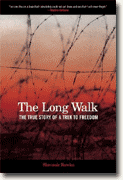
long walkThe Long Walk: The True Story of a Trek to Freedom by Slavomir Rawicz, 1/5

I enjoyed reading this book immensely–the epic tale of Rawicz’s imprisonment, transfer to a Siberian prison camp, subsequent escape with six comrades and 4,000-mile hike to freedom was fascinating, touching and inspiring.  When I sat down to write this review, I easily chose a rating of 5/5.  However, curious about the fate of the book’s protagonists (which was left strangely unaddressed by the author), I did some light researching about the story and was horrified to discover that it is almost certainly untrue!

Now, I am a very suspicious, cynical person in general, but this caught me off guard; I was already familiar with the story, the book had been recommended by a family friend, and there is even a commendatory quote on the cover from historian Stephen Ambrose!  That said, as soon as some doubt was cast on the story’s authenticity, I did recognise several warning signs that had simply not registered while reading the book.  For example, many of the scenarios described did not seem physically possible to survive (particularly the number of days in a row spent hiking without any food, the crossing of the Gobi desert without any means of transporting water, and the hike over the Himalayas with no proper climbing gear).  The aid rendered by the camp commandant’s wife and the female co-escapee they acquired along the way seemed more the stuff of novels than real life.  Also, Rawicz’s descriptions of his comrades and their relationships with each other were shallow and cliched–not at all what you’d expect from a group of men who spent 18 months traveling and suffering together.  His immediate rejoining of the Polish army upon release from a Calcutta hospital seemed unbelievable, as does the fact that he was never in further contact with his fellow escapees.

It is also not encouraging that the story was first “discovered,” then ghost-written, by Daily Mail journalist Ronald Downing, whose reputation is only better than his employer’s in that it is nonexistent.  The BBC provides a very convincing argument for the story’s untruthfulness, as does Rawciz’s Wikipedia article. An article by explorer Mikael Strandberg gives a good summary of the doubts surrounding the book’s authenticity and he concludes in an update that “the story is inspiring, but it isn’t true.”  The kindest opinion possible, held by researcher Zbigniew Stanczyk, is that Rawicz conflated several true escape stories into one, with the intent of gaining publicity for fellow sufferers of Stalinist gulags.  Personally, I sensed nothing in Rawicz’s account to merit giving him the benefit of the doubt to such an extent.

Thus, a mass of probable untruths transformed a 5/5 book to a 1/5 for me and I regret the time I spent reading it.  I will not even attempt the other book that was lent me (As Far As My Feet Will Carry Me by Cornelius Rost, aka Clemens Forell), which seems to suffer from the same issues.

[Why I read it: it was lent to our family by a friend of our inlaws.]

Framley Parsonage

framley parsonage anthony trollopeFramley Parsonage by Anthony Trollope, 3/5

This serial novel’s slow development and sappy, rushed ending evince few of the qualities that made me love the first and second books in the Barchester series.  There is plenty of potential in Framley Parsonage‘s several storylines, the most important of which portrays a vicar’s uncharacteristic pecuniary indiscretions and their aftermath.  The reader is also given insight into the romancing of the vicar’s sister by the local lord (much to his mother’s horror), the unfortunate Mr. Sowerby’s self-inflicted decline into poverty, and, less interestingly, metaphorised commentary on the political machinations of the day.  Fun characters from previous books, such as Barchester’s most eligible spinster–the fabulously wealthy and unromantic Martha Dunstable, Mr. and Mrs. Arabin, and the off-putting Grantly and Proudie families raise this novel above the previous one in my estimation.  But, despite the introduction’s depiction of an astoundingly popular, respected work of literature, I felt that Framley Parsonage was pretty standard 19th-century fare that certainly diminished my excitement to finish the series.

[Why I read it: I enjoyed the first two books in the series (The Warden and Barchester Towers) so much that I’m determined to read the remaining four books.]

Meet Mr Mulliner

meet mr mulliner pg wodehouseMeet Mr Mulliner by P.G. Wodehouse, 5/5

These short stories are chock-full of the inimitable wit that is the Wodehouse trademark.  Meet Mr Mulliner is the first in the series, which includes Mr Mulliner Speaking and Mulliner Nights.

[Why I read it: I’m always a fan of Wodehouse and have a particular fondness for these stories because of the hilarious Wodehouse Playhouse dramatizations.]

Phaedo

phaedo platoPhaedo (On the Soul) by Plato, 4/5

This dialogue presents Plato’s account of the philosophical discussions that occurred amongst Socrates and his friends on the night of the former’s death.  Never having read the classical philosophers but awed by a vague awareness of their reputation, I expected the main topic of discussion—the controversial idea of the immortal soul—to be proved by the rigorous application of flawless logic, secular rationality and esoteric thinking.

This assumption caused me some problems as I read through the first 3/4 of the book and found many of the arguments it contains to be…well…unsatisfactory.  Questionable assumptions were frequently made and used as the basis for further arguments.  Often, issues of linguistics and philosophy seemed muddled up together, with shifting definitions leading to unconvincing conclusions.  Some lines of reasoning seemed frankly circular and many explanations seemed to create more questions than they answered.

At first, I was very frustrated with myself, thinking my stupidity surpassed lack of understanding to reach actual disagreement!  But as I read on, it became more and more apparent that Plato and Socrates must be famous for something other than infallible reasoning about philosophical issues.  In his complex “myth of the afterlife” near the end of the dialogue, Socrates finally gives up all pretense of logic, weaving a strange and wonderful tale of rivers and regions of the earth where souls travel after bodily death.

When I finally reached the following quote, I realized that what I had expected to be a grand testament to human intellectualism was in fact something much more touching and powerful: a dying man’s hopeful affirmation of faith that death is not the end.

Now to insist that those things are just as I’ve related them would not be fitting for a man of intelligence; but that either that or something like it is true about our souls and their dwellings, given that the soul evidently is immortal, that, I think, is fitting and worth risking, for one who believes that it is so—for a noble risk it is—so one should repeat such things to oneself like a spell; which is just why I’ve so prolonged the tale (114d).

[Why I read it: my knowledge of Greek literature is lacking, so when I saw this short book encompassing two famous philosophers at the thrift store, I thought it might be a good place to start.]

Love’s Labour’s Lost

loves labours lost shakespeareLove’s Labour’s Lost by William Shakespeare, 4/5

Armed only with the ambiguous aid of some humourless footnotes and crusty endnotes, I could sense a veritable jet stream of jokes, puns and witticism blowing right over my head.  How I missed my customary “cheater’s edition,” with its modern English translations on each facing page!  Unfortunately for me and my limited understanding of Elizabethan English, the play is more dialogue- than plot-driven and, though the premise is cute and there were many funny moments, I often found myself quoting one movie-watcher’s insightful comment on A Midsummer Night’s Dream (1999): “I can’t understand a damn word they are saying…”

[Why I read it: One day last week, I had an hour to kill while waiting for a ride.  Imagine my horror when I looked in my backpack and found myself bookless (French homework obviously doesn’t count).  Like a literary knight in shining armour, my sister produced her personal copy of Love’s Labour’s Lost, thus banishing my unhappy state.]

The Alchemist

alchemist paulo coelhoThe Alchemist by Paulo Coelho, 2/5

This relentlessly aphoristic story of spiritual self-discovery derives its limited appeal, in my opinion, from a competent use of archetypal characters and scenarios.  However, Coelho’s seeming ambition to attain full-on Guru status results in a narrative that is less a stream from the fount of wisdom than a diarrhea-like flow of half-digested, context-less fragments borrowed from every major religion, with no regard for consistency or original meaning.  The result is the sort of appealingly spiritual drivel that sounds like nonsense to most people with strong religious beliefs, but that omnists and artistic atheists would call beautiful and “like soooooo deep, you know?”

Several similes involving bovine manure come easily to mind, but perhaps it is more apt to think of The Alchemist as a sort of amateur symphony composed of tiny, jumbled-up fragments of very famous, very beautiful music from the span of thousands of years.  Connoisseurs and practicers of music, recognising the butchery of varying sources, would likely find the result to be unoriginal, baffling and a ridiculous mockery of true Music.  Everyone else would likely think the symphony was the most profound thing they’d ever heard.

[Why I read it: the author was unrecommended to me by a friend, who thought I might hate Coelho enough to write an amusingly vitriolic review.  I’m afraid that, this time, we’ll both have to settle for mild disdain instead…]

Cheaper by the Dozen

cheaper by the dozen frank and ernestine gilbrethCheaper by the Dozen by Frank B. Gilbreth Jr. and Ernestine Gilbreth Carey, 5/5

I can’t believe I didn’t get around to reading this classic until now.  I think that I had a bad impression of it from my mom, who had a bad impression of it from the movie versions.  At any rate, this book is hilarious and, to someone who knows big families or comes from one (like I do), it is utterly believable.  It made me laugh so hard that I had to read a couple parts aloud to the family.  It would make a great read-aloud book, by the way, if the reader can control the giggles.  I’ve requested the much-less-well-known sequel, Belles on Their Toes, from the library, as well as an autobiography of the mother, so I have more Gilbreth escapades to look forward to in future.

[Why I read it: I wanted to find out why a couple family friends found it so amusing that I’d posted Morse code in the bathroom for the kids to learn.  It seems Mr. Gilbreth had the same idea, though with a much cleverer execution…]