Personal Injuries

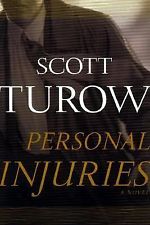
personal injuries scott turowPersonal Injuries: A Novel by Scott Turow, 2/5

This book has all the right components–characters with strong personalities and motivations, an exciting, page-turner plot about an undercover FBI agent working with a corrupt-lawyer-turned-informant to bring down a bevy of crooked judges, and expertise on the part of the author, who is himself a practicing attorney.  However, the whole thing just didn’t work for me.  The characters felt cliched and unreal, the plot melodramatically contrived and a bit gimmicky, and the writing style strained.  The technical parts were a little dry, but infinitely preferable to the sexed up sub plot.  I feel that the book should have been enjoyable, but I’m left just wishing I could get back the time I spent reading it.

[Why I read it: An acquaintance who is an attorney mentioned a different book, Burden of Proof, by this author, but the library didn’t have it.]

The Hitchhiker’s Guide to the Galaxy Audiobooks

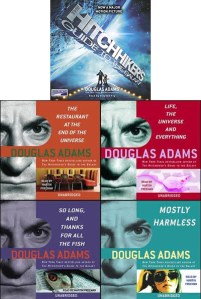
Hitchhiker's Guide to the Galaxy Audiobooks douglas adams stephen fry martin freemanThe Hitchhiker’s Guide to the Galaxy by Douglas Adams, narrated by Stephen Fry
The Restaurant at the End of the Universe by Douglas Adams, narrated by Martin Freeman
Life, the Universe and Everything by Douglas Adams, narrated by Martin Freeman
So Long, and Thanks for All the Fish by Douglas Adams, narrated by Martin Freeman
Mostly Harmless by Douglas Adams, narrated by Martin Freeman
Overall rating: 5/5

Very rarely do I stop what I’m doing and think Do you know what would be great right now? A soundtrack of someone reading out loud much too slowly for hours and hours, completely oblivious to whether I’ve become distracted or have just woken up from an impromptu nap with no idea how much story I’ve missed.  You see, audiobooks are a form of entertainment that require a strangely specific level of participation on the part of the listener.  You must be doing something while you listen, not just staring at a blank wall, but it mustn’t be anything too interesting or you will get distracted and lose track of the story.  There simply aren’t many activities in my life that fit this criteria.  If I want to experience a certain book, I’ll read it quickly and efficiently in my spare time; if I’m doing an activity that leaves a little brain space free, I’ll listen to music.  Even if I were a truck driver, window washer or commuter who relied on audiobooks to stay sane, I’d still consider listening to a book to be an inferior experience to reading a book.

At least, that was my opinion until I heard about five minutes of The Restaurant at the End of the Universe while driving to school with my sister.  The first thing that struck me was not Douglas Adams’ bone-achingly funny writing, but Martin Freeman’s extraordinary narration skills.  He doesn’t just read, he acts.  And, with his plaintive, everyman, English accent, he is perfectly cast.  The second thing that struck me was how much funnier and more enjoyable Adams’ humour-packed writing is when delivered at normal speaking speed instead of my usual voracious reading tempo, which barely leaves time to absorb one joke before the next is past.  In fact, I felt the series was strangely well-suited to the audiobook format, not realising until much later that The Hitchhiker’s Guide to the Galaxy in fact started as a BBC radio comedy series!  So in a sense, the audiobooks are more in tune with the original concept than the books, which could almost be considered spin-offs.

With regard to the quality of Douglas Adams’ writing, I have few complaints besides the dreariness with which the series ends.  Sure, there are ups and downs, parts that are brilliant and parts that lag, inventive jokes and cliched ones, but the overall effect is one of astounding genius and imagination.

[Why I listened to it: My sister’s friend listened to the series repeatedly while working as a window washer, so she decided to give it a try and I heard excerpts when we happened to drive to school together.  I actually bought the entire book series (in one volume) last year, but had not gotten around to reading it before encountering the audiobooks.]

The Last Chronicle of Barset

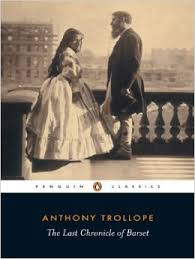
last chronicle of barset anthony trollopeThe Last Chronicle of Barset by Anthony Trollope, 5/5

This sixth book in the Barchester Chronicles provides a satisfying, yet bittersweet, ending to the series.  The main plot focuses on the unfortunate Reverend Josiah Crawley, an impoverished man of unbending integrity and crippling pride who is, to everyone’s shock, accused of stealing a cheque.  Familiar faces abound in the subplots, which include the courtship of disgraced Grace Crawley by Archdeacon Grantly’s widowed son, the romantic tribulations of Johnny Eames and Lily Dale (main characters from the previous book, The Small House at Allington), hen-pecked Bishop Proudie and his dreadful wife’s involvement in the Crawley affair, and the latter years of dear old Septimus Harding, protagonist of the first book in the series, The Warden.  Overall, the tone of the book is more serious and less witty than the reader might expect and the stories are somewhat less engaging than could be hoped, but any author that can bring tears to my eyes twice in one book must be doing something right.

A note for readers new to the series: Those with the time and inclination to read the whole series and the patience to endure its lower-quality third and fourth books will be well rewarded. However, for less perfectionist readers, I feel that it is entirely reasonable to skip the third and fourth books altogether.  And for readers even less ambitious, the first two books would suffice (the second book, Barchester Towers, is actually my favourite of the entire series).  Readers new to Trollope and hesitant to invest time and energy will be glad to learn that the first book, The Warden, is not only the shortest in the series, but gives a very good indication of what they are in for if they continue.

[Why I read it: it concludes the Barchester Chronicles series, which I started six months ago.]

The Starfish and the Spider

starfish and spider ori brafman rod a beckstromThe Starfish and the Spider: The Unstoppable Power of Leaderless Organizations by Ori Brafman and Rod A. Beckstrom, 3/5

Using real-life examples, Brafman and Beckstrom explore the contrasting characteristics of centralized and decentralized organizations.  The term “centralized” is associated with traditional for-profit businesses, which usually have hierarchical organization, official headquarters and utilize the top-down method of decision making. In contrast, “decentralized” entities are idealogy- and community-driven, featuring resiliently chaotic structures and utilizing bottom-up decision making.

The souped-up magazine article cum research paper style is very popular for books of this genre and for good reason–it is entertaining and easy to read.  This book is no exception and has the added benefit of being on an interesting and relevant topic.  However, I feel that the authors spent rather too much time describing the obvious and comparing apples with oranges; it seems clear from the examples that centralized and decentralized organizations have very different functions and goals, so it doesn’t make much sense to spend a lot of time comparing them (the MPAA doesn’t aspire to be The Pirate Bay and vice versa).  A small portion of the book was spent more usefully, in my opinion, analyzing the conflict between these two styles of organization, and near the end of the book, the authors finally look at what aspects of decentralization can be successfully employed by more traditional businesses.

[Why I read it: my dad wanted to know what I thought about it before reading it himself.]

What If?

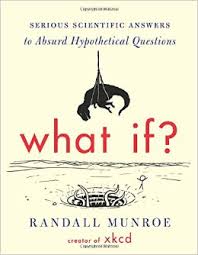
what if randall munroeWhat If?: Serious Scientific Answers to Absurd Hypothetical Questions by Randall Munroe, 5/5

What would happen if everyone on Earth stood as close to each other as they could and jumped, everyone landing on the ground at the same instant?  Is it possible to build a jetpack using downward-firing machine guns?  From what height would you need to drop a steak for it to be cooked when it hit the ground?

With his trademark wit, scientific know-how, and ability to draw strangely hilarious stick figures, Randall Munroe answers some of the vital questions that have been asked by readers of his webcomic, xkcd.  I expected this book to be underwhelming and a bit of a chore to read (à la almost all the other books based on webcomics I’ve encountered), but it was hilarious and accessible–my teenaged brother got his hands on it before me and read the whole thing in short order.  The content seems well-suited to book format and, surprisingly, I found it to be even funnier and more readable than the What If? blog that inspired its creation.

[Why I read it: I’ve been a fan of xkcd for several years now.]

The Small House at Allington

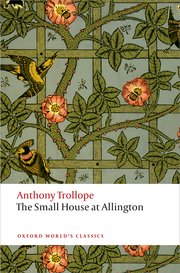
small house at allington anthony trollope oxford world's classicsThe Small House at Allington by Anthony Trollope, 4/5

With good humour, skill, and psychological insight, Trollope tells a twisted tale of love and loss that centers around passionate Lily Dale and her more sensible sister, Bell; social climber Adolphus Crosbie; John Eames, the quintessential boy-man; and a collection of other characters who inspire love, disgust and pity by turns.  Though the preceding two books in the series were disappointing, I feel that in this fifth novel Trollope captures once again the unique voice and perspective that made me fall in love with the Barchester Chronicles.  Fingers crossed that the sixth and final book in the series will be similarly inspired.

[Why I read it: I am reading my way through the Chronicles of Barsetshire, having started with The Warden a few months ago.  Strangely, my library contained all the books in the series except for this one, which they kindly purchased at my request.  They are the best!]

Odes

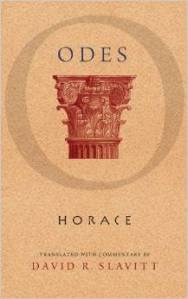
odes horace david slavittOdes by Horace, translated with commentary by David R. Slavitt, 2/5

Slavitt sets himself a Herculean task–translating the Latin Odes of eminent Roman poet Horace with a view to recreating for modern readers a similar reading experience to the one that the poems might have offered ancient audiences, who enjoyed a different language, different range of knowledge, and different sensibilities.

The commentary Slavitt provides for each ode, clarifying difficult parts of the text and explaining what he added in or left out, is both helpful and horrifying: helpful in that it provides insight into the intricate art of translation, horrifying in its revelation of some of the liberties he takes with the text.  It set my teeth on edge when Slavitt inserted the anachronistic “cougar” (an older woman who chases younger men) into one of the odes, explaining that “Had such a convenient concinnity of terms been available to Horace, I am sure he’d have used it” (134).  Or when he describes a “murder” of crows, using the word because it’s “one I have always liked” (130).  Or when he invents unwarranted poetic additions simply to increase the “linguistic density” of the poem (113).

I admire Slavitt’s stated goal very much, but felt that many of the liberties he took with the text were unscholarly, unjustified and disrespectful to the original works.  After all, it boils down to this: Horace was one of Rome’s leading poets.  Who is David R. Slavitt?  I would have had absolutely no problem with this book if Slavitt had just fully indulged himself and created a work titled Odes by David R. Slavitt, inspired by Horace.

In addition to my dislike of Slavitt’s approach to translation, I also did not much enjoy the resulting poems themselves.  This is not a reflection of their quality or value, just the fact that I failed to experience a connection with them.  Poetry has always seemed to me a very personal thing–you never know what is going to resonate, when, and with whom.  Overall, however, I did not find the odes to be very beautiful or thought-provoking, they generally did not demonstrate pleasing word choices and metres, and they did not make me look at things in new or different ways (all aspects common to poetry I enjoy).

[Why I read it: I think I just stumbled across it while browsing in the library and thought it looked interesting.]

Of Mice and Men

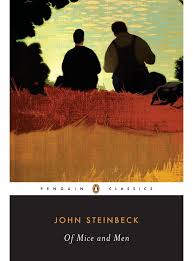
of mice and men john steinbeckOf Mice and Men by John Steinbeck, 3/5

It is embarrassing to admit, but I really don’t understand why this novella is so famous and respected.  Is it merely because of the shocking ending?  The fact that it was censored by many schools?  Besides the linguistic value of the dialogue, which can be presumed to accurately represent the spoken English of a certain time and social class, I found little else to recommend this simple story.  Yes, it is competently written, has some nice imagery and a few touching scenes, but by the end the main sensation it inspired was the question “Why?”  As in, “Why was this even written?  Why would anyone want to read it?”  Now there are many works of literature for which I could not answer those same questions, but the big difference is that those works of literature don’t really inspire me to ask those questions in the first place.

I thought this edition’s substantial introduction would perhaps give some insight into the book’s point, but it was full of “troubled interplay,” “concentration on the circumscribed space,” “allegorical potential,” “symbiotic dependency”…all the silly things that scholars love to write about writing and readers hate to read.  The most helpful bit was an actual quote from Steinbeck to his disappointed agents: “I probably did not make my subjects and my symbols clear.  The microcosm is rather difficult to handle and apparently I did not get it over–the earth longings of a Lennie who was not to represent insanity at all but the inarticulate and powerful yearning of all men.”  I would have to agree with the author that this point was not at all communicated by the story, at least to me.

As a side note, I cannot believe that high schoolers are forced to read books like this, The Old Man and the Sea, The Catcher in the Rye, The Great Gatsby, Lord of the Flies and the works of Shakespeare.   Whatever their literary value might be according to scholars and those with mature taste, I only know that, if this were the only sort of literature I was exposed to at a young age, I would likely not read at all.

[Why I read it: It is famous, but wasn’t really on my radar until I saw several references to it in the film Man on Fire (1987).]

The Princess Bride

princess bride william goldman s morgensternThe Princess Bride: S. Morgenstern’s Classic Tale of True Love and High Adventure by William Goldman, 5/5

Reading this book was a strange experience because I could not separate it in my mind from the 1987 film, which I had seen many times before I realised it was based on a real book and many, many more times before actually reading the novel for the first time (years ago).  I was delighted to experience all the “extras” that didn’t make it into the movie but contribute to a novel that is hilarious and fantastical.  Goldman’s editorial asides, biographical anecdotes and surprisingly plausible insistence that he is merely the translator, not the creator, of this tale, create a mind-bending false reality that seems to blur the line between fact and fiction (when actually, it’s all fiction).  The book is also a valuable read for those interested in screenwriting and filmmaking.  When compared to the movie, it is an education to realise what was left out, what was added in, and what was changed by an author who is also an accomplished screenwriter.

[Why I read it: I was too young to completely understand the book the first time; it might never have ended up back on my reading list if one of my sisters-in-law hadn’t mentioned it and given me a craving.]


Belles on Their Toes

belles on their toes frank gilbreth jr ernestine gilbreth careyBelles on Their Toes by Frank B. Gilbreth Jr. and Ernestine Gilbreth Carey, 5/5

I thought this lesser-known companion to the popular Cheaper by the Dozen would suffer from Sequel Syndrome but it doesn’t–the stories it contains are funny, touching, and calculated to make even a cynical reader like myself wish the book were ten times longer.  While the first book is dominated by the charismatic person of their father, this sequel is a tribute to the mother who somehow managed to keep the family together after her husband’s death, put all the children through college, keep up the family business and pioneer the male-dominated world of industrial engineering.

[Why I read it: I enjoyed Cheaper by the Dozen.]