Picture Quote — Dylan Thomas

Picture quote from the Dylan Thomas poem “Poem.” “A dark as deep My love as a round wave To hide the wolves of sleep And mask the grave.” © 2016 omnirambles.com


Picture quote from the Dylan Thomas poem “Poem.” “A dark as deep My love as a round wave To hide the wolves of sleep And mask the grave.” © 2016 omnirambles.com

Picture quote from the Dylan Thomas poem “The Ploughman’s Gone.” “You shall go as the others have gone, Lay your head on a hard bed of stone, And have the raven for companion.” © 2016 omnirambles.com

Picture quote from the Dylan Thomas poem “Youth Calls to Age.” “Though there are years between us, they are naught; Youth calls to age across the tired years: ‘What have you found,’ he cries, ‘what have you sought?’ ‘What you have found,’ age answers through his tears, ‘What you have sought.’ © 2016 omnirambles.com

A picture quote from the Dylan Thomas poem “Out of a War of Wits.” “For out of a house of matchboard and stone Where men would argue till the stars be green, It is good to step onto the earth, alone, And be struck dumb, if only for a time.” © 2016 omnirambles.com

A picture quote from the Dylan Thomas poem “The Clown in the Moon.” “I think, that if I touched the earth, It would crumble; It is so sad and beautiful, So tremulously like a dream.” © 2016 omnirambles.com
A Modest Proposal and Other Satires by Jonathan Swift, 4/5
Swift combines wit, humour and venom in this collection of satires that attack everything from organized religion to politicians and fellow writers. The 18th-century language and references to now-obscure people and issues do not hinder this book’s continued relevance and, in my opinion, even enhance the timelessness of Swift’s observations–one of my favourite parts of reading very old literature is realizing how little people’s basic natures change with the passage of time.
Why I read it: One of Dad’s coworkers cited “A Modest Proposal” as his all-time favourite piece of literature, which made me curious to read it. Also, I’ve been meaning to read Gulliver’s Travels for quite a while and I thought it was in this collection (which it wasn’t).
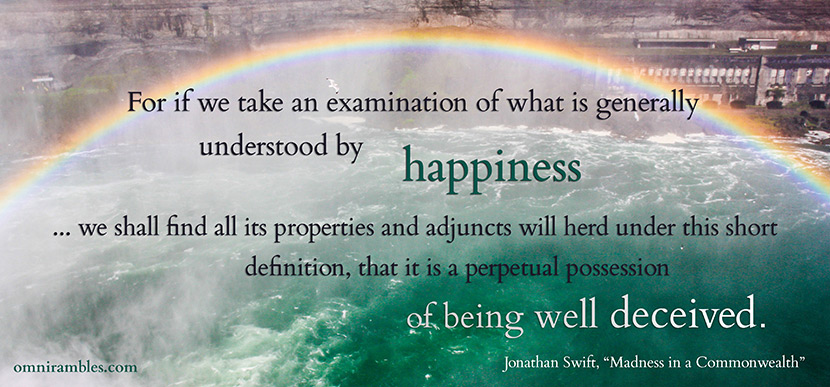
I made a couple picture quotes for this book:
Why Grizzly Bears Should Wear Underpants by Matthew Inman (aka The Oatmeal), 4/5
Recklessly funny, Inman doesn’t hold back at all in this collection of comics which tackles topics from commuting via polar bear to eating Play-Doh. This book is definitely not for the sensitive soul–while he considerately pixelates most of the cartoon privates, the author does somehow manage to invent euphemisms that are more offensive than the real thing.
[Why I read it: I’m on an Inman binge.]
My Dog: The Paradox: A Lovable Discourse about Man’s Best Friend, by Matthew Inman (aka The Oatmeal), 3/5
This book contains only one comic, so it is more of a novelty than anything. However, it is still pretty cute and I recognise his cartoon dog’s infectious enthusiasm in my own mutt (though mine certainly uses fewer swearwords).
[Why I read it: ordered all of Inman’s stuff from the library at once, then read it in one sitting.]
How to Tell if Your Cat is Plotting to Kill You by Matthew Inman (aka The Oatmeal), 4/5
A laugh-out-loud-funny collection of cat-themed comics from The Oatmeal.
[Why I read it: Reading Inman’s The Terrible and Wonderful Reasons Why I Run Long Distances reminded me that he has other hilarious books out there that I hadn’t read yet.]
The Dispossessed by Ursula K. Le Guin, 2/5
Le Guin’s exploration of that inherently contradictory concept, an anarchist society, felt pointless and unbelievable, probably because anarchy itself (even the idealized, fictional version portrayed in this book) seems ridiculously illogical, unrealistic and childish, as I understand it. Is the government oppressive? Get rid of all forms of authority! Do the rich exploit the poor? Get rid of all possessions! Is anarchy failing? Apply more anarchy!
My main problem is not necessarily with Le Guin’s portrayal of anarchy in the book (though I did find that pretty implausible) but that when it inevitably starts to unravel, she falls back on more anarchy as the answer. It’s as if rebellion was a cause itself, not something to be employed in the service of a cause. Her attempts to extract some sort of deep philosophical meaning from the simple fact that a society of rebels will inevitably become a regime to be rebelled against itself did not resonate with me at all.
Another reason I didn’t enjoy reading this book is that I dislike feeling preached-at and reading fiction that contains fake science and sexual themes, all of which are prominent features of The Dispossessed and annoyed me enough to ruin any chance of achieving suspension of disbelief.
[Why I read it: Jan from choir recommended Le Guin to me a couple years ago and my friend Sarah mentioned on Facebook that she’s a huge fan.]