
Tagged: play
Bertram
Bertram; or, The Castle of St. Aldobrand by Charles Robert Maturin, 3/5
Drama is my least favorite literary genre and via ebook is my least favorite method of literary consumption, but my curiosity was adequately rewarded by this obscure, yet affectingly tragic and well-written play from the early 19th century, made available online by the University of Virginia Library.
Why I read it: A dramatic quote from this play, used as a chapter epigraph in The Hidden Hand, piqued my curiosity:
“By hell and all its host, he shall not live.
This is no transient flash of fugitive passion—
His death hath been my life for years of misery—
Which else I had not lived—
Upon that thought, and not on food, I fed,
Upon that thought, and not on sleep, I rested—
I come to do the deed that must be done—
Nor thou, nor sheltering angels, could prevent me.”
The Works of Oscar Wilde
 The Works of Oscar Wilde by Oscar Wilde, 5/5
Oscar Wilde is one of my favorite authors and I have read (and re-read) his major works, such as the entrancing novella, The Picture of Dorian Gray, and the impossibly witty play The Importance of Being Earnest. However, there were a few of his short stories, plays and poems that I’d never encountered before, so this collection was a delightful mix of old favourites and new discoveries.
Why I read it: this collection was a birthday present from my dad.
Medea
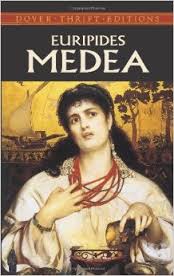 Medea by Euripides, translated by Rex Warner, 5/5
This play has a killer plot: when her husband, Jason, dumps her and upgrades to a more royal model, Medea, [formerly] devoted wife and mother of two sons (unnamed in the play, I call them “Collateral” and “Damage”), manages to take the moral high ground, despite being an accomplished murderess, and plots a terrible vengeance. As you can imagine, tensions run high and there is a lot of deliciously vitriolic dialogue. Warner’s translation is straightforward and unflowery, resulting in an entertaining read that I would love to see performed some day.
[Why I read it: found it at the thrift store and thought it would fit in well with my plan to read more classics.]
Love’s Labour’s Lost
 Love’s Labour’s Lost by William Shakespeare, 4/5
Armed only with the ambiguous aid of some humourless footnotes and crusty endnotes, I could sense a veritable jet stream of jokes, puns and witticism blowing right over my head. How I missed my customary “cheater’s edition,” with its modern English translations on each facing page! Unfortunately for me and my limited understanding of Elizabethan English, the play is more dialogue- than plot-driven and, though the premise is cute and there were many funny moments, I often found myself quoting one movie-watcher’s insightful comment on A Midsummer Night’s Dream (1999): “I can’t understand a damn word they are saying…”
[Why I read it: One day last week, I had an hour to kill while waiting for a ride. Imagine my horror when I looked in my backpack and found myself bookless (French homework obviously doesn’t count). Like a literary knight in shining armour, my sister produced her personal copy of Love’s Labour’s Lost, thus banishing my unhappy state.]
Twelfth Night
 Twelfth Night by William Shakespeare, 5/5
This lighthearted and unrelentingly witty play is similar to As You Like It and A Midsummer’s Night Dream, but is my favourite of the three. While I find it distracting to see the modern version of the text side-by-side with the original, in this case, it really helped me to understand a lot of humour that would otherwise have gone right over my head.
[Why I read it: part of the aforementioned long-term mission to read everything by Shakespeare. I picked this copy up from the thriftstore.]
The Winslow Boy
 The Winslow Boy: A Play in Four Acts by Terence Rattigan, 3/5
I have yet to develop much of a taste for plays, finding that they typically (though of course, not always) have shallow plots and lack character development. This work is no exception, but I enjoyed the 1999 movie version, starring Jeremy Northam, so much that it was still a fun read.
 OmniRambles