
Tagged: Nonfiction
Moonwalking with Einstein
Moonwalking with Einstein: The Art and Science of Remembering Everything by Joshua Foer, 2/5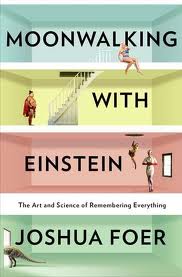
This book was not nearly as interesting as the title made me hope it would be. There wasn’t much of practical use in it and it was written in a dry, unengaging, unlikable style. It struck me as a nice magazine article that had been fleshed out with lots of predictable rabbit trails and speculation. A little research revealed that this is exactly what it is; the author is a freelance journalist and this is his only book, for which he received $1.2 million in advance. The book’s background really shows – it feels written for profit, not passion.
The Essential Spinoza
The Essential Spinoza: Ethics and Related Writings, edited by Michael L. Morgan, 5/5
Writing in an uncompromisingly mathematical style, Spinoza undertakes to dismantle all conceptions and preconceptions about God, life, the universe and everything, painstakingly rebuilding his philosophy from a logical progression of definitions, axioms, propositions, proofs and corollaries and resulting in the most intellectually challenging work I have ever read. While there was much that I did not understand, there was also much that found immediate application to my own comprehension of God, religion, and existence. I was taken right out of my head by Spinoza’s approach to everything that matters to humans – it was like seeing through a one-way mirror after a lifetime of being on the reflective side.
The Filter Bubble
The Filter Bubble: What the Internet is Hiding from You by Eli Pariser, 4/5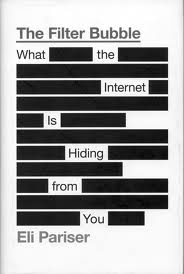
This book explores the ways that the increasing personalisation of the internet affects its users both in the short and long term senses. It also explores many other related issues, including the ethics of mass media, the psychology of advertising, the centralization of internet control, and the internet’s potential both to advance and harm the development of human society. I was very interested to learn that data about internet users is a huge and unbelievably valuable commodity for advertisers and that the gathering, buying and selling of this data is largely behind the scenes, with little accountability and opaque to public scrutiny. This book is scary and challenging, but not sensational or fluffy, as are most books of its ilk. I would have given it 5/5 if Pariser had been a little more scholarly with his handling of citations (there is a detailed “notes” section at the end, but the sources are sorted by chapter and not linked directly to the text, making it time-consuming to verify his claims). I recommend that everyone read this book. It will not be a waste of time.
The Ego and the Id
The Ego and the Id by Sigmund Freud, 1/5
While it is true that a greater knowledge of psychoanalysis and its specialised vocabulary, resulting from a familiarity with the rest of Freud’s writings, would no doubt increase my comprehension of his ideas, the pervasive odour of bullshit which oozes from between the pages of this eminently unscientific work encourage me rather to avoid all other products of Freud.
The Complete Idiot’s Guide to Understanding Football
The Complete Idiot’s Guide to Understanding Football by Mike Beacom, 2/5
This book was an entertaining read, but not nearly as informative as I had hoped. The shortage of diagrams/illustrations made it hard to understand formations and trick plays. The information was not presented sequentially – many terms were not explained at all or were explained at random points in the book. Also, the writing style was unfittingly panegyrical and subjective. For example: “It’s been said that Ginger Rogers could do everything Fred Astaire could do, only she could do it backward and in heels. Well, that’s how cornerbacks think of themselves compared to wide receivers – without the heels, of course” (166). Ha bloody ha.
The Film That Changed my Life
The Film That Changed my Life: 30 Directors on Their Epiphanies in the Dark by Robert K. Elder, 5/5
Two things must accompany the reading of this book, besides an appreciation of the more technical side of films: immediate access to imdb.com and an empty list entitled “Films to watch.” For me, this was a good introduction to many iconic directors with whom I am regretfully unfamiliar and a fascinating glimpse into how others watch, enjoy and are influenced by a variety of films. An example of the book’s power… after reading the interview about Citizen Kane, I am inspired to re-watch the movie (despite hating it the last three times I saw it). The only thing I didn’t like was the inevitable inclusion of spoilers for many of the movies.
 OmniRambles