
Tagged: Nonfiction
Black Hawk Down
Black Hawk Down by Mark Bowden, 5/5
I think this is a masterpiece of war journalism for several reasons. Firstly, Bowden treats his sources with respect and courtesy instead of manipulating and abusing them for the sake of furthering his own career. This is not as common an attitude as I would wish and expect. Secondly, it is clear that the accuracy of his portrayal is Bowden’s main concern. He wastes no time searching for a sensational “angle” and doesn’t create unnecessary drama. Thirdly, Bowden clearly recognizes the limits of his own expertise, refraining from sweeping allegations and extrapolations with regard to political and military strategy. He is intelligent enough to avoid turning an admittedly controversial story into a personal soapbox. Fourthly, the book is scrupulously well cited, with an annotated bibliography and detailed information provided on the sources.
How to Disappear
How to Disappear: Erase Your Digital Footprint, Leave False Trails, and Vanish Without a Trace by Frank M. Ahearn with Eileen C. Horan, 2/5
Sometimes I get the strong feeling that I would hate a particular person if I ever met them. Frank Ahearn is one of those people. Just do a Google Image Search for his name and you’ll see what I mean from the pictures. He comes across as a low-class, egocentric, sleazy scumball, bent on glamorizing a career that seemed to consist mostly of lying to people over the telephone in order to obtain personal info to be sold to whatever shady employer happened to have the cash. It is no credit to him that he finally got out of the skip-tracer career because his morally reprehensible methods became illegal (or at least, more punishable). The book provides some good info and entertaining stories, but lots of the info is commonsense and repetitive and it is all couched in an unbearably bullshit style.
50 big ideas you really need to know
50 big ideas you really need to know by Ben Dupre, 2/5
These short essays on a variety of topics, ranging from philosophy to physics, were too surfacey and simplistic for me. I did not like the format of the book; it was very disjointed, with distracting quotations and random boxes of text floating around. I appreciate that Dupre manages to write from a relatively impartial viewpoint on controversial topics, though he did come across as pro-Communism, which is repellant to me. I was a little confused by his essays on conservatism and liberalism until I realised that he’s English and this book is only published in the UK. That explains many of the slight differences in perspective throughout.
Primetime Propaganda
Primetime Propaganda: The True Hollywood Story of how The Left Took Over Your TV by Ben Shapiro, 3/5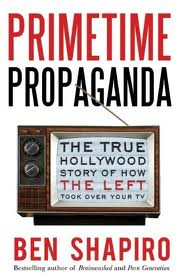
Shapiro makes the well-documented and compelling case that virtually everyone involved in the TV industry is outspokenly liberal, proud to push their agendas through the powerful medium of TV, while shutting out and shutting down any conservatives who might be foolhardy enough to attempt to join the industry. The tone is uneven throughout, but Shapiro generally manages to be respectful and rational, though he does make some generalizations/statements about liberals that made me angry on their behalf. While Shapiro’s main points are undoubtedly true, I felt like he was really reaching when it came to specific TV shows and specific instances of liberalism.
The Call
The Call: Finding and Fulfilling the Central Purpose of Your Life by Os Guinness, 2/5
This book is the final nail in Os Guinness’ coffin, as far as I am concerned; I have now read three books by him, two of which I found extremely unimpressive, and I will avoid his work in the future. I found this book to be pointless and an almost complete waste of time. It offered no substance, practical information or advice. My main complaint against Guinness is his lack of originality – the one thing he is best at is quoting other people and telling their stories. Whenever he quoted C.S. Lewis or G.K. Chesterton (which was frequently), I found myself wishing I was reading a book by them instead.
No Fear of Failure
No Fear of Failure: Real Stories of How Leaders Deal with Risk and Change by Gary Burnison, 3/5
There were some interesting and inspiring interviews in this book, but couched in lots of “manager speak” buzzwords and catchphrases.
The Eureka Method
The Eureka Method: How to Think Like an Inventor by John Hershey, 2/5
This is a poorly-written, largely unhelpful, book that spends too much time on the obvious, while glossing over the difficult. What it lacks in substance it makes up for in fluff, the diagrams/illustrations being the worst offenders. One of the most pointless is Figure 5-4, which takes up a third of the page to illustrate a “ten-button keypad lock” as ten circles, each containing a number from 0-9. There are other equally pointless illustrations throughout. The most useful part of the book is Appendix A, which explains patents and patent laws.
The Case for Civility
The Case for Civility: And Why Our Future Depends on It by Os Guinness, 4/5
Guinness looks at how modern American views of tolerance and the idea of separation between church and state have moved away from the intent of the First Amendment with regards to religion: namely, to ensure freedom OF religion, not freedom FROM religion. He argues that rather than attempting to remove religion from politics and public discussion, anti-religious, non-religious and religious philosophies should be accorded the same respect, consideration and civility in the public square. I admire and agree with many of Guinness’ points, but the fact remains that as long as there is money to be made and power to be grabbed from encouraging the illogical, impassioned, hate-filled polarization of people over topics of religion and politics, civil discussion will be impossible. In the light of modern culture, media and politics, Guinness’ book is a discouragingly small glimmer of reason and common sense.
Unspeakable
Unspeakable: Facing up to Evil in an Age of Genocide and Terror by Os Guinness, 2/5
This book tells some touching stories and provides some good quotes, however it does not dive very deeply into the subject. Its unconvincing surface exploration of such a major issue would probably be most useful to already established Christians. It comes nowhere close to the apologetics of C.S. Lews, G.K. Chesterton and the like.
The Renaissance Soul
The Renaissance Soul: Life Design for People with Too Many Passions to Pick Just One, by Margaret Lobenstine, 2/5
Lobenstine’s positive attitude toward people who are unwilling to settle down to one career was refreshing and she told several inspiring success stories. However, the book failed to convince me that success as a multi-talented person relies on anything other than your standard hard work and good opportunities that can’t be planned for. The cynical side of me is quick to point out that any career and life coach who has had over 5,000 clients, as Lobenstine has, is bound to come up with enough success stories for a book. Also, it felt very circular to take career advice from someone whose career is giving out advice.
 OmniRambles