
Tagged: essay
The Federalist Papers

The Federalist Papers by Alexander Hamilton, James Madison, and John Jay, 5/5
In these 85 essays, originally published in 1787-88 by New York newspapers, three Founding Fathers use the pseudonym “Publius” to argue passionately for the ratification of the newly-proposed Constitution of the United States. Blow by blow, the authors address and dismantle the most popular criticisms of the day, occasionally stooping to empty rhetoric and snide remarks, but more often establishing logical and convincing rebuttals, based on common sense, the events of history, the practices of other nations, and a clear-eyed appraisal of human nature (recognizing both its positive and negative tendencies). It was a strange and refreshing experience to encounter in-depth and nuanced arguments, presented with respect for the everyday reader’s intelligence and belief in their sincere desire to form an educated and fair-minded opinion. Almost two hundred and forty years later, it is easy to be cynical and pessimistic about the future of our country, but it is no exaggeration to say that reading this book, in combination with the actual Constitution, re-kindled my love, pride and admiration for the grand experiment that is the United States of America.
Why I read it: A free copy showed up in my mailbox, completely unsolicited. Unfortunately, I peeled the mailing label off to read the back cover and now can’t recall what organization sent it.
A Modest Proposal and Other Satires
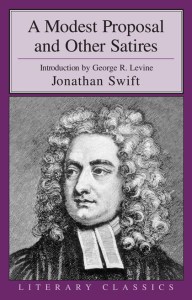 A Modest Proposal and Other Satires by Jonathan Swift, 4/5
Swift combines wit, humour and venom in this collection of satires that attack everything from organized religion to politicians and fellow writers. The 18th-century language and references to now-obscure people and issues do not hinder this book’s continued relevance and, in my opinion, even enhance the timelessness of Swift’s observations–one of my favourite parts of reading very old literature is realizing how little people’s basic natures change with the passage of time.
Why I read it: One of Dad’s coworkers cited “A Modest Proposal” as his all-time favourite piece of literature, which made me curious to read it. Also, I’ve been meaning to read Gulliver’s Travels for quite a while and I thought it was in this collection (which it wasn’t).
I made a couple picture quotes for this book:


On the Pleasure of Hating
On the Pleasure of Hating by William Hazlitt, 1/5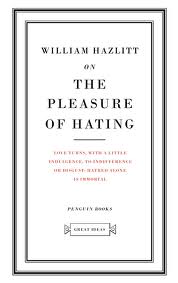
I started this book by accident, somehow confusing the author with the more frequently-quoted Walter Pater. Of the six essays it contains, the last (for which the collection is named) seemed to me most interesting and unique. It comments on the perceived propensity of humankind towards evil and the negative, but I was most interested by its cynical description of friendship. The rest of the essays come across as editorials written by a well-read man of medium intellect, something that would appear in magazines of the day (1820s), but has little lasting value to offer. Perhaps this explains the comment on Wikipedia that “his [Hazlitt’s] work is little read and mostly out of print,” somewhat at odds with the previous assertion that Hazlitt is “now considered one of the great critics and essayists of the English language.”
50 big ideas you really need to know
50 big ideas you really need to know by Ben Dupre, 2/5
These short essays on a variety of topics, ranging from philosophy to physics, were too surfacey and simplistic for me. I did not like the format of the book; it was very disjointed, with distracting quotations and random boxes of text floating around. I appreciate that Dupre manages to write from a relatively impartial viewpoint on controversial topics, though he did come across as pro-Communism, which is repellant to me. I was a little confused by his essays on conservatism and liberalism until I realised that he’s English and this book is only published in the UK. That explains many of the slight differences in perspective throughout.
 OmniRambles