
Tagged: education
Education for Absolute Pitch

Education for Absolute Pitch: A New Way to Learn Piano by Naoyuki and Ruth Taneda, translated by Christopher Aruffo, 5/5
For several years, I sang in a choir with a tenor who had perfect pitch and, while I might have mentally referred to him by the not-awe-inspiring moniker “the human pitch pipe,” there was something undeniably god-like and enviable about his ability to pull any note out of thin air. I was very surprised to learn, many years later, that children between the ages of 3 and 4.5 years old can actually be taught this magical ability! What at first sounds “too good to be true” is soon clarified by this handbook, which lays out the intense, consistent, and long-term practice required in the pursuit of absolute pitch.
The German We Hear and Play method that this book outlines combines ear training (via “games” played with stuffed animals and colored balls) and rhythmic training with a meticulous piano curriculum. As a piano teacher with more than 20 years of experience, I do not find this method’s highly structured, color coordinated and extremely slow-moving approach to be very appealing. However, I am used to starting students at 6 years old and without focusing on ear training, so it makes sense that some concessions must be made for much younger children acquiring the skill of perfect pitch in conjunction with piano skills. I am cautiously optimistic about trying this method with my own toddler!
Why I read it: I believe I encountered the We Hear and Play method on translator Christopher Aruffo’s website, while looking for software that would teach perfect pitch to adults. The We Hear and Play website does not appear to have been updated recently, but I did reach out to Aruffo, who assured me immediately that it is still very much functional, while kindly offering additional help and resources.
Range
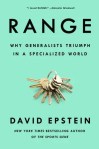
Range: Why Generalists Triumph in a Specialized World by David Epstein, 5/5
On good days, I appreciate the diverse array of skills and experiences that make me who I am. Not yet 40 years old, I can make a credible case for claiming the informal titles of musician, intellectual, artist, athlete, teacher, and photographer. Many days, though, I struggle with feeling like a failure for never having pursued a “proper” career (and the money that comes with one) and so far not finding that one big, important thing I am supposed to be doing with my life.
If I’d read this book earlier, I could have avoided some of those bad days. Epstein blows apart the notion that choosing a career path as early as possible and pursuing it single-mindedly in ever-increasing depth, is the only road to success. Instead, he makes a convincing argument for the value of developing a broad base of interests and experiences, while unashamedly searching for pursuits with high “match quality” to yourself (instead of making a virtue of never quitting). The time this takes need not be wasted, since the most innovative contributions tend to come from people making connections between superficially disparate experiences and ideas, not from those who have specialized the most in any given field.
Life has not been as linear and predictable as I expected; in this book I was comforted to see a reflection of that experience. I learned that, contrary to the claims of pop psychology, personalities and even core values can change over time. That it is ok not to jump on the academic bandwagon of learning more and more about less and less. That continuing to follow my curiosity will provide the best chance of encountering my life’s purpose. And that I shouldn’t undervalue (or under-utilize) the skills and experiences I accumulate along the way just because they weren’t all acquired on a traditional timeline.
Why I read it: I think it was mentioned in Steven Kotler’s The Art of Impossible.
 OmniRambles