
Tagged: christianity
No Man Is an Island
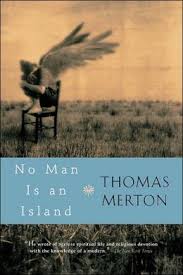 No Man Is an Island by Thomas Merton, 3/5
At first, I thought this collection of thoughts on 16 different spiritual topics was reasonably profound and insightful. It wasn’t until Merton started saying, with blithe confidence, things I doubted or disagreed with that I missed the intellectual underpinnings characterising the likes of C.S. Lewis and G.K. Chesterton. Merton’s unintellectual approach to spiritual matters is made palatable by his eloquent writing skills, perhaps dangerously so. Those who approach this book wishing to be told what to think could quite possibly be led into error, but those who have already given thought to such topics will likely recognise much truth in what he says.
[Why I read it: the title is appealing and seemed relevant to my life at the moment. I originally thought the phrase “no man is an island” came from this book, but it actually originated in a poem by the 17th-century poet John Donne. Interestingly, from the same short poem comes the phrase “for whom the bell tolls.”]
The Weight of Glory and Other Addresses
 The Weight of Glory and Other Addresses by C.S. Lewis, 5/5
I half-expected C.S. Lewis’ intellectual style to be unsuited to the short-speech format, but was only slightly surprised to find that he is as brilliant a writer of sermons as a writer of books. Of the nine essays in this collection, I found “The Weight of Glory” to be the most challenging and “Is Theology Poetry?” the most encouraging, both addressing, to some extent, struggles I am currently experiencing.
My deepening distaste for humanity in general and aversion to interaction with humanity in particular made some parts of “The Weight of Glory” difficult to read and almost impossible to believe (though I have fewer reasons to doubt Lewis’ assertions than to trust them).
It may be possible for each to think too much of his own potential glory hereafter; it is hardly possible for him to think too often or too deeply about that of his neighbour. The load, or weight, or burden of my neighbour’s glory should be laid on my back, a load so heavy that only humility can carry it, and the backs of the proud will be broken. It is a serious thing to live in a society of possible gods and goddesses, to remember that the dullest and most uninteresting person you can talk to may one day be a creature which, if you say [saw?] it now, you would be strongly tempted to worship, or else a horror and a corruption such as you now meet, if at all, only in a nightmare. All day long we are, in some degree, helping each other to one or other of these destinations. It is in the light of these overwhelming possibilities, it is with the awe and the circumspection proper to them, that we should conduct all our dealings with one another, all friendships, all loves, all play, all politics. There are no ordinary people. You have never talked to a mere mortal. Nations, cultures, arts, civilisations – these are mortal, and their life is to ours as the life of a gnat. But it is immortals whom we joke with, work with, marry, snub, and exploit – immortal horrors or everlasting splendours (18).”
Luckily, Lewis can comfort as well as he convicts and I found the following excerpt (greatly weakened by the lack of supporting context) to be a welcome antidote to the noxious mélange of malaise and meaninglessness to which I have been lately putting up an admittedly feeble resistance:
If, on the other hand, I swallow the scientific cosmology as a whole, then not only can I not fit in Christianity, but I cannot even fit in science. If minds are wholly dependent on brains, and brains on biochemistry, and biochemistry (in the long run) on the meaningless flux of the atoms, I cannot understand how the thought of those minds should have any more significance than the sound of the wind in the trees. And this is to me the final test. This is how I distinguish dreaming and waking. When I am awake I can, in some degree, account for and study my dream. The dragon that pursued me last night can be fitted into my waking world. I know that there are such things as dreams; I know that I had eaten an indigestible dinner; I know that a man of my reading might be expected to dream of dragons. But while in the nightmare I could not have fitted in my waking experience. The waking world is judged more real because it can thus contain the dreaming world; the dreaming world is judged less real because it cannot contain the waking one. For the same reason I am certain that in passing from the scientific points of view to the theological, I have passed from dream to waking. Christian theology can fit in science, art, morality, and the sub-Christian religions. The scientific point of view cannot fit in any of these things, not even science itself. I believe in Christianity as I believe that the Sun has risen, not only because I see it, but because by it I see everything else (91).”
[Why I read it: it was given me as a birthday present and I am always eager to read anything nonfiction by C.S. Lewis.]
George MacDonald: An Anthology
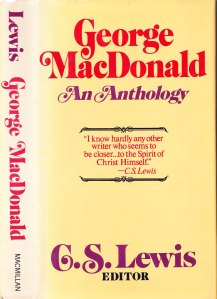 George MacDonald: An Anthology, ed. C.S. Lewis, 4/5
While Macdonald’s Phantastes is one of the best fantasy books I’ve ever read and I enjoyed the Curdie books as a child, I’ve never been a fan of his other novels and was not particularly looking forward to reading this anthology. Just as it feels wrong that I love Bach but not his favourite instrument, the organ, so I always thought it felt wrong to love C.S. Lewis and not George Macdonald, one of Lewis’s most-loved inspirations. Happily, the issue is cleared up in the preface, where Lewis calls the Macdonald books I happen to like “the great works,” while admitting that “necessity made MacDonald a novelist, but few of his novels are good and none is very good” (xxix). The rest of the preface provides an excellent discussion of mythology, which would make the book a must-read in any case.
Each of the 365 excerpts presented in this collection is worthy of a day’s reflection and reading the whole book in one go felt rather like going to a dinner buffet that only serves steak. There is an aura of the commonsense and uncompromising, softened by the humility and gentleness that should be the defining characteristics of every Christian. Some of my favourite quotes were the ones on spiritual “dryness,” where MacDonald points out that the firm foundation on which our faith is built cannot be shaken by changing emotions and feelings:
That man is perfect in faith who can come to God in the utter dearth of his feelings and desires, without a glow or an aspiration, with the weight of low thoughts, failures, neglects, and wandering forgetfulness, and say to Him, “Thou art my refuge” (1).
Troubled soul, thou are not bound to feel but thou art bound to arise. God loves thee whether thou feelest or not. Thou canst not love when thou wilt, but thou art bound to fight the hatred in thee to the last. Try not to feel good when thou art not good, but cry to Him who is good. He changes not because thou changest. Nay, He has an especial tenderness of love toward thee for that thou art in the dark and hast no light, and His heart is glad when thou doest arise and say, “I will go to my Father.” …Fold the arms of thy faith, and wait in the quietness until light goes up in thy darkness. For the arms of thy Faith I say, but not of thy Action: bethink thee of something that thou oughtest to do, and go to do it, if it be but the sweeping of a room, or the preparing of a meal, or a visit to a friend. Heed not thy feeling: Do thy work (18).
N.B. Most of the book is not written in the old-timey, King James Version speech.
[Why I read it: given to me as a birthday present by my parents.]
The Sacred Search
 The Sacred Search: What if it’s not about who you marry, but why? by Gary Thomas, 2/5
If only this book’s contents lived up to the promise of its subtitle. Unfortunately, the author focuses less on the “why” and more on outlining a convoluted set of criteria with which to judge the “who.” This criteria is self-defeatingly simplistic – a Christian couple could check all the right boxes and still end up miserable or alternatively, could meet almost none of the criteria and still have a good marriage. By preaching to the low-hanging fruit – people who haven’t yet considered the possibility of applying Christian principles, common sense and thoughtfulness to their search for marital bliss – Thomas dilutes his message to an almost unbearably obvious and formulaic level.
The book’s main problem is illustrated by the chapter devoted to helping the reader rate, on a scale of 1-10, six specific character aspects of potential spouses (here’s a hint – you’d better hope for a cumulative score of 45 or higher) (143). It is a mystery to me how Thomas expects people so clueless that they need to be told to look for a spouse who has high scores in areas like “knows how to communicate” and “resolves conflict in a healthy way” to be capable of making accurate assessments or gaining any value from this exercise.
Less importantly, but still notably, Thomas is one of the most awkward authors I have ever encountered. Many of the things he writes are unintentionally (I assume) offensive and insulting. He suggests that, since “most people never use the degree they get from college,” it is reasonable to make finding a spouse there “one of the top goals.” He actually compares it to an unemployed person visiting a job fair (78). In a later chapter, he encourages people to play private eye on their intended, using techniques to uncover their past such as asking sly questions, looking at old photo albums, subtly questioning the person’s family and friends, and observing how they pray, since “someone might succeed in lying to you, but it’s a little trickier to present a false front to God” (179-182). The only strategy he suggests for girls who want to be noticed more is to cook, claiming that guys will “figure out who put the food on the table” (79). According to Thomas, someone who only reads the Bible during church will have “negligible” spiritual growth and will “never be spiritually wiser than he or she already is” (127). I’m not trying to nitpick unfairly – there were pages and pages of other equally embarrassing examples that I could have chosen from.
I respect Thomas’s effort to encourage people who are in love to approach marriage in a thoughtful way that is consistent with their religious beliefs and, as far as very general principles and study questions are concerned, his writing has some value. However, I believe that a lot more value could be had from this book by tearing off the front cover, cutting out a rectangle around the subtitle, handwriting the text of Matthew 6:33 on the back of the rectangle and using it as a bookmark for Book III, Chapter 6 (Christian Marriage), in C.S. Lewis’s Mere Christianity.
There is a God
 There is a God: How the world’s most notorious atheist changed his mind by Antony Flew with Roy Abraham Varghese, 2/5
This book succeeds in a purely biographical sense, but is weak in the area of apologetics which, in this case, mostly consist of lengthy quotes from sources that Flew found convincing, strung together with stilted prose. Given the depth of the subject and the limited length of the book, Flew was unable to give the numerous quotations the individual context they needed in order to be convincing, so I found myself continually questioning the true validity of his points. While I trust his expertise as a philosopher, I simply could not understand most of his philosophy-related references and, since I don’t trust him as a scientist, his numerous science-related claims seemed dubious.
Ultimately, reading this book just made me realise (not for the first time) what a true genius C.S. Lewis was.
The Abolition of Man
 The Abolition of Man or Reflections on education with special reference to the teaching of English in the upper forms of schools by C.S. Lewis, 5/5
I mistakenly thought I’d already read everything by C.S. Lewis, so I was both surprised and delighted when Samuel came home for Thanksgiving break with a book by Lewis that I’d never even heard of before. Luckily, it is very short (a series of three college lectures) and I was able to finish reading it before the break ended.
The first chapter is somewhat snarky and rambling, but The Abolition of Man soon settles down to a fascinating analysis of the relationship between science and Tao, the innate, traditional values that give human existence its meaning and humanness. The shortness of the book meant that it was less in-depth (though also, more difficult) than I would have wished. In fact, the very conciseness of some of the points makes it easy to miss their importance and paradigm-changing nature. For example:
“…But you cannot go on ‘explaining away’ for ever: you will find that you have explained explanation itself away. You cannot go on ‘seeing through’ things for ever. The whole point of seeing through something is to see something through it. It is good that the window should be transparent, because the street or garden beyond it is opaque. How if you saw through the garden too? It is no use trying to ‘see through’ first principles. If you see through everything, then everything is transparent. But a wholly transparent world is an invisible world. To ‘see through’ all things is the same as not to see (81).”
Surprised by Joy
Surprised by Joy: The Shape of My Early Life by C.S. Lewis, 5/5
Finding out that a couple fellow altos in choir are atheists made me want to rerereread Lewis’ compelling description of his philosophical journey from childhood, through atheism to Christianity. So much of what he says resonates with me and I always find it incredibly encouraging that such an intellectually uncompromising, well-read person would eventually find all signs pointing to God. I don’t love the book just because it supports my own religious convictions, though; I admire Lewis’ frank, disarming writing style and analytical approach to life.
A Place for Truth
A Place for Truth: Leading Thinkers Explore Life’s Hardest Questions, edited by Dallas Willard, 4/5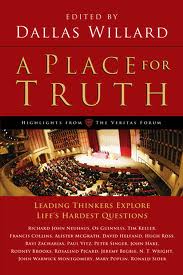
This book contains selected lectures from the Veritas Forum, a discussion platform set up in 1992 by a group of Christians at Harvard. I particularly enjoyed the first half of the book – the lectures addressing truth, faith and science. It is encouraging to be reminded that live Christianity not only withstands intellectualism, but welcomes it, and that a Christian scientist is not a contradiction of terms. It was also see comforting to see that, despite the largely media-driven polarisation of our world on the topic of religion and the active antagonism of a few haters on both sides, civil discussions between Christians and non-Christians are possible.
 OmniRambles