
Tagged: 4/5
Von Ryan’s Express
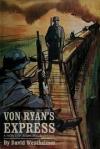
Von Ryan’s Express by David Westheimer, 4/5
The movie portrayal of this suspenseful WWII prison escape story was a beloved family favorite at my house, growing up, and I’m embarrassed to admit my shock upon discovering, much later, that it did not in fact portray a true event, but was based on a work of historical fiction. Despite substantial differences between film and novel, I really enjoyed the latter’s believable personalities, exciting events, and overall tone of confident authenticity that no doubt can be attributed to the author’s firsthand POW experience.
Why I read it: A recommendation from my sister, who lent me her copy.
The Perfect Guide to Sumo
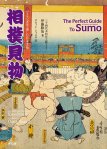
The Perfect Guide to Sumo in Japanese and English by Katsuharu Ito, translated by David Shapiro, 4/5
This small book on a large topic is packed with minuscule text and beautiful, historic artwork. I wish it were available in a larger, better edited format that would do justice to the informative dual-language text and generous illustrations.
Why I read it: my husband and I are fans of sumo.
We Who Wrestle with God

We Who Wrestle with God: Perceptions of the Divine by Jordan B. Peterson, 4/5
A good indicator of Truth with a capital T is that the insights it produces expand the mind and effortlessly illuminate even the darkest corners of a topic, where lesser conceptions fear to tread. There are not many corners more dark than the blood-soaked, primal tales of the Old Testament around which Peterson’s bold and wide-ranging existential exploration occurs. More than just an in-depth character study of God, as revealed through crucial episodes of the Old Testament, this substantial work explores our relationship with the intangible realities of existence on both an individual and societal level, and the codification of these eternal truths into our oldest and most meaningful stories.
Free of the timeworn arguments and vocabulary of Christian apologetics, Peterson’s approach is sure to earn him a “straight to hell” label from many (and not just fundamentalists). I will admit to feeling an uneasy chill, that only others with a religious background would likely understand, at the language of the last couple paragraphs in particular. I won’t go into detail, though, because given the context of the previous 500+ pages, I believe the issue is merely evidence of the author’s tendency to follow a train of thought wherever it may lead, even if it means committing the sin of entering new, unexplored territory in what is supposed to be concluding material. Speaking of sins, I must comment on the astounding number of typos and errors this book contains–by far the most I have ever encountered in a published work. Hopefully these will be rectified in future editions.
Lest I end this review on a sour note, let me re-iterate how amazed I am that a work so broad in scope could be, at the same time, incredibly nuanced. There is something inspired about Peterson’s perspective, which allows him to dissect the most challenging and abstract aspects of the human experience without killing its joy and mystery.
Why I read it: I was curious about Peterson’s theological beliefs, and trusted that he would have an interesting and intellectual approach to the topic.
12 Rules for Life
12 Rules for Life: An Antidote to Chaos by Jordan B. Peterson, 4/5
Jordan Peterson is, in my opinion, one of the most brilliant thinkers and lecturers of the 21st-century in his field and, if he were a more intentional writer, I believe he would deserve a place with the immortal greats of philosophy. Unfortunately, instead of utilizing the writing process to distill and clarify his ideas, he settles for more or less transferring his thought processes straight onto the page. The result is very uneven in tone, bouncing wildly between folksy storytelling and esoteric musings that challenged even my well-trained attention span (exhibit A: Ornithology: An Introduction). It took three tries for me to make it through this book, but I was rewarded by Peterson’s fearless acceptance of the most terrible aspects of human existence and the deeply satisfying integration of that chaos into a perspective that ennobles the common man and makes one want to pick up a sword and fight dragons.
Rule 1: Stand up straight with your shoulders back.
Rule 2: Treat yourself like someone you are responsible for helping.
Rule 3: Make friends with people who want the best for you.
Rule 4: Compare yourself to who you were yesterday, not to who someone else is today.
Rule 5: Do not let your children do anything that makes you dislike them.
Rule 6: Set your house in perfect order before you criticize the world.
Rule 7: Pursue what is meaningful (not what is expedient).
Rule 8: Tell the truth–or, at least, don’t lie.
Rule 9: Assume that the person you are listening to might know something you don’t.
Rule 10: Be precise in your speech.
Rule 11: Do not bother children when they are skateboarding.
Rule 12: Pet a cat when you encounter one on the street.
Why I read it: I became familiar with Peterson when he achieved viral popularity a few years ago.
Flatland
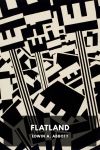
Flatland: A Romance of Many Dimensions by Edwin A. Abbott, 4/5
This bizarre little story is told from the perspective of a two-dimensional “Flatland” dweller, whose visits to one-dimensional “Lineland” and three-dimensional “Spaceland” encourage the reader to consider how very plausible it is that there exist in reality unlimited additional dimensions, of which humankind is arrogantly ignorant.
Why I read it: my dad lent it to me and I had heard of it before (I can’t remember where).
The Bullet that Missed

The Bullet that Missed: A Thursday Murder Club Mystery by Richard Osman, 4/5
This third installment in the series brings back some of the charm and wit that was missing from the second book, in my opinion.
Why I read it: the third book in the series.
All the Light We Cannot See

All the Light We Cannot See: A Novel by Anthony Doerr, 4/5
I could complain that this story lost me a bit near the end, but that could very well be a symptom of the pure exhaustion I was feeling at 1am, after reading the entire book in one day. While I can’t claim to be as emotionally traumatized (in a good way) as other reviewers seem to be, I did find this to be a well-crafted and beautifully-written work of historical fiction. I especially appreciated how the author was able to keep my interest equally in both the main character’s story arcs, despite switching between them for the bulk of the book in a way that would be annoying if not so thoughtfully done. A prominent MacGuffin and too little time spent weaving the two character’s stories together after they finally met, is all that keeps this from being a classic, in my opinion.
Why I read it: an oft-mentioned entry in the comments on an Instagram post about favorite (or most meaningful–I can’t remember which) books.
Save the Cat! Writes a Novel

Save the Cat! Writes a Novel: The Last Book on Novel Writing You’ll Ever Need by Jessica Brody, 4/5
Inspired by Blake Snyder’s “Save the Cat!” formula for screenwriting, author Jessica Brody breaks down the 15 basic plot points necessary for each of the 10 genres into which all stories can be categorized. Numerous examples and detailed breakdowns of famous novels are provided, making this a convincing, if somewhat tedious read.
Do I think it is necessary to follow a formula while writing a novel? Of course not. Does it steal the magic a bit to identify the unexpectedly unvaried elements that so many stories have in common? Yes, it does. But I can imagine that this handbook could be a lifesaver for a new or struggling author, or anyone looking to troubleshoot plot/pacing issues.
Why I read it: it was on a list of recommended resources for writers on my Instagram feed.
The Midnight Library
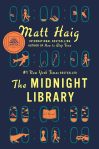
The Midnight Library: A Novel by Matt Haig, 4/5
It feels petty to complain that this deeply meaningful novel about existential crisis and regret boils down to a few cliches and wraps up a little too tidily–the fact remains that I read it greedily in one sitting, shedding a few tears in the process. I couldn’t shake an intense feeling that it was written just for me, which I’m sure is exactly how many other readers feel and is a testament to the author’s writing skill and insight into the mental struggles of modern existence.
Why I read it: an oft-mentioned entry in the comments on an Instagram post about favorite (or most meaningful–I can’t remember which) books.
100 Poems

100 Poems by Seamus Heaney, 4/5
I love that this collection of poems was hand-selected by Heaney’s wife and children after his death, not just to include his most loved and famous works, but ones that held personal significance and memories for his family as well. With that in mind, it felt like a privilege to read this collection and made it easier to focus on what I personally found beautiful and resonant, rather than feeling the need to make a value judgement about what I did not understand or connect with. One of my favorite moments was in the poem “Mossbawn: Sunlight,” when a baker is described as dusting the board with “a goose’s wing” (32).
On a separate topic, I want to take this opportunity to send some bad energy towards the fellow library user who felt that it was reasonable to make distracting pencil marks throughout the entire book. I erased every single one.
Why I read it: The author was featured on an episode of Antiques Road Trip and I was surprised that I had never heard of such a famous and beloved poet before.
 OmniRambles